
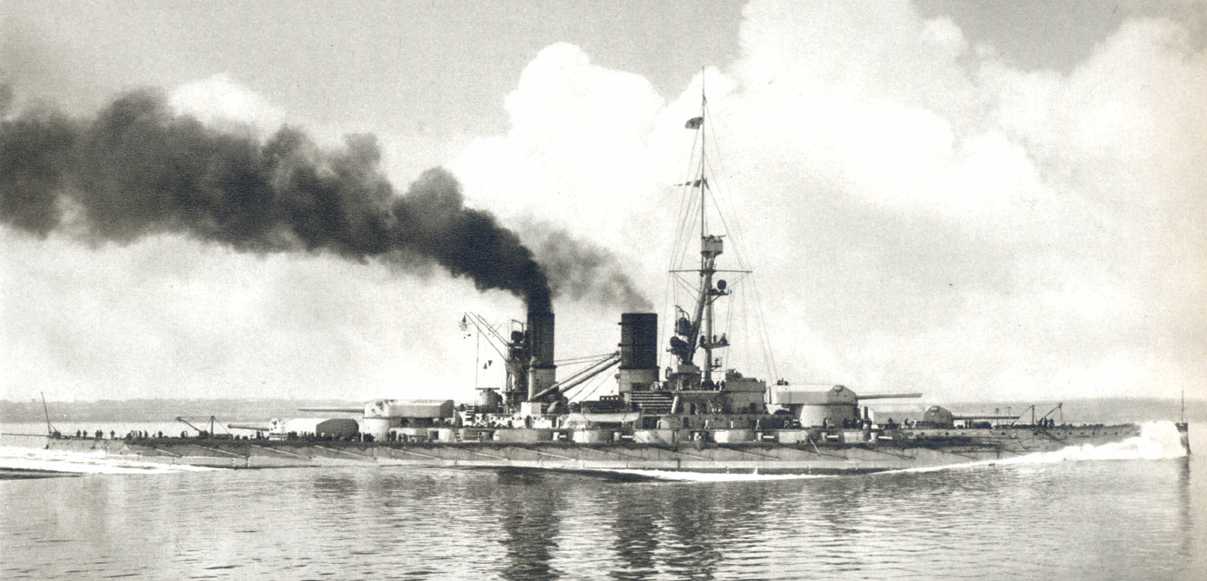
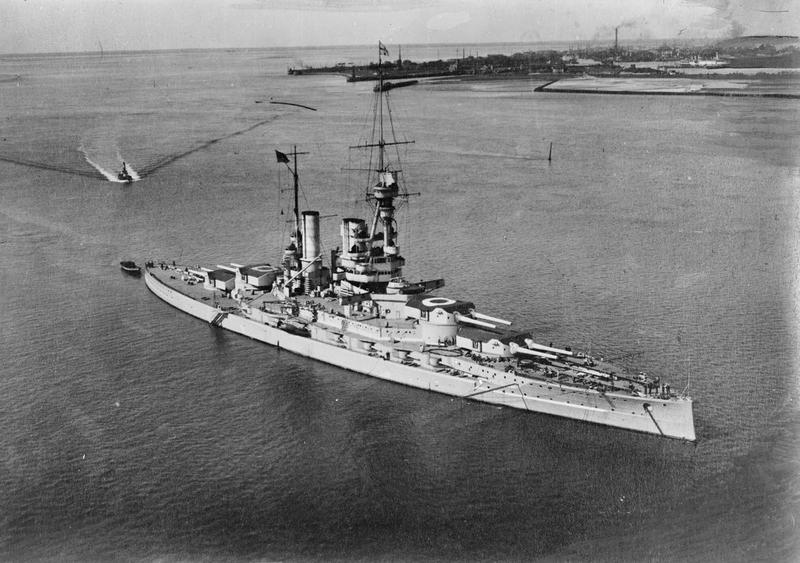
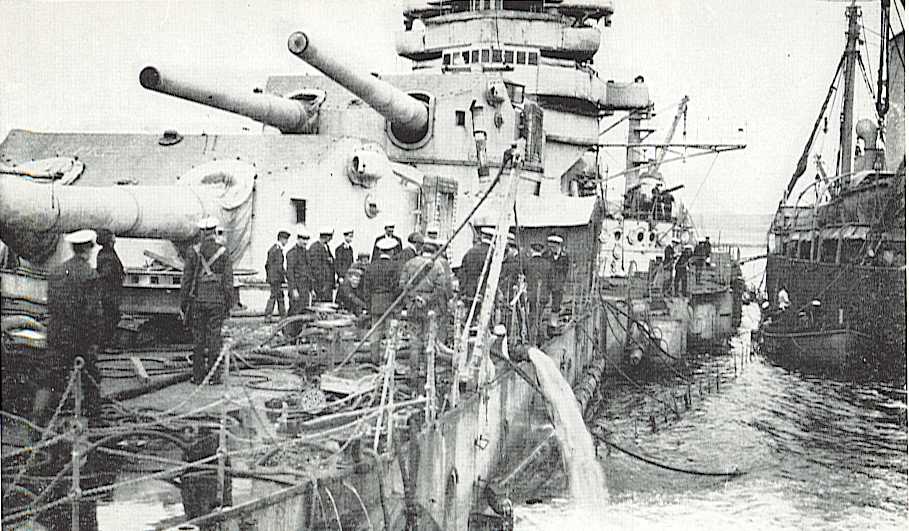
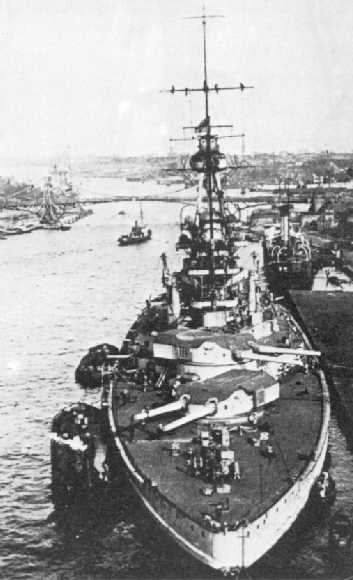
The most powerful German naval gun of World War I. Used on the Baden class battleships, which were completed too late to participate in the Battle of Jutland (Skagerrak) and saw little action during the rest of the war. This gun was also planned for the Ersatz York class of fast battleships of which only the first ship in the class was laid down before construction was halted in 1917, approximately 26 months before completion.
Those guns planned for the uncompleted battleships Sachsen and Württemberg were instead used as land artillery. A number of these guns were greatly altered and used for the very long range "Paris Gun." More were used on the Western Front where they were known as "Max" or "Lange Max" (Long Max). Four guns were used in Coast Defense Battery Deutschland and one more was used at Battery Pommern. Another battery of four guns was installed near Kiel. There were also two railway mountings, known as Max and Wotan.
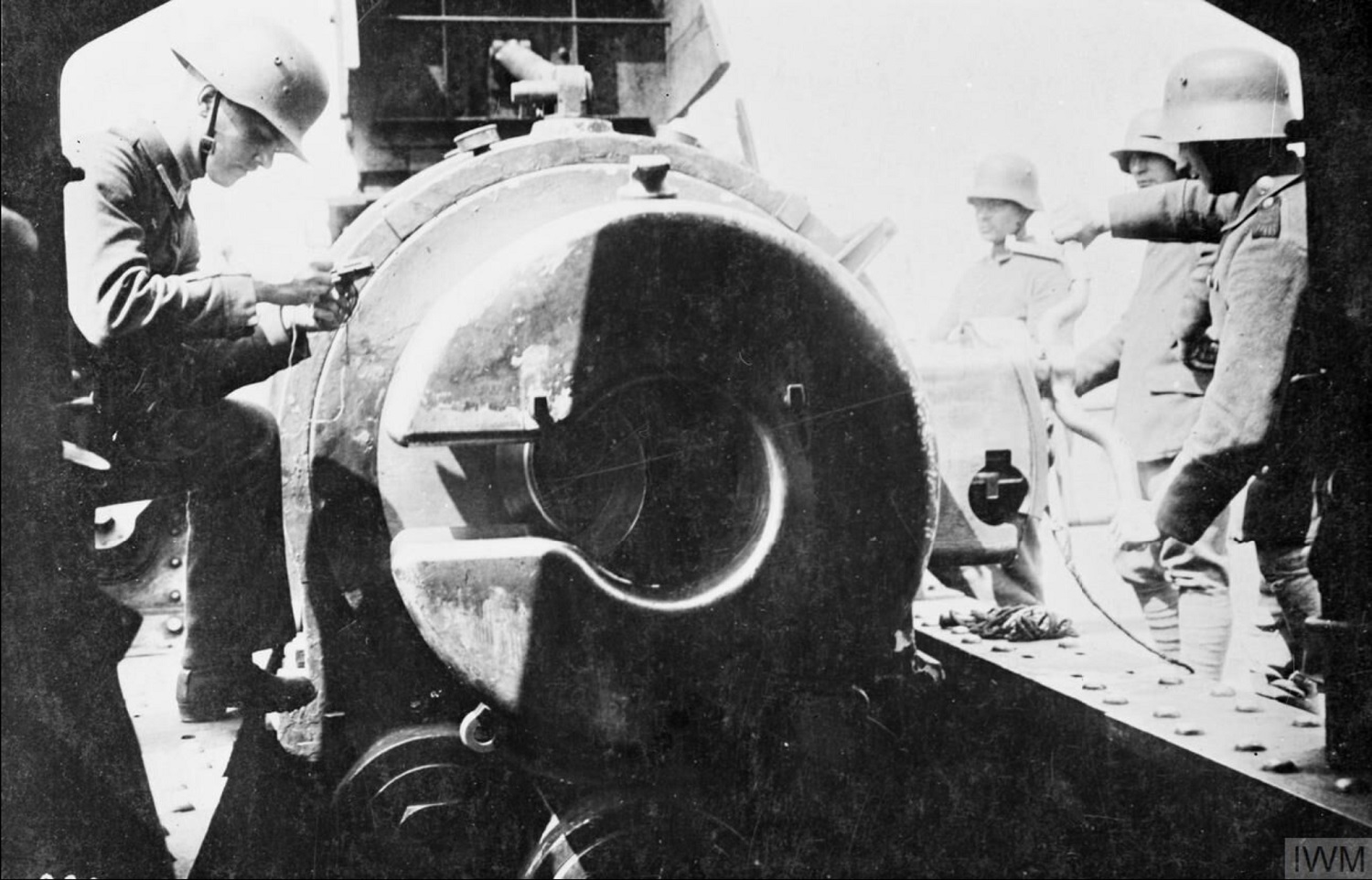
The Pommern battery, located at Leugenboom in Belgium, is perhaps best known for firing about 500 rounds between June 1917 and October 1918 at ranges of up to about 48,000 yards (44,000 m), including many at Allied positions in and around Dunkirk (Dunkerque). When the Germans abandoned this gun in late 1918, the guncrew tried to disable it by firing a projectile into the concrete bulwark, in the hope that it would explode on the concrete and damage the cannon. This did not succeed as the projectile penetrated the concrete and only exploded some 875 yards (800 m) away. Other guns were transported back to Germany but one abandoned gun was captured by the Belgian Army at a railway station west of Brussels. After the war, the Military Inter-Allied Commission of Control ordered the destruction of all remaining guns as well as certain emplacements. As a result, at least seven surviving guns were destroyed between 1921 and 1922. However, the gun captured by the Belgians was preserved and in 1924 it was sold to France who used it as part of a study on long range weapons. The gun was trialed in April 1924 at the firing range of the ALVF (l'artillerie lourde sur voie ferrée - Heavy Railway Artillery) of Saint-Pierre Quiberon and remained there until June 1940 when it was recaptured by the German army. It was apparently not put back into service by the Germans and its ultimate fate is unknown at this time, but it was probably scrapped during the war or soon afterwards.
Construction was of A tube, two or three reinforcing tubes in one layer, a jacket extending to 22 feet (6.7 m) from the muzzle and used a Krupp horizontal sliding wedge breech block. Campbell estimated that a total of 40 guns were manufactured.
| Designation | 38 cm/45 (14.96") SK L/45 |
|---|---|
| Ship Class Used On | Ersatz Yorck and Baden Classes |
| Date Of Design | 1913 |
| Date In Service | 1916 |
| Gun Weight | about 176,370 lbs. (80,000 kg) 1 |
| Gun Length oa | 673 in (17.100 m) |
| Bore Length | 634.3 in (16.112 m) |
| Rifling Length | 544 in (13.816 m) |
| Grooves 2 | (100) 0.118 in deep x 0.236 in (3 mm x 6 mm) |
| Lands 2 | 0.236 in (6 mm) |
| Twist | Uniform RH 1 in 30 |
| Chamber Volume | 16,482 in3 (270 dm3) |
| Rate Of Fire | 2.5 rounds per minute 3 4 |
- ^For an interesting comparison of British and German guns as seen by British ordnance personnel, see the extract from "Progress in Gunnery Material, 1921" ADM 186/251 on the British 15"/42 (38.1 cm) Mark I datapage.
- ^2.12.2
Rifling dimensions above from "The German Defenses on the Coast of Belgium" and appear to be actual measurements. "Naval Weapons of World War One" gives different values as follows:
At start At muzzle Grooves (100) 0.150 in (3.80 mm) D x 3.05 in (7.74 mm) W 0.226 in (5.74 mm) W Lands 0.165 in (4.20 mm) 0.244 in (6.20 mm) - ^Post-war loading tests by the British on Baden found that it took only 23 seconds from the time her 38 cm guns fired until they were ready to fire again, as compared to 36 seconds for the 15 inch (38.1 cm) guns on HMS Queen Elizabeth.
According to Norman Friedman in "Naval Weapons of World War One":
"The difference included a much faster cycle for firing, recoil, runout and return to loading position (2.5 seconds vs. 6 seconds) . . . Also, the Queen Elizabeth required a much longer time (5 seconds vs. 1.5 seconds) to open the breech and a similarly long time to close it because it used a long-arm mechanism."
The British, thanks to their any angle loading design, theoretically did not need to depress the guns to reload and the 36 second cycle time does not include any time for it. However, the British discovered difficulties (Note 10g) in loading at high elevations and found that loading with the gun at +5 degrees or less was a better method. Unfortunately, as their gunsights were coupled to the gun barrels, this method did unsight the gunners. In comparison, the German 23 second cycle time included 5.5 seconds to lower the gun to the loading position and then elevating it back to the firing position. As the gunsights on the German turrets were not directly connected to the gun barrels, the gunners could remain on target while the guns were lowered to be reloaded.
- ^A report by the Belgian Chief of Artillery quoted in "The German Defenses on the Coast of Belgium" states that the rate of fire for the Pommern gun was one shot in five minutes when using electrical power for elevation and one shot in ten minutes when using manual power.
- The gun at Battery Pommern battery was Krupp No. 15 L. The four guns at Battery Deutschland were Krupp No. 9 L, No. 35 L, No. 36 L and No. 41 L.
| Type | Cartridge - Bag |
|---|---|
| Projectile Types and Weights 1a 2a 3a | Ship Projectiles
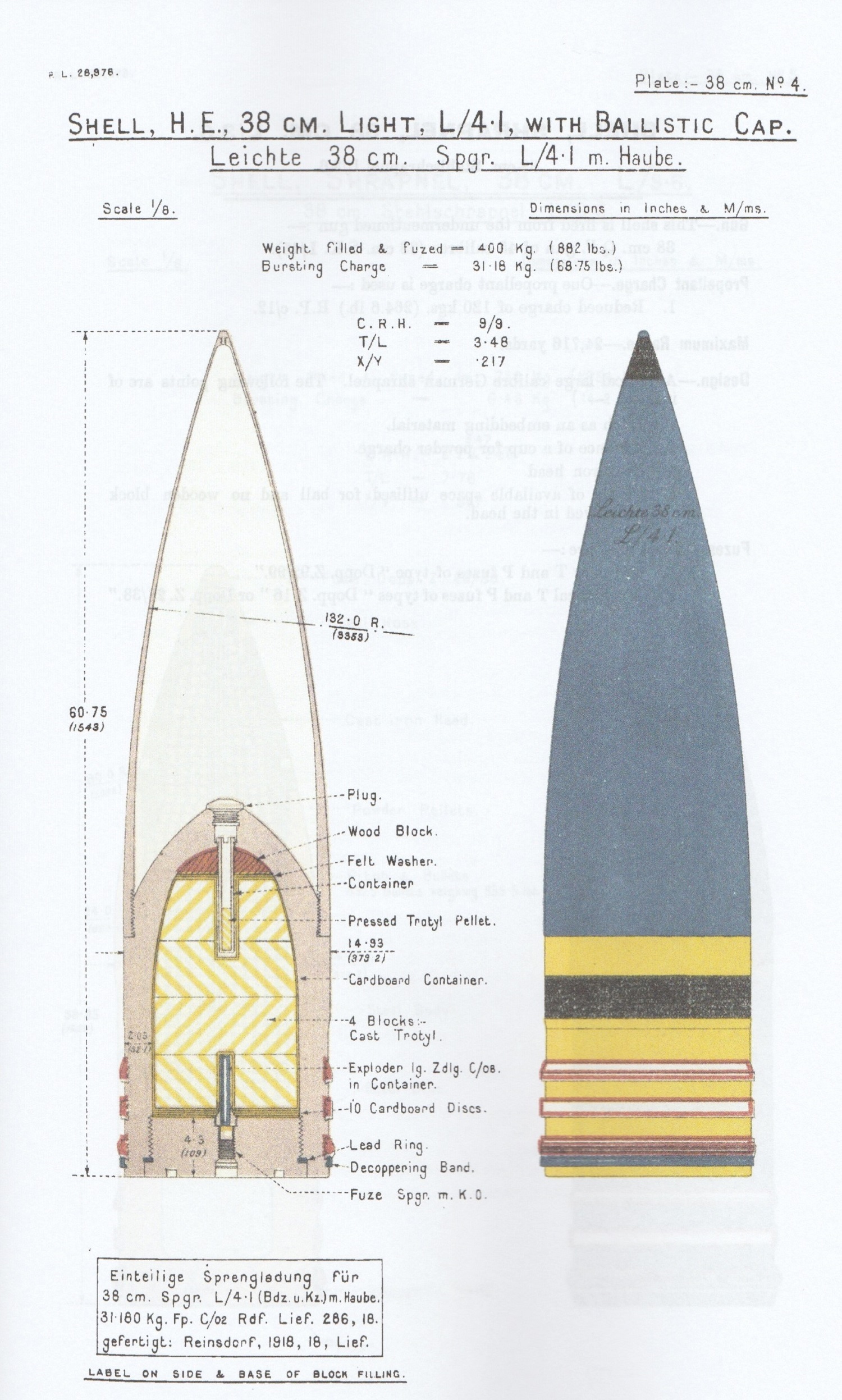
APC L/3,5 4a 5a 6a: 1,653 lbs. (750 kg) APC L/3,6 4a 5a 6a: 1,653 lbs. (750 kg) HE L/4,1 base fuze 5a 7a Coastal Artillery Projectiles
|
| Bursting Charge 9a | APC L/3,5: 52.5 lbs. (23.8 kg) TNT 10a APC L/3,6: 52.5 lbs. (23.8 kg) TNT 9a HE L/4,1: 147.5 lbs. (66.85 kg) TNT HE L/5,4 base fuze: 137.5 lbs. (62.36 kg) TNT
|
| Projectile Length | APC L/3,5: 52.0 in (132.0 cm)
APC L/3,6: 52.2 in (132.7 cm) HE L/4,1: 61.0 in (155.0 cm) HE L/5,4 base fuze: 81.0 in (205.7 cm)
|
| Propellant Charge 11a | Ships 12a 403.4 lbs. (183 kg) RP C/12 (820 x 18/8) Coastal Artillery 13a |
Cartridge Case Type, Size and Empty Weight | Brass, 380 x 856 mm, 125.6 lbs. (57.0 kg) 14a |
| Muzzle Velocity 15a | APC L/3,5: 2,625 fps (800 mps)
APC L/3,6: 2,625 fps (800 mps) HE L/4,1: 2,625 fps (800 mps) Coastal HE L/5,4 base fuze: 2,625 fps (800 mps)
|
| Working Pressure | 20.0 tons/in2 (3,150 kg/cm2) |
| Approximate Barrel Life | 300 rounds |
| Ammunition stowage per gun | Baden: 90 rounds 17a Ersatz Yorck: 90 rounds |
- ^
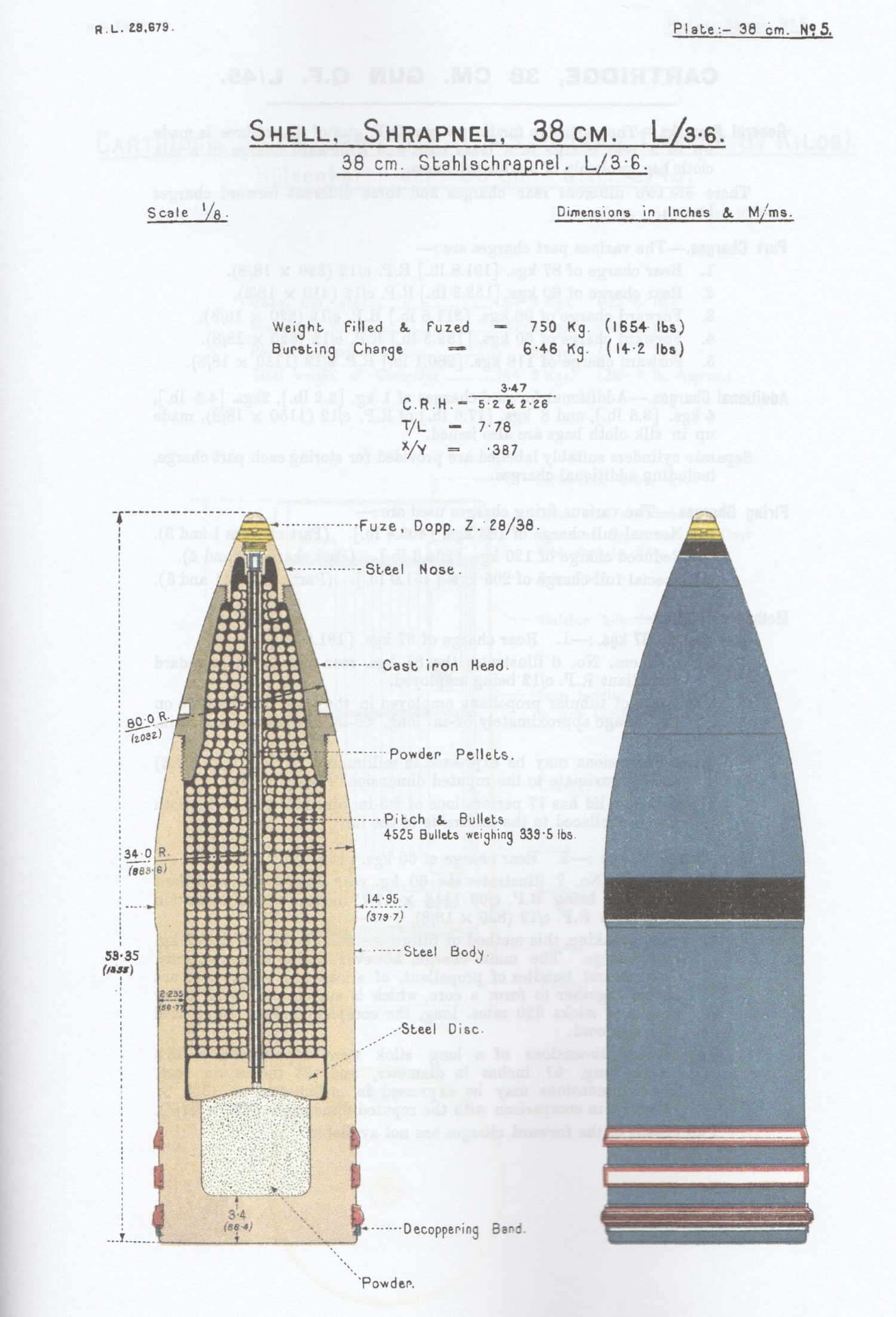
Actual Projectile designations APC L/3,5 38 cm Psgr. L/3,5 APC L/3,6 38 cm Psgr. L/3,6 HE L/4,1 base fuze 38 cm Spgr. L/4,1 Bdz. Coastal HE L/5,4 base fuze 38 cm Spgr. L/5,4 m. Bdz. (m.Hb) Coastal HE L/5,4 base and nose fuze 38 cm Spgr. L/5,4 m. Bdz. u. Kz. (m.Hb) Coastal Light HE L/4,1 Leichte 38 cm Spgr. L/4,1 m. Bdz. u. Kz. (m.Hb) Coastal Shrapnel L/3,6 38 cm Stahlschrapnel L/3,6 - ^In "The German Defenses on the Coast of Belgium" the author notes another HE shell of 754 lbs. (342 kg) with a range of 52,000 yards (48,000 m) but this seems to be a mis-identification of the Coastal Light HE L/4,1.
- ^There were other Coastal Artillery projectiles under development during the war which did not enter service, with one of these still surviving at the Deutsches Historisches Museum (German Historical Museum) in Berlin.
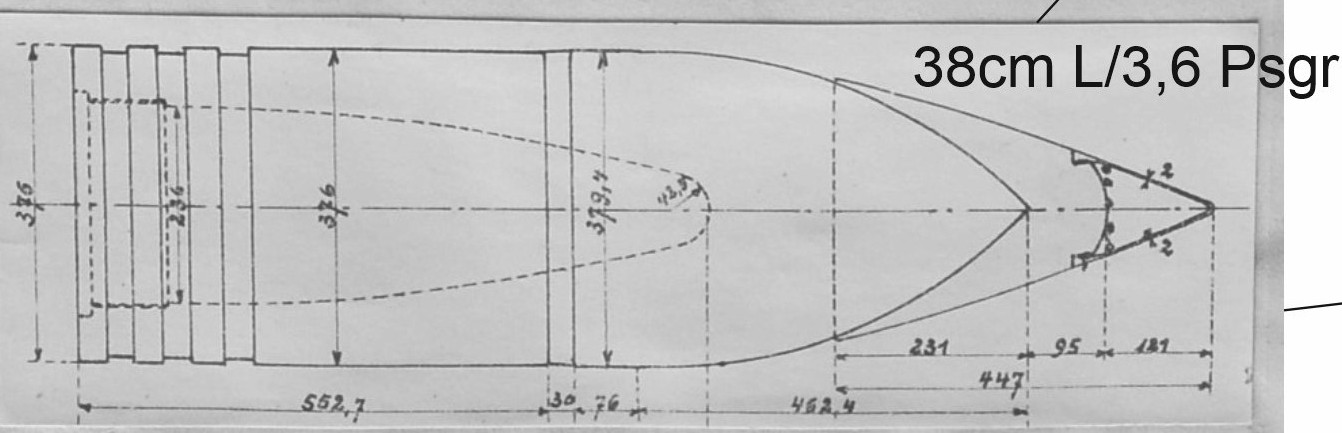
- ^4.14.2The APC L/3,5 was the original design to enter service. The APC L/3,6 was a later development where the windshield was made from thin mild steel with holes drilled into its circumference to further weaken the attachment between the armor piercing cap and the windscreen. This modification improved their armor penetration. Older Psgr. L/3,5 shells were retrofitted with these new ballistic caps. The windshield and AP cap for the APC L/3,5 weighed 118.6 lbs. (53.8 kg) while those for the APC L/3,6 originally weighed 111,3 kbs, (50.5 kg) and then later were reduced to 110.2 lbs. (50.0 kg). See below for more details.
- ^The HE L/4,1 base fuze projectiles were not part of the initial outfit of S.M.S. Bayern when commissioned as the initial fuze design in combination with the enlarged explosive charge was not considered to be bore safe. A modified version with an extra safe fuze was approved for service in May 1916 after which Bayern took delivery.
- ^APC L/3,5 burster weight includes the paper container (Pappbüchse) and beeswax but not the weight of the wooden plug (Holzspitze).
- ^These guns, like most large caliber German guns of this era, used a "fore charge" which was propellant in a double bag silk case and a "rear charge" which was propellant in a brass case. The brass case helped to seal the breech of the gun.
- ^A Note on Sources: The propellant weight for ships stated in "Naval Weapons of World War One" is 277 kg (610.7 lbs.). This value is much too high, even if the 57.0 kg (125.6 lbs.) casing weight is subtracted out.
- ^A Note on Sources: For Coastal Artillery, I have selected to use the propellant weights shown in the British post-war "Diagrams of the Great War" to be used in the above table as the weights are taken from examination of captured German munitions and documents. This work says that Coastal Artillery had two different "Rear Charges" and three different "Forward Charges" as follows:
Diagrams of the Great War
Propellant for 38 cm Coastal ArtilleryID Number Charge Description 1 Rear Charge of 191.8 lbs. (87.0 kg) RP C/12 (820 x 18/8) 2 Rear Charge of 132.3 lbs. (60.0 kg) RP C/12 (410 x 18/8) 3 Forward Charge of 211.6 lbs. (96 kg) RP C/12 (820 x 18/8) 4 Forward Charge of 132.3 lbs. (60 kg) RP C/12 (820 x 18/8) 5 Forward Charge of 260.1 lbs. (118 kg) RP C/12 (1150 x 18/8) Both Rear Charges used the same casing.
Normal Full Charge - ID Numbers 1 and 3: 403.4 lbs. (183 kg) RP C/12 *
Reduced Charges - ID Numbers 2 and 4: 264.6 lbs. (120 kg) RP C/12
Special Full Charge - ID Numbers 1 and 5: 451.9 lbs. (205 kg) RP C/12* From other sources, this also appears to be the standard full charge for ships.
An alternative loading of the ID Number 2 Rear Charge was two bundles of RP C/00 (410 x 17/7) wrapped with a bundle of RP C/00 (820 x 17/7) with the total propellant weight being 132.3 lbs. (60 kg). This was apparently to use up existing stocks of the older propellant.
This work also lists small trim charges of 2.2, 4.4, 8.8 and 17.6 lbs. (1, 2, 4 and 8 kg) of RP C/12 all in silk bags.
The reference "The German Defenses on the Coast of Belgium" says that there were three charges used for coastal guns, the "Hutzenkartasch" (Hülsenkartusche or Rear) charge and two different "Vorkartasche" (Vorkartusche or Fore) charges. These appear to be a sub-set of the ones listed above, specifically ID Numbers 1, 3 and 5, but with slightly different weights. This work states that there were two propellant loads used for coastal artillery:
ID Numbers 1 and 3: 403.4 lbs. (183.0 kg)
ID Numbers 1, 3 and 5: 663.6 lbs. (301.0 kg)This last loading has one rear and two fore charges, a combination which would not fit into the chamber of the gun. The more likely combination would be ID Numbers 1 and 5, the "Special Full Charge" described above.
- ^The case weight given above includes the case, lid and other non-propellant items.
- ^The original muzzle velocity was 2,920 fps (890 mps) but dispersion was unacceptable at this velocity.
- ^The Shrapnel projectile was only fired with reduced charges.
- ^Outfit for the Baden class was 60 APC and 30 HE per gun.
This section is the work of delcyros who researched the development of the German 38 cm projectiles.
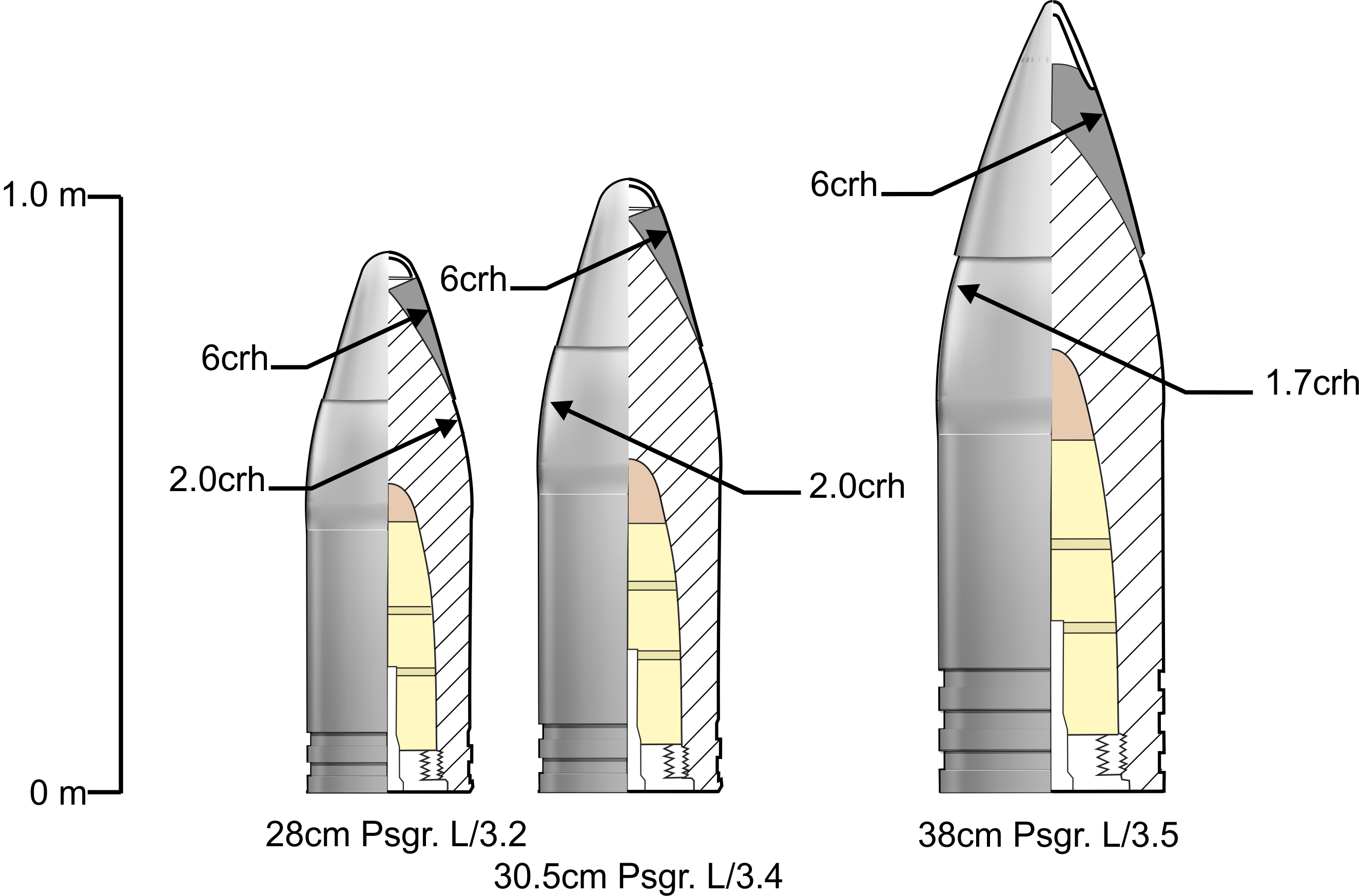
The adjacent sketch shows scale drawings of German World War I armor piercing projectiles (Psgr.) for the major cannons. All of these had an AP cap contour equal to 6.0crh, but with differently sized meplats. The projectile nose body of the Psgr. 28.3 cm and 30.5 cm was 2.0crh, while the Psgr. 38 cm had a somewhat blunter, 1.7crh projectile nose under the cap. Notice also in these sketches that the AP cap and windscreen had a different shape than the earlier projectiles. The Psgr. 28.3 cm L/3,2 and 30.5 cm L/3,4 projectiles were required to and capable of penetrating plates of 0.8 Thickness/Diameter (T/D) in a condition fit to burst when striking KC armor at 20 deg obliquity. This requirement existed in addition to the 1.0 T/D at normal and 0.5 T/D at 30 degrees imposed upon them. For the 38 cm L/3,5 and 35 cm L/3,6 (intended for the unfinished Mackensen class battlecruisers) the corresponding requirement for the 35 cm L/3,6 projectile was to penetrate a 280 mm KC plate and for the the 38 cm L/3,5 to penetrate a 300 mm KC plate at a 20 degree obliquity with the actual penetration velocities realized ranging between 582 and 607 mps.
However, unlike the performance of the smaller projectiles, the original design of the Psgr. 38 cm did not quite meet the 20 degree requirement. This initial prototype Psgr. 38 cm was a L/3,4 projectile which had a design very similar to the earlier Psgr. 30.5 cm, but had a minimally larger meplat. Various iterations of this projectile were tested, but they all broke up when striking a 300 mm KC plate at 15 degrees. As a result of these failures, the old design was abandoned and a new prototype was designed. This version had a blunter nose and a thicker AP cap but no windscreen. These projectiles, despite being somewhat lighter than the first prototype, all penetrated intact at a 15 degrees striking angle. With this success, a final design iteration added a windscreen on top of the thick AP cap in order to improve range and striking velocity. However, a planned set of tests at 20 degrees was not executed due to the end of hostilities.
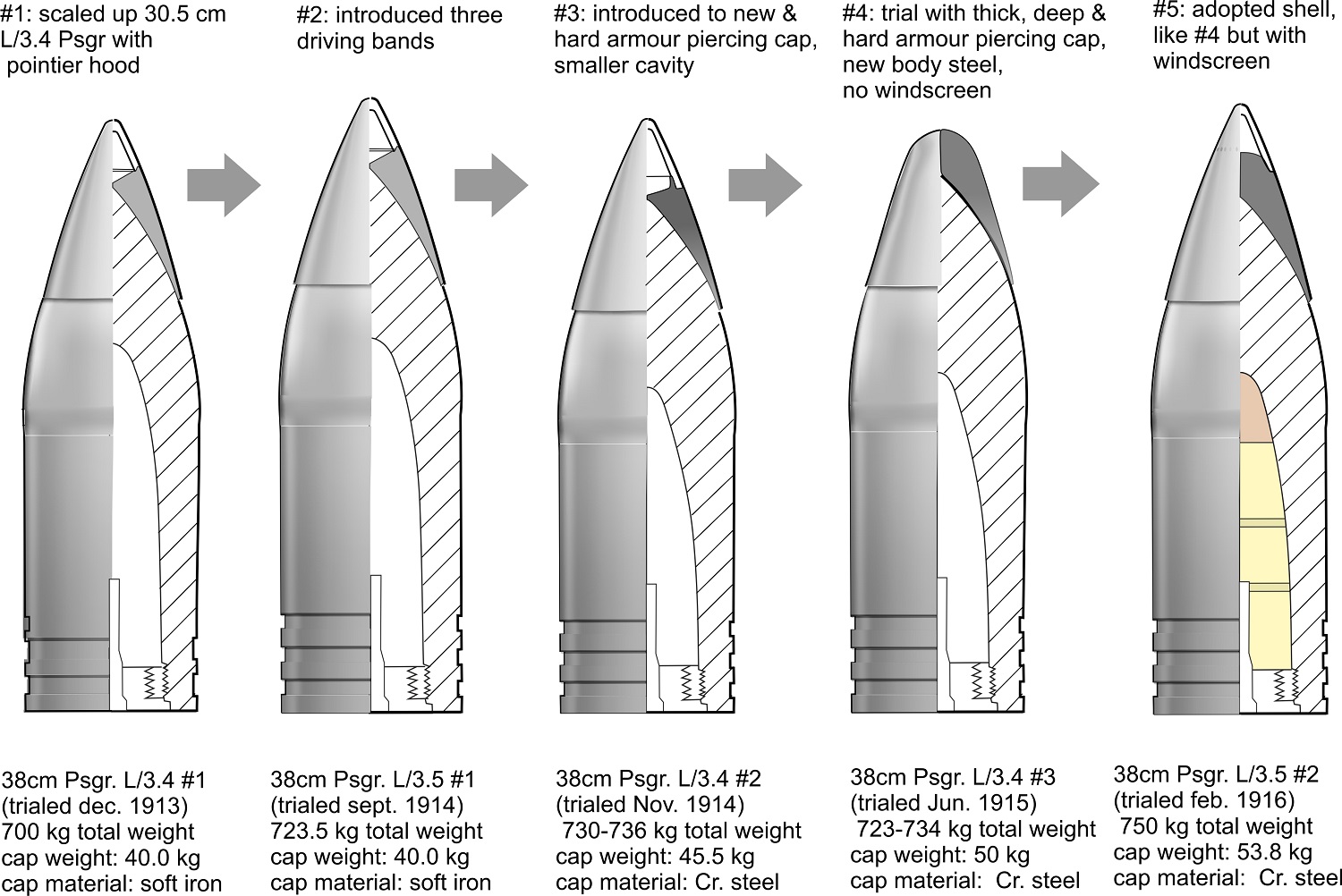
Notice that the transition towards hard armor piercing caps was made late in 1914. But it also took a thick and deep cap to fully exploit the benefits of hard AP-caps, as the hard Firth type cap alone only marginally improved penetration. Consequently, all of the designs for the Psgg. 38 cm L/3,5, 35 cm L/3,6 and 28.3 cm L/3,7 projectiles employed chromium steel for the armor piercing cap. These caps were made from the same steel composition as the shell body. The thicker and harder AP-cap (#4) resolved the break up issues reported earlier for 38 cm trial projectiles of the older series when striking 0.8 T/D at 15 degrees. Sketch copyrighted by delcyros.
There was no problem foreseen for meeting these requirements for this new design, as these projectiles had successfully penetrated at 15 degrees with a large excess velocity, so much so that they had to be dug out several kilometers behind the test plates. However, the burster cavity was frequently damaged, starting from the area of the upper driving band groove. This was exactly the same experience that the British had in the early 1920s with their improved 15 inch (38.1 cm) Mark Va ("Greenboy"), of which a majority successfully penetrated a 10 inch (25.4 cm) plate at 20 degrees and a few penetrated in a condition fit to burst a 12 inch (30.5 cm) plate at a 20 degree obliquity. The British shells which passed this raised proof value were designated as "Superproof" and were painted with a blue band. In both nations, the penetration specifications imposed on the 15 inch (38.1 cm) and 38 cm projectiles were very challenging and difficult to meet.
The real outlier here was the older German Psgr. 30.5 cm L/3,4, which was capable of meeting the 15 inch (38.1 cm) APC Mark Va regular proof specification of penetrating 10 inches (25.4 cm) at 20 deg, yet this projectile was considerably smaller and lighter than the British 15 inch (38.1 cm) projectile. Curiously, the same Psgr. 30.5 cm projectile was also about as good as the Psgr. 38 cm L/3,5 in penetrating thick KC armor at normal inclinations (0 degrees). Tests against an experimental 450 mm KC plate found little difference between the performances of the Psgr. 30.5 cm and 38 cm projectiles. One of the two 30.5 cm projectiles which managed to completely penetrate the plate also stayed intact in a condition fit to burst.
Further experiments showed that the ballistic cap design of the 38 cm Psgr. L/3,5 interfered with the armor penetration and a new ballistic cap was developed. Initially, trials with this new ballistic cap also failed at 15 degrees, but the breakage was related to the base of the projectile. It was found that the fuze adapter threads needed to be strengthened. In addition, holes were drilled into the base of the ballistic cap to further weaken it, similar to what was done to the 35 cm Psgr. L/3,6. This new design proved successful at meeting the armor penetration requirements (as were older L/3,5 without windscreen). To distinguish the new projectiles from the older Psgr. L/3,5, they were now designated as the 38 cm Psgr. L/3,6. Older 38 cm Psgr. L/3,5 projectiles already in service were modified by changing the ballistic cap to the new design. The different shape of the windscreen of the L/3,6 (less of a meplat and thus pointier) had compensatory exterior ballistic advantages. The actual ballistics for them had to be reconfirmed and they turned out to be similar to the earlier 38 cm Psgr. L/3,5 and the 38 cm Spgr. L/4,1 Bdz.
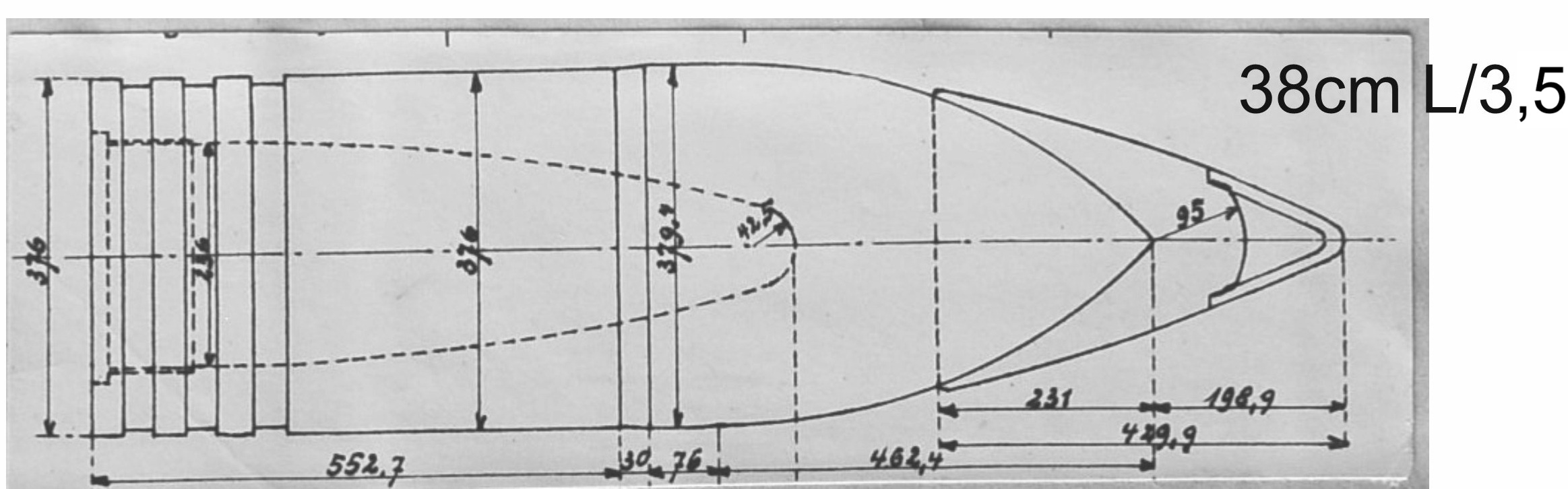
The original 38 cm Spgr. L/4,1 Bdz. was not quite as good in perforation capability as was the 30,5 cm Spgr. L/3,8 Bdz. projectile. Experimental 38 cm Spgr. projectiles made with an armor piercing cap fitted to the nose would usually break up when striking a 170 mm or 180 mm (6.7 or 7.1 in) KC K1 armor plate at a 90 degree (perpendicular) angle. For this reason, the fitting of an armor piercing cap was abandoned and new projectiles were made to a standard Spgr. Bdz. design (see sketch below). This new design was capable of perforating 110 mm (4.33 in) soft homogenous [turret roof] armor - weiche Nickelstahlplatte (soft nickel steel plate), presumably Q420 as the nickel-lean deck armor plate was listed separately - at a 78 degree obliquity and a striking velocity of 439.1 mps (1,440 fps), equivalent to about 15,000 m (16,400 yards) downrange, very approximately.
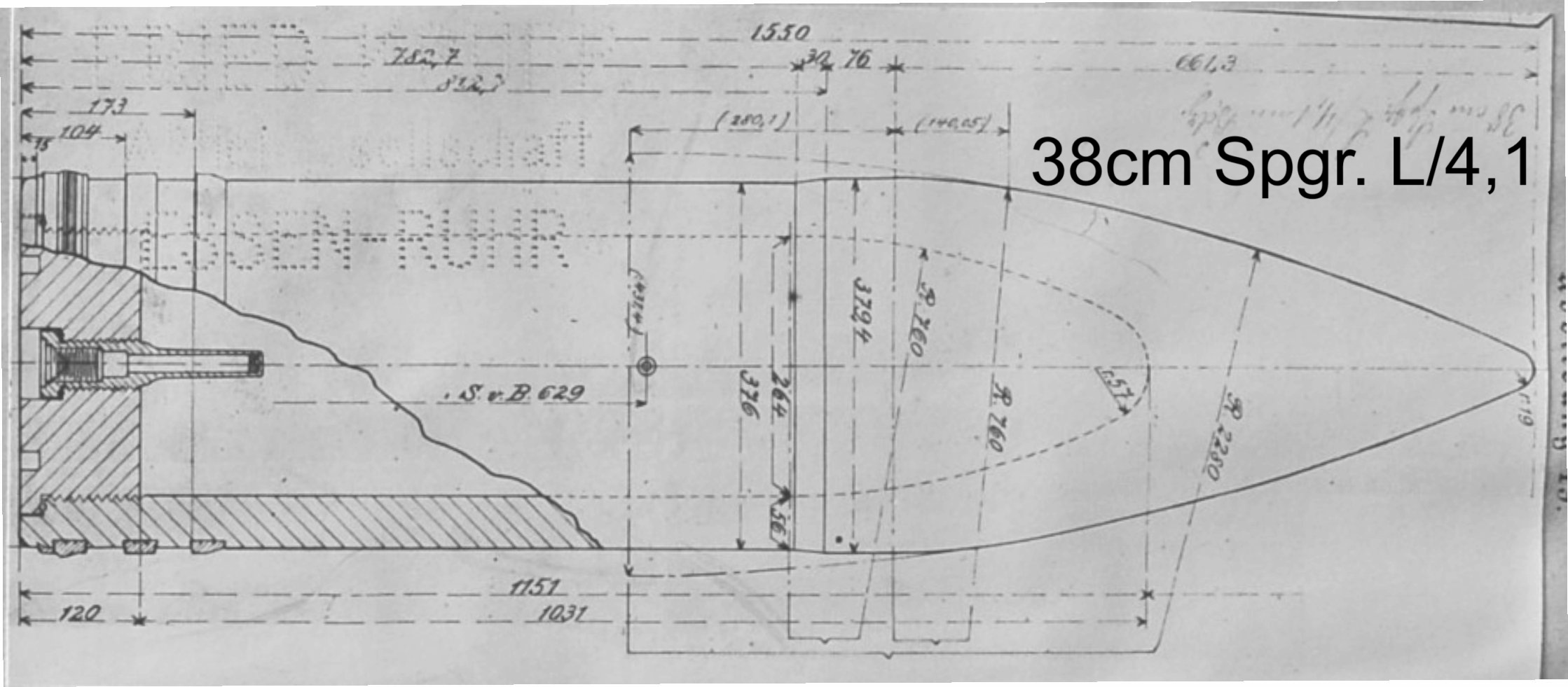
Data extracted from BAMA RM6-3347 "Entwicklung unser Marineartillerie 1913-1920. Volume V (Issue II. "Gschosse")", originally classified "Geheim!" (SECRET), issued by the Reichswehrministerium, Marineleitung (Berlin 1923), pp. 3-15 (Psgr.) and pp. 20-27 (Spgr.).
| Elevation | Distance |
|---|---|
| 16 Degrees | 22,310 yards (20,400 m) |
| 20 degrees | 25,370 yards (23,200 m) |
| Projectile | Distance |
|---|---|
| APC L/3,5 | 42,000 yards (38,400 m) |
| HE L/4,1 base fuze | 37,400 yards (34,200 m) |
| Coastal HE L/5,4 base fuze | 42,320 yards (38,700 m) |
| Coastal HE L/5,4 base and nose fuze | 42,320 yards (38,700 m) |
| Coastal Light HE L/4,1 | 51,950 yards (47,500 m) |
| Coastal Shrapnel L/3,6 | 24,720 yards (22,600 m) 1b |
- ^Coastal Shrapnel was fired only with reduced charges.
- Railway guns had a maximum range of about 24,000 yards (22,000 m).
| Range | Side Armor | Deck Armor |
|---|---|---|
| 10,936 yards (10,000 m) | 15.35 in (390 mm) | --- |
| 13,670 yards (12,500 m) | 13.78 in (350 mm) | --- |
| 21,872 yards (20,000 m) 1c | 10.43 in (265 mm) | --- |
| 27,340 yards (25,000 m) | 8.66 in (220 mm) | --- |
- ^There is evidence to suggest that these guns achieved penetrations of 13.23 in (336 mm) at 21,872 yards (20,000 m) against World War I-era armor.
- The above information is from "German Capital Ships of World War Two" and is derived from trials conducted in 1938 when these guns were compared against the 38 cm guns intended for the Bismarck class battleships.
| Range | Side Armor | Deck Armor |
|---|---|---|
| 9,510 yards (8,700 m) | 14.0 in (356 mm) | --- |
| 10,280 yards (9,400 m) | 13.5 in (343 mm) | --- |
- ^The penetration in this table is for intact penetration in a condition fit to burst after striking at a 30 degree obliquity (60 degrees per the German definition) against improved quality KC armor of the World War I era and not against the original, 1890´s KC/a.
- The above information is from "M.D.V. 352 Heft 09."
| Designation | Two-gun Turrets 1e Baden 2e (4) and Bayern (4): DRH LC/1913 Württemberg (4), Sachsen (4) and Ersatz Yorck (4): DRH LC/1914 |
|---|---|
| Weight | This data is only for Bayern, other ships may be different.
A: 853.7 tons (867,440 kg) B: 856.1 tons (869,880 kg) C: 853.3 tons (866,950 kg) D: 836.8 tons (850,240 kg) |
| Elevation 3e | Baden (as completed): -8 / +16.0 degrees
Bayern (as completed ): -5 / +20.0 degrees Battery Deutschland reportedly had three BSG mountings capable of +45 degrees and one BSG mounting
capable of +55 degrees
|
| Elevation Rate | 5 degrees per second |
| Train | About +150 / -150 degrees |
| Train Rate | 3 degrees per second |
| Gun recoil | 49 in (125 cm) |
| Loading Angle | 2.5 degrees |
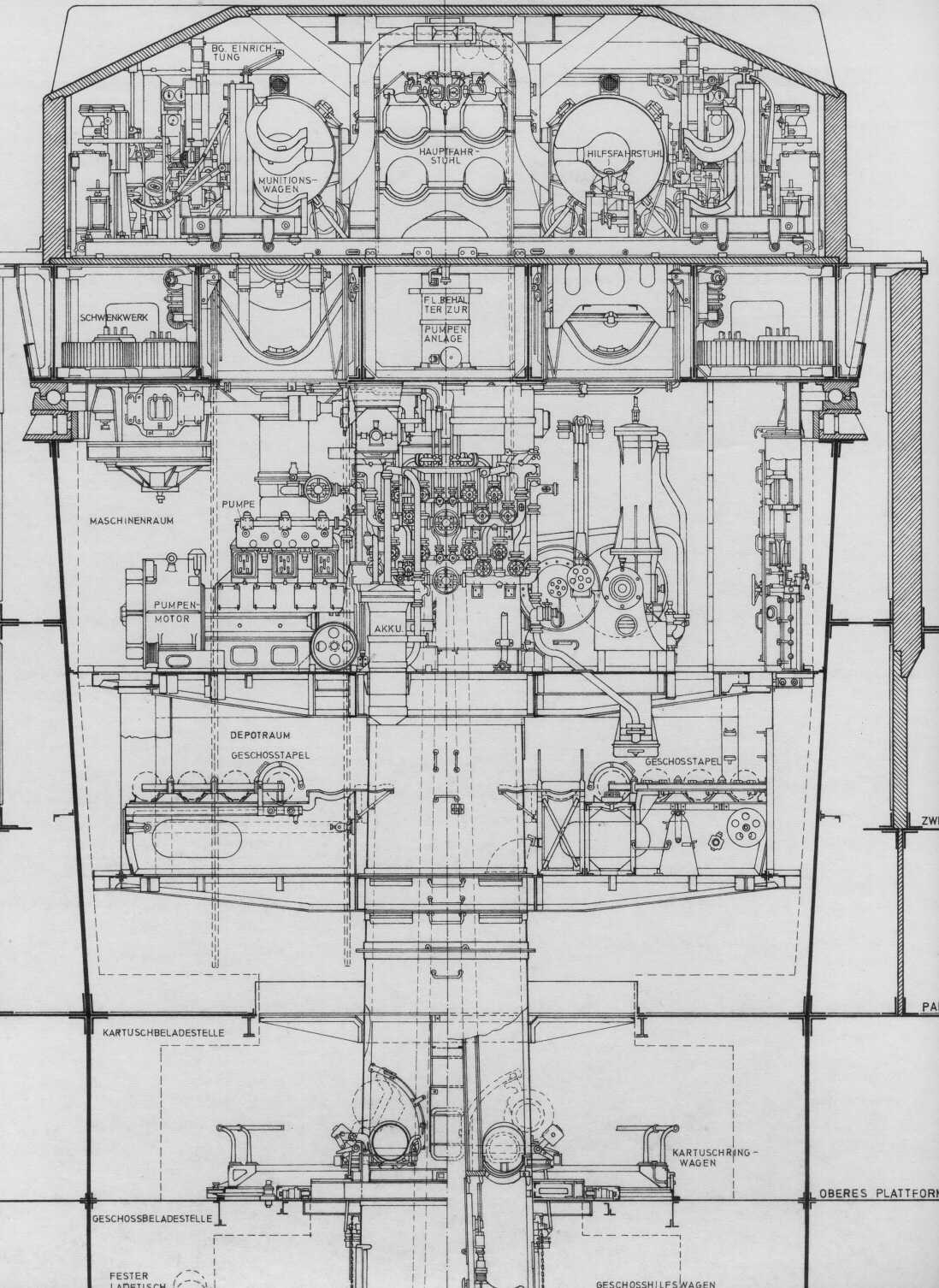
- ^Typical of German designs, these turrets ran on ball races containing 144 steel ball bearings of about 6.5 inches (16.5 cm) in diameter. Roller bearing ring diameter was 28.7 feet (8.75 m). Turrets were powered as much as possible with electric motors directly, with electrically powered hydraulics being used for the elevating gear, the hoists and each gun had a hydraulically worked rammer and breech. Training was all electric. Each turret had a machinery room directly below the turret, followed by a handling room. At the bottom of the stalk was a cartridge handling room which held 36 fore charges. Rear charges and additional fore charges were stored in the magazines. Cartridges were loaded onto a central hoist below the handling room while projectiles were loaded on the next deck below. Projectile hoists ran directly from the handling room to the gunhouse. Once in the gunhouse, the projectiles and cartridges were power rammed towards the rear of the turret onto powered loading cars which ran on rails across the turret. These cars could feed either gun, but normally the guns were loaded together. As the breech mechanism did not extend past the end of the gun, the breeches could be opened before the cars were in place, thus speeding the loading cycle. Shell and cartridges were loaded by a chain and telescoping rammer. The projectile was rammed first and then both propellant charges were rammed as a unit. The total length of both charges was 63 in (160 cm).
- ^A British post-war analysis of the mountings on Baden criticized them for their lack of flash protection, but this seems overstated. The German use of enclosing all charges in brass greatly reduced the risk of flash igniting the charges. Thus they did not need the elaborate anti-flash fittings as found in British post-Jutland designs. The analysis noted that the German turrets were less foolproof than British designs as there were places where mistakes could jam them. The British report further stated that there was "a remarkable absence of precautions against sabotage" which seems more of a curious indictment against British sailors than a criticism of the German design.
- ^Elevation in Baden was not increased during the war. Any ship completed after Bayern would probably also have had an elevation range of -5 / +20 degrees.
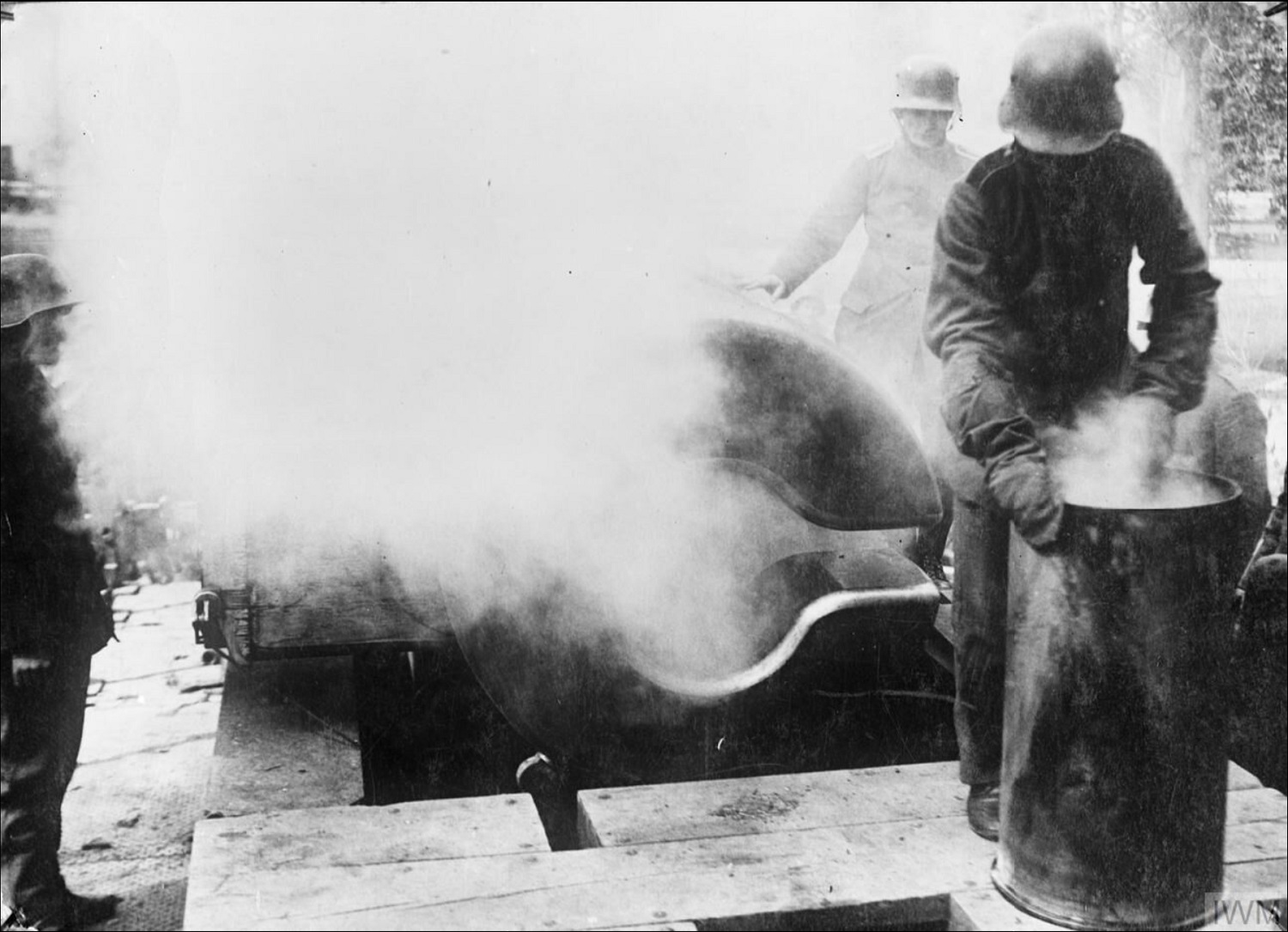
- ^A Note on Sources: "Images of the Great War" states that the Pommern Battery required eight men to ram the projectiles. However, a report by the Belgian Chief of Artillery quoted in "The German Defenses on the Coast of Belgium" states that twelve men were necessary while an IWM photograph (Q 44813) shows only six men loading a 38 cm Spgr. L/5,4 m. Bdz. (m.Hb) into the gun.
- ADM 186/251 notes that the shell grabs and the foot grip plating used in the shell rooms were both very efficient and should be copied in future British designs. However, it also notes that the Auxiliary Loading Chamber was "both a poor and an elaborate arrangement." The Auxiliary Loading Chamber allowed an "alternate supply of six projectiles per gun to be sent to the gun-house by means of an electrically driven hoist. There is no ready means of replenishing the secondary loading compartment from the shell room."
- Distance between gun axes was 145.6 in (370 cm).
Armor thickness given in "Naval Weapons of World War One" by Norman Friedman Baden class Ersatz Yorck class Face 14.0 in (35 cm) 11.8 in (30 cm) Sides 9.8 in (25 cm) Rear 11.4 in (29 cm) Roof Flat 4.7 in (12 cm) 5.9 in (15 cm) Front 7.9 in (20 cm) 9.8 in (25 cm) Sides 4.7 in (12 cm)
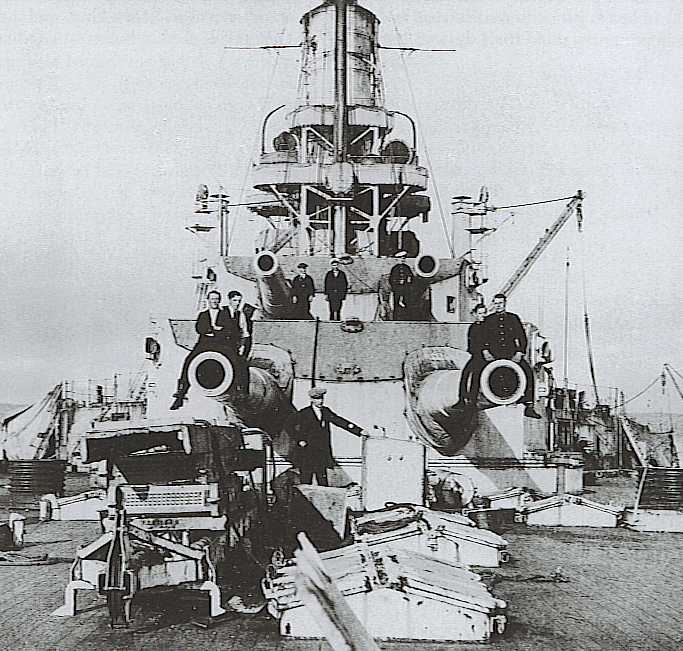

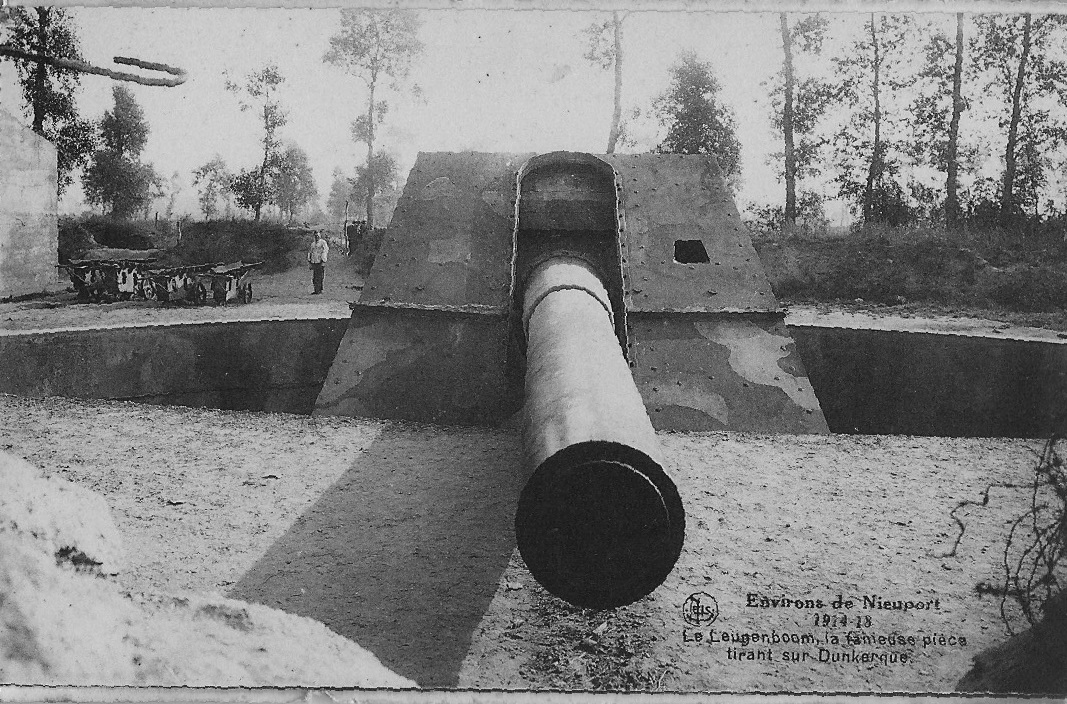
"Surroundings of Nieuwpoort 1914-18: The famous Leugenboom [name of area in Belgium where the Pommern Battery was located] cannon that fired at Dunkirk."
The armored shield on this cannon was 60 mm thick and the concrete ring around the mount was 2 meters high and 3 meters thick. Note the ammunition transfer carts at the left rear, one of these may be the one shown in the museum photograph below.
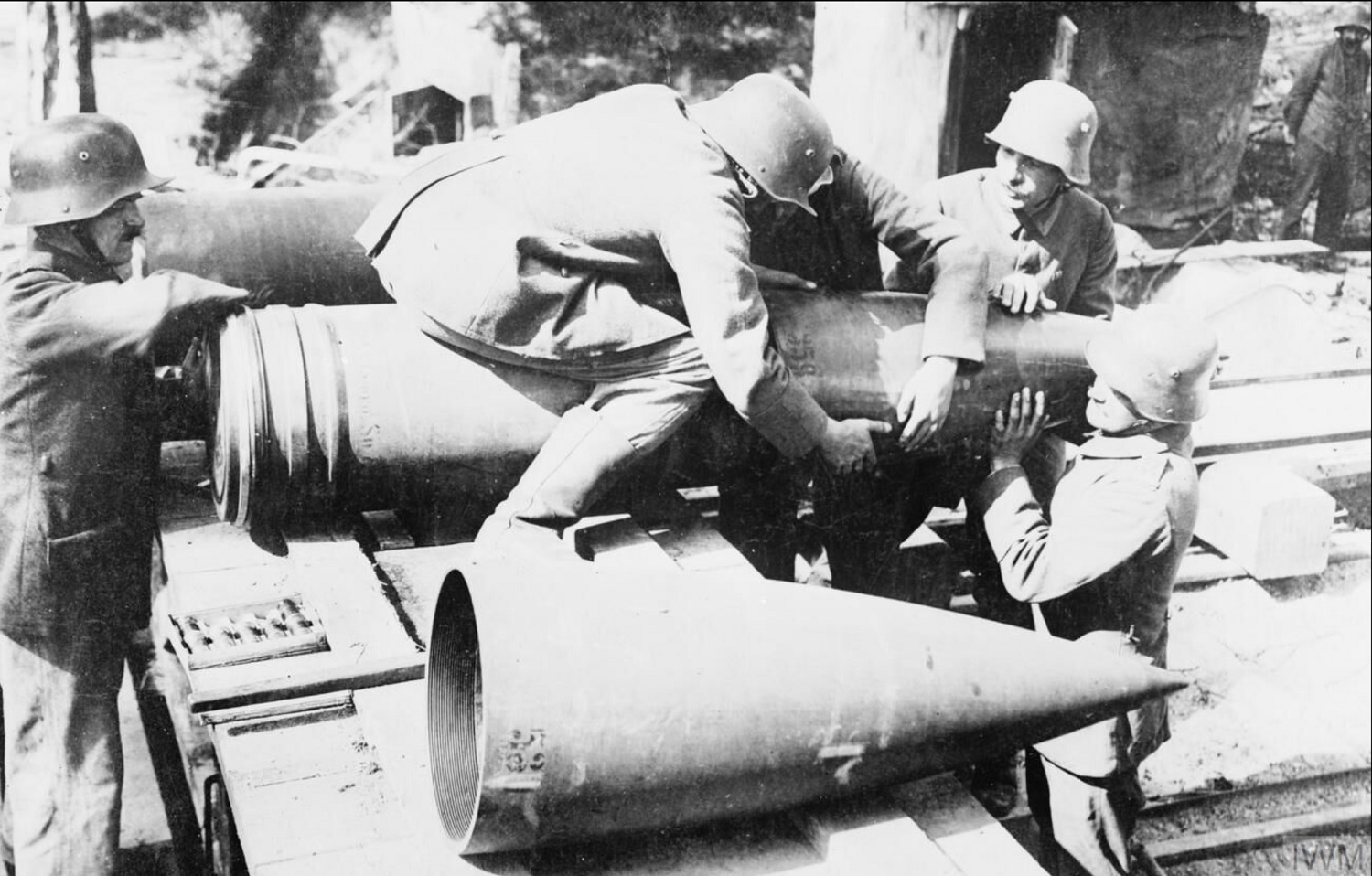
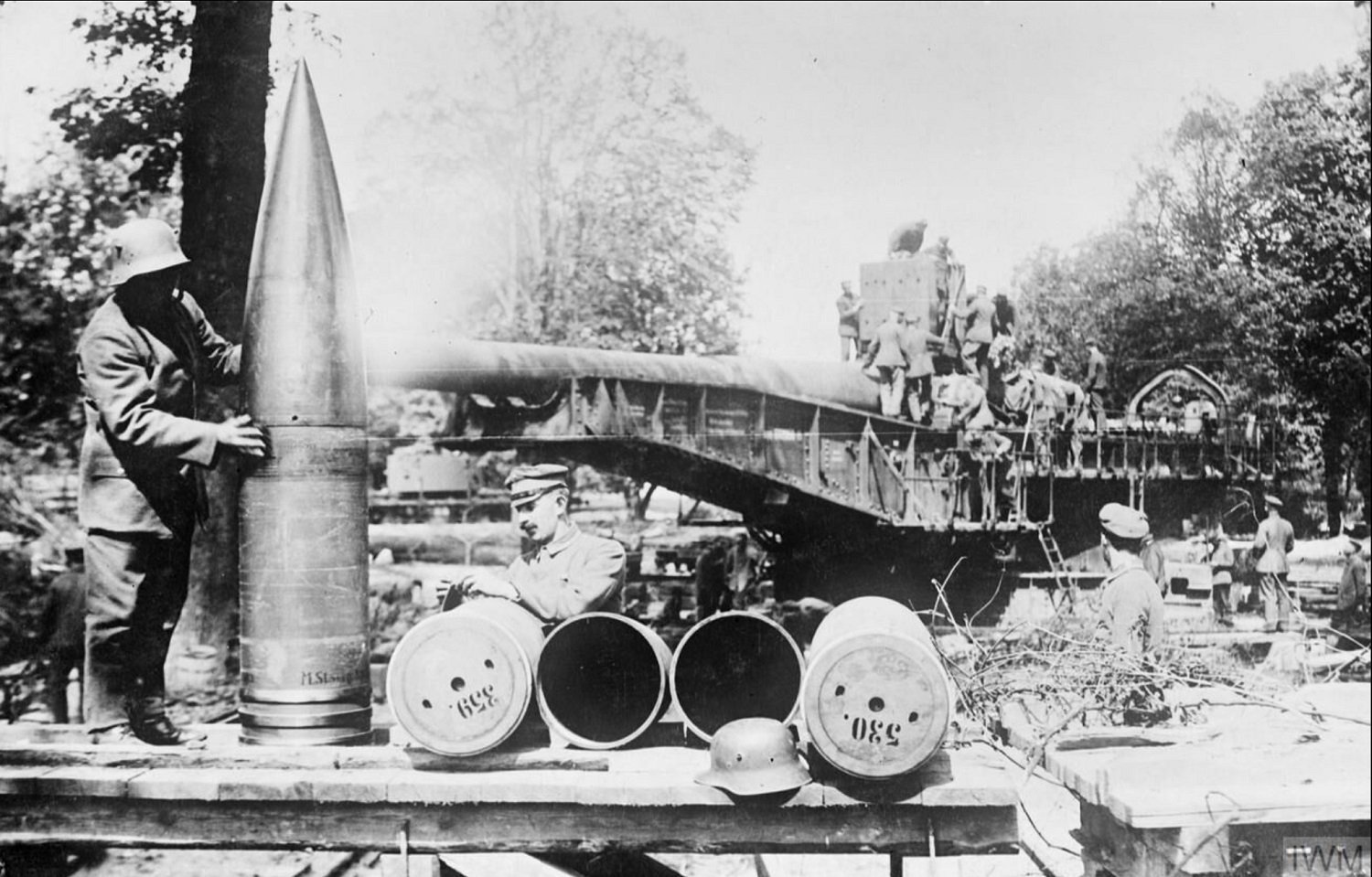
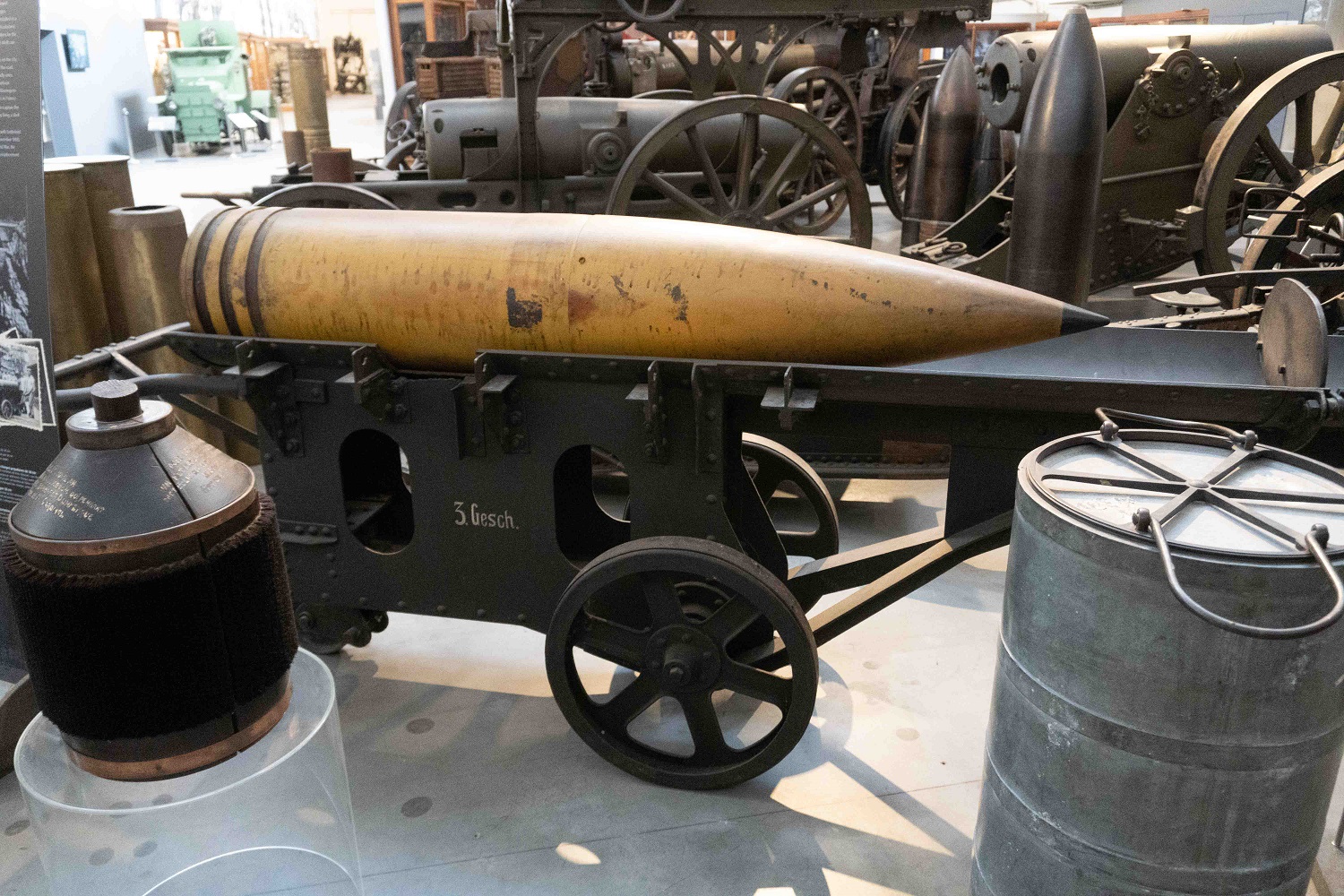
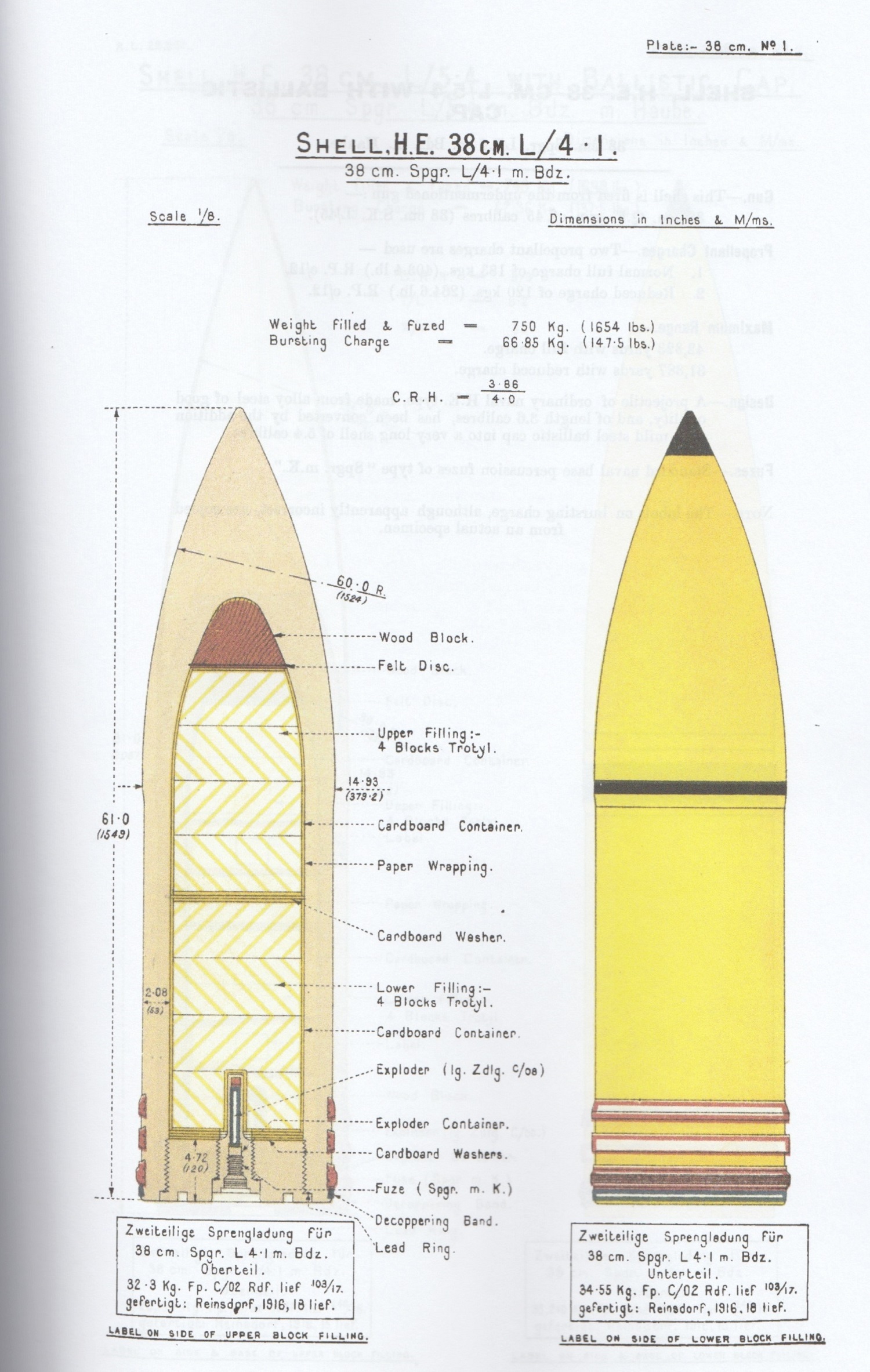



"Big Gun Monitors: The History of the Design, Construction and Operation of the Royal Navy's Monitors" by Ian Buxton
"Jutland: An Analysis of the Fighting" by John Campbell
"De kust bezet 1914-1918" (The Occupied Coast 1914-1918) by Alex Deseyne
"Battleship Design and Development 1905-1945" and "Naval Weapons of World War One" both by Norman Friedman
"Große Kreuzer der Kaiserlichen Marine 1906 - 1918" by Axel Grießmer
"German Warships 1815-1945" by Erich Gröner
"The Big Gun: Battleship Main Armament 1860-1945" by Peter Hodges
"The German Defenses on the Coast of Belgium" by Lt. Col. H.W. Miller USA in "The Journal of the American Society of Mechanical Engineers" Vol. 42, No. 6, June 1920
"The Baden Trials" article by William Schleihauf in "Warship 2007"
"Die Geschichte der deutschen Schiffsartillerie" by Paul Schmalenbach
"German Warships of World War I" by John C. Taylor
"German Capital Ships of World War Two" by M.J. Whitley
---
ADM 186/251 (a copy is at Royal Navy Flag Officers 1904-1945)
"Diagrams of Great War - German Naval Guns; Shells & Explosives; Fuses & Exploders" by The Royal Laboratory Woolwich 1921-22
"M.D.V. 352 Heft 09" Vize Adm. Trotha, Der Organismus der Kaiserlichen Marine und der erste Weltkrieg, Berlin 1930, and has been tabulated by Vize Admiral Rogge there at p.75.
---
Special Help from Peter Lienau, Thorsten Wahl, Helen Peeters and delcyros
Images of the Great War
Les Canons de l'Apocalypse, data for use on Land Mountings (in French)
S. Berliner, III - Ordnance Page
HMS Hood Association Website
12 October 2007 - Benchmark
26 August 2011 - Added projectile information
19 May 2012 - Updated to latest template
23 November 2012 - Added rifling note, propellant note and additional mounting information
15 December 2013 - Added photograph of coastal artillery
30 April 2014 - Added overhead photograph of Baden
01 November 2014 - Additional projectile information
30 January 2021 - Converted to HTML 5 format
15 January 2022 - Added reference
12 June 2022 - Minor formatting changes, converted broken links to point at Wayback Archives
28 August 2022 - Converted Royal Navy Flag Officers links to point at Wayback Archives
30 November 2022 - Added Development of Psgr. 38 cm section and sketches of 38 cm projectiles used by coastal artillery,
added information on propellants
01 January 2023 - Added Note on Sources regarding m.Hb, added ammunition stowage for Ersatz Yorck
16 August 2023 - Added to captions for the 38 cm Spgr. L/5,4 coastal projectiles
24 January 2024 - Added and redid photographs of 38 cm guns used as coastal artillery
29 April 2024 - Added comment about Ersatz York class
16 August 2024 - Minor changes
03 September 2025 - Added sketches and information about Psgr. L/3,5, Psgr. L/3,6 and Spgr. L/4,1
19 June 2026 - Added photograph source note