
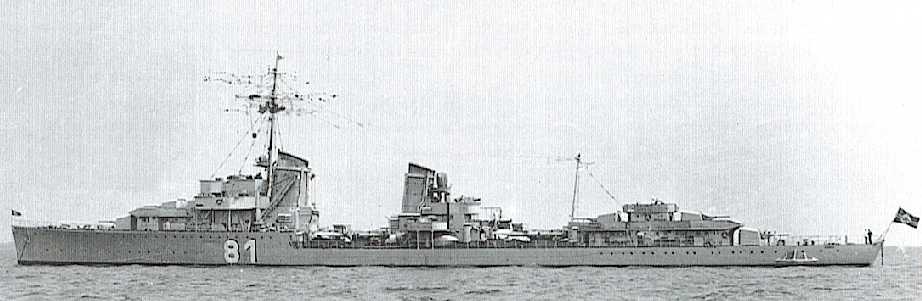
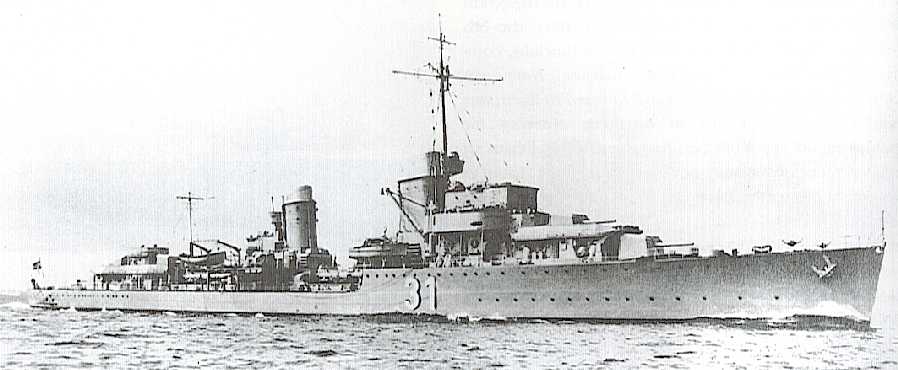
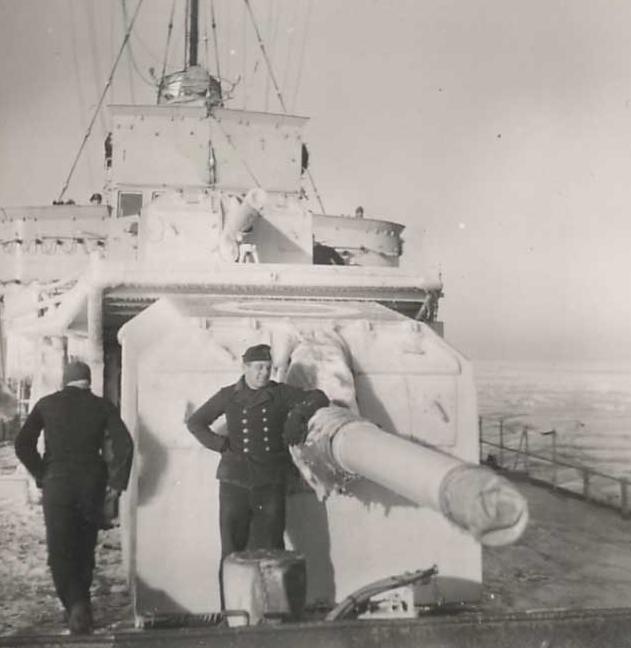
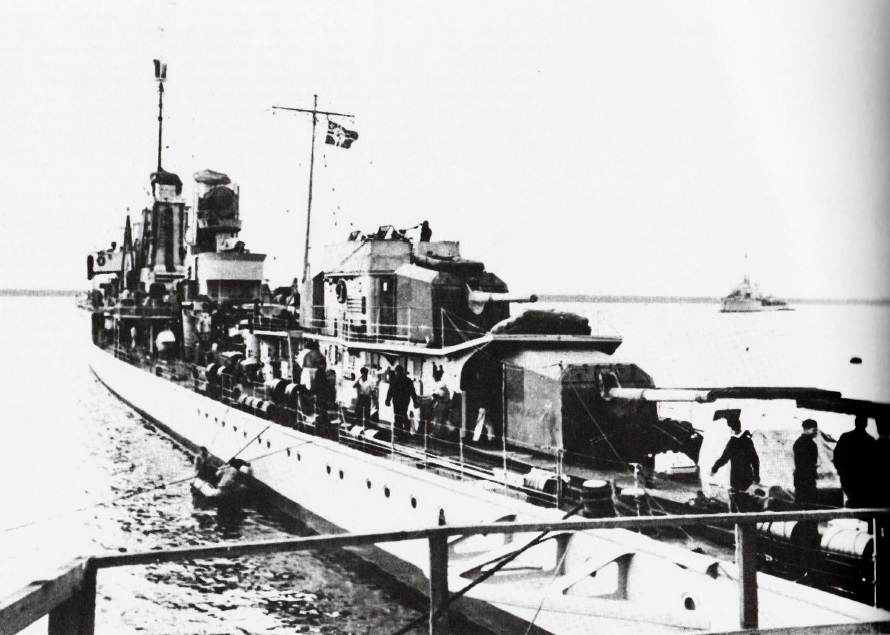
A low-angle weapon intended for surface action, this gun armed all of the German destroyers built before the start of World War II and a few war-built ones. There was also a twin mount planned for the never-built Type XI U-boats (U-Kreuzer).
At least eight of these guns were exported to Greece for arming the destroyers of the Vasilevs Georgios class.
Early guns were bored-out versions of the 10.5 cm/55 (4.1") SK C/28. The production guns were constructed of a loose barrel, jacket and breech end piece with a vertical sliding breech block.
Some of these guns were still in service as of 2003 in coastal defense units in Norway.
All German 12.7 cm guns had an actual bore diameter of 12.8 cm (5.04 in).
| Designation | 12.7 cm/45 (5") SK C/34 |
|---|---|
| Ship Class Used On | Germany 1 Destroyers: Z1, Z17 and Z35 classes (Types 1934, 1936 and 1936B) Torpedo Boats: T61 class, Leopard and Luchs Gunboat: Grille Training ship: Bremse as rearmed U-boats: Type XI 2 Greece
|
| Date Of Design | 1930 |
| Date In Service | 1934 3 |
| Gun Weight | 8,036 lbs. (3,645 kg) 4 |
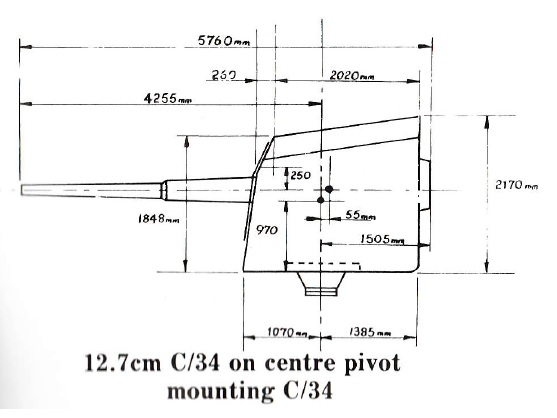
| Gun Length oa | 226.8 in (5.760 m) |
| Bore length | 213.8 in (5.430 m) |
| Rifling Length | 178.6 in (4.536 m) |
| Grooves | (40) 0.059 in deep x 0.236 in (1.5 mm x 6.0 mm) |
| Lands | 0.157 in (4.0 mm) |
| Twist | Increasing RH 1 in 35 to 1 in 30 |
| Chamber Volume | 744 in3 (12.19 dm3) |
| Rate Of Fire | 15 - 18 rounds per minute 5 |
- ^This weapon was also planned for the Type 1938B Destroyers which never made it off the drawing board.
- ^Guns designed for the Type XI U-Boats weighed 10,196 lbs. (4,625 kg) due to their increased breech end weights.
- ^The Type 24 torpedo boats Leopard and Luchs were used to test the prototypes of these weapons and had their 10.5 cm/55 guns replaced in 1932. Much information was gathered during these evaluations and the improved production version made its service debut in 1934.
- ^Converted 10.5 cm (4.1") SKC/28 guns weighed 7,848 lbs. (3,560 kg).
- ^This weapon was designed for a ROF of 18 - 20 rounds per minute, but the above figure was typical for well-trained crews. As these were open mounts, bad weather or Arctic conditions could greatly reduce the ROF.
| Type | Separate |
|---|---|
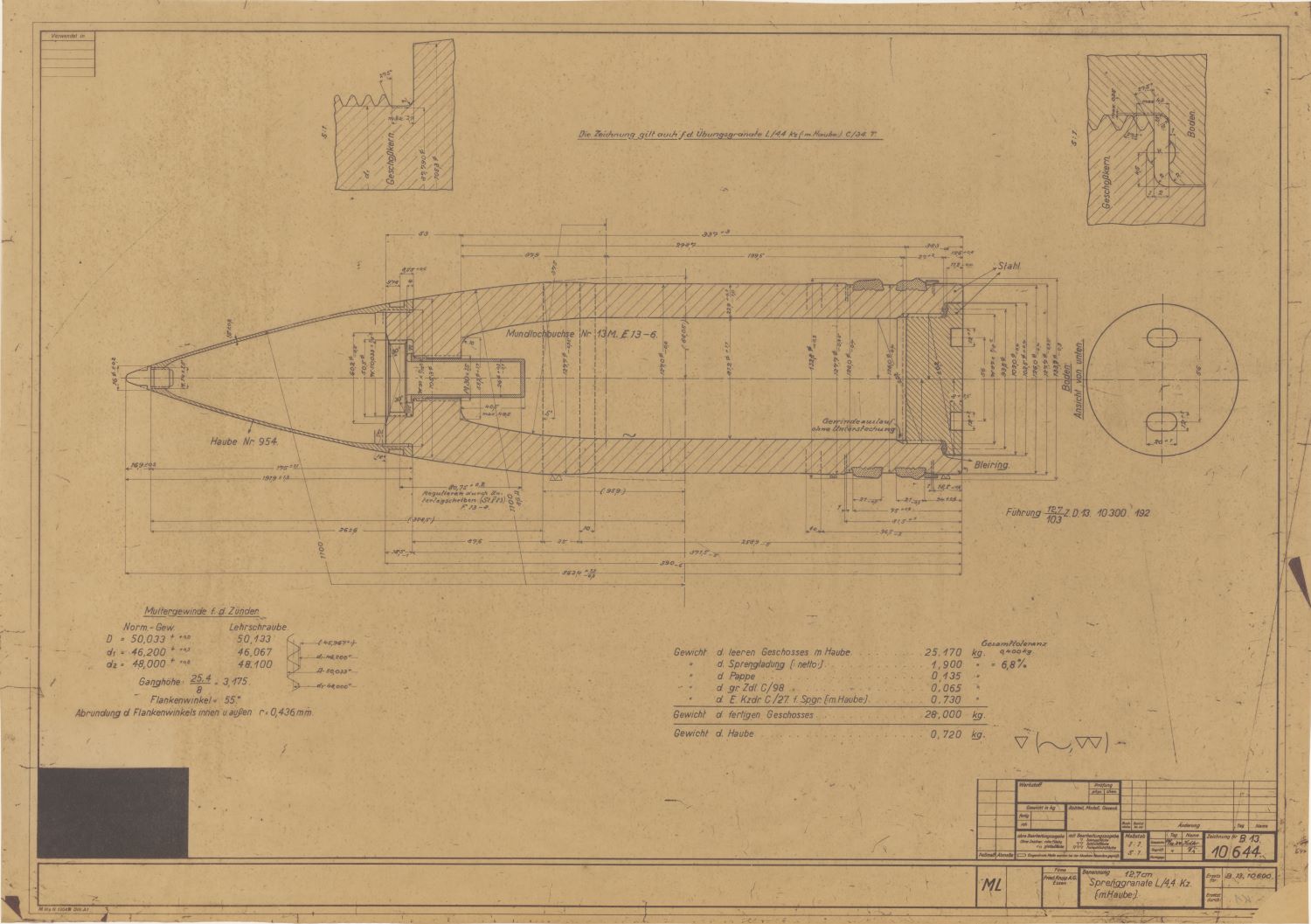
| Projectile Types and Weights 1a 2a 3a | HE L/4,4 nose fuze 4a: 61.7 lbs. (28.0 kg)
HE L/4,4 nose fuze AA 5a: about 60.2 lbs. (27.3 kg) ILLUM L/4,5: 60.4 lbs. (27.4 kg) |
| Bursting Charge 6a | HE L/4,4 nose fuze: 4.20 lbs. (1.905 kg) or 3.87 lbs. (1.755 kg) TNT 7a |
| Projectile Length | HE L/4,4 nose fuze: 22.2 in (56.5 cm)
HE L/4,4 nose fuze AA: N/A ILLUM L/4,5: about 22.7 in (57.6 cm) |
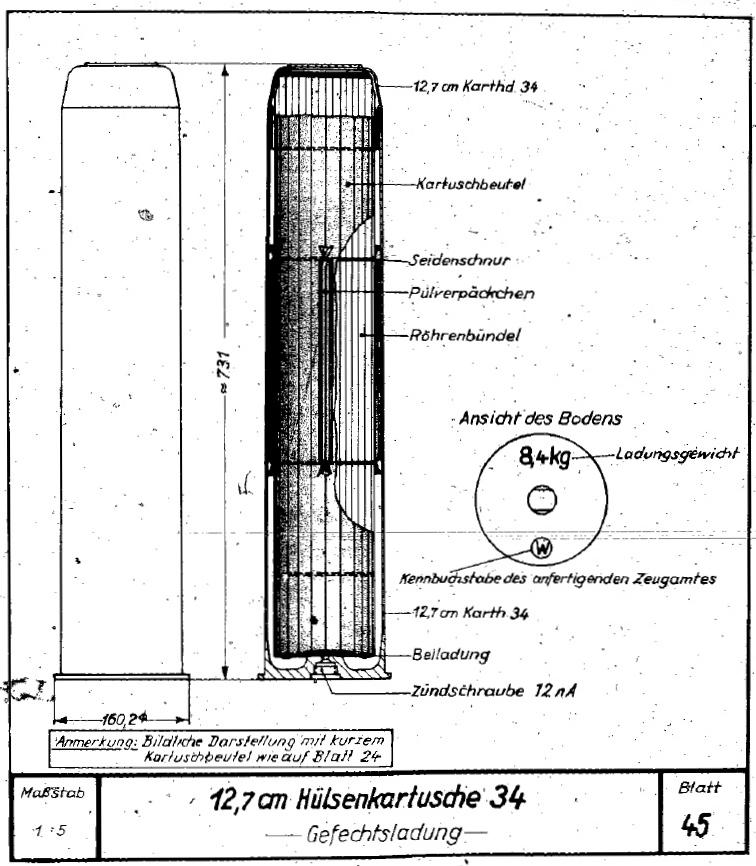
| Propellant Charge | HE L/4,4 nose fuze: 19.2 lbs. (8.7 kg) RP C/38 (690 x 6,4/2,6) or 18.5 lbs. (8.4 kg) RP C/32 (690 x 8/4,25)
ILLUM L/4,5: 18.9 lbs. (5.84 kg) Tri RP f. Lg. (690 x 9/6) or 12.3 lbs. (5.60kg) RP f. Lg. (690 x 6,5/4,5) |
| Cartridge Case Type, Size and Weight | Brass, 128 x 680 mm, N/A 8a HE L/4,4 nose fuze Cartridge - Loaded: 35.3 lbs. (16.0 kg)
|
| Muzzle Velocity | HE: 2,723 fps (830 mps)
ILLUM: 2,133 fps (650 mps) |
| Working Pressure | 18.7 tons/in2 (2,950 kg/cm2) |
| Approximate Barrel Life | 1,950 rounds |
| Ammunition stowage per gun | Z1, Z17 and Z35 classes: 120 rounds 9a Leopard and Luchs: 100 rounds T61: 150 rounds Type XI U-boats: 270 rounds Grille and Bremse: N/A Vasilevs Georgios: 192 rounds |
- ^The sources below differ regarding the ammunition used for these weapons. For the most part, I have relied upon the data in M.Dv. Nr. 170,27 and in "German Destroyers of World War Two."
- ^Some sources including "Naval Weapons of World War Two" state that HE base fuze ammunition was supplied for these weapons, but this is not supported by M.Dv. Nr. 170,27 nor by "German Destroyers of World War Two."
- ^
Actual German designations HE L/4,4 nose fuze 12,7 cm Spgr. L/4,4 Kz (m.Hb) HE L/4,4 nose fuze AA 12,7 cm Spgr. L/4,4 Kz (m.Hb) – Haube abgeschraubt [unscrewed cap] Illumination L/4,5 12,7 cm Lg L/4,5 - ^There were two versions of the HE L/4,4 nose fuze projectile, these having minor differences in the fuze packaging and very slight differences in the burster weight.
- ^The AA projectile was the same as the standard HE Nose projectile, but had a time fuze in place of the instantaneous impact fuze and did not use the ballistic cap (windshield). This AA projectile was similar to that for the 15 cm/60 (5.9") SK C/25, see Anti-Aircraft Projectiles on that datapage for a sketch.
- ^Burster weight (reiner Sprengstoff) from M.Dv. Nr. 170,27.
- ^The burster of the HE projectile was made entirely with Fp 1.
- ^The cartridge rim diameter was 160.2 mm.
- ^Outfits for destroyers were HE nose fuze with and without tracer and 80 illumination rounds per ship.
- Nose fuzed HE was 8.6crh.
- Exercise and practice rounds were produced for this weapon.
- Nammo Raufoss produced an anti-ship projectile (ASP M88) starting in 1989. This projectile had the same interior and external ballistics as the earlier German 12.7 cm rounds and was essentially a scaled up version of the ASP M85 used for former German 10.5 cm/45 (4.1") guns. The projectile weighed 61.7 lbs. (28.0 kg) and had a bursting charge of 7.0 lbs. (3.2 kg).
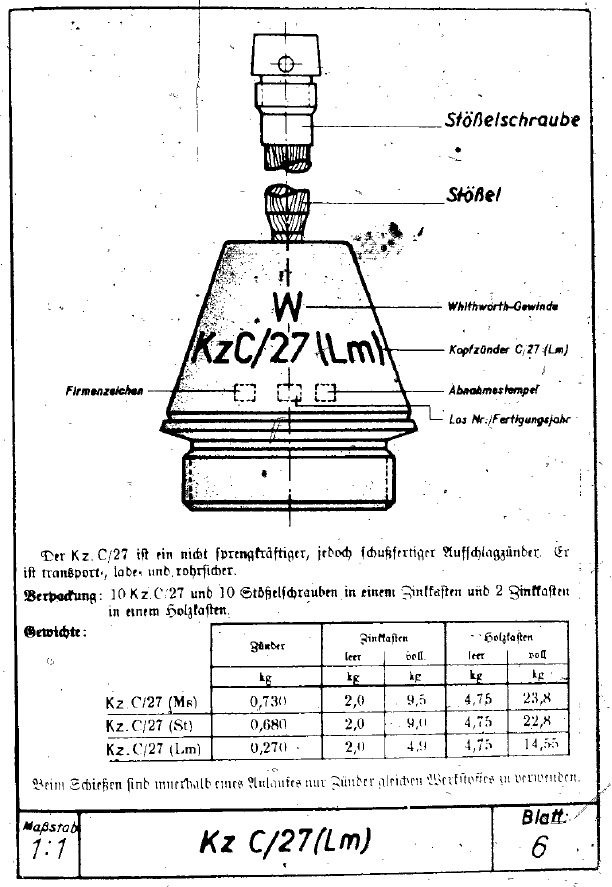
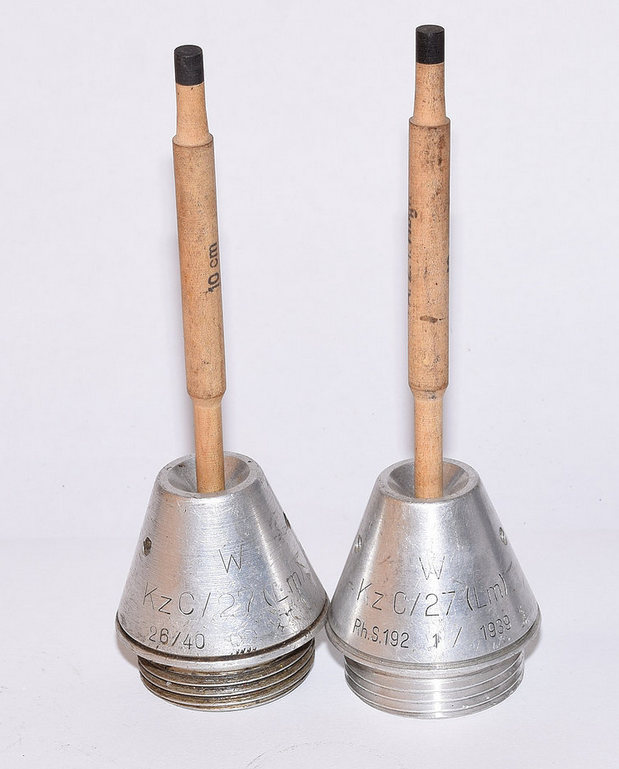
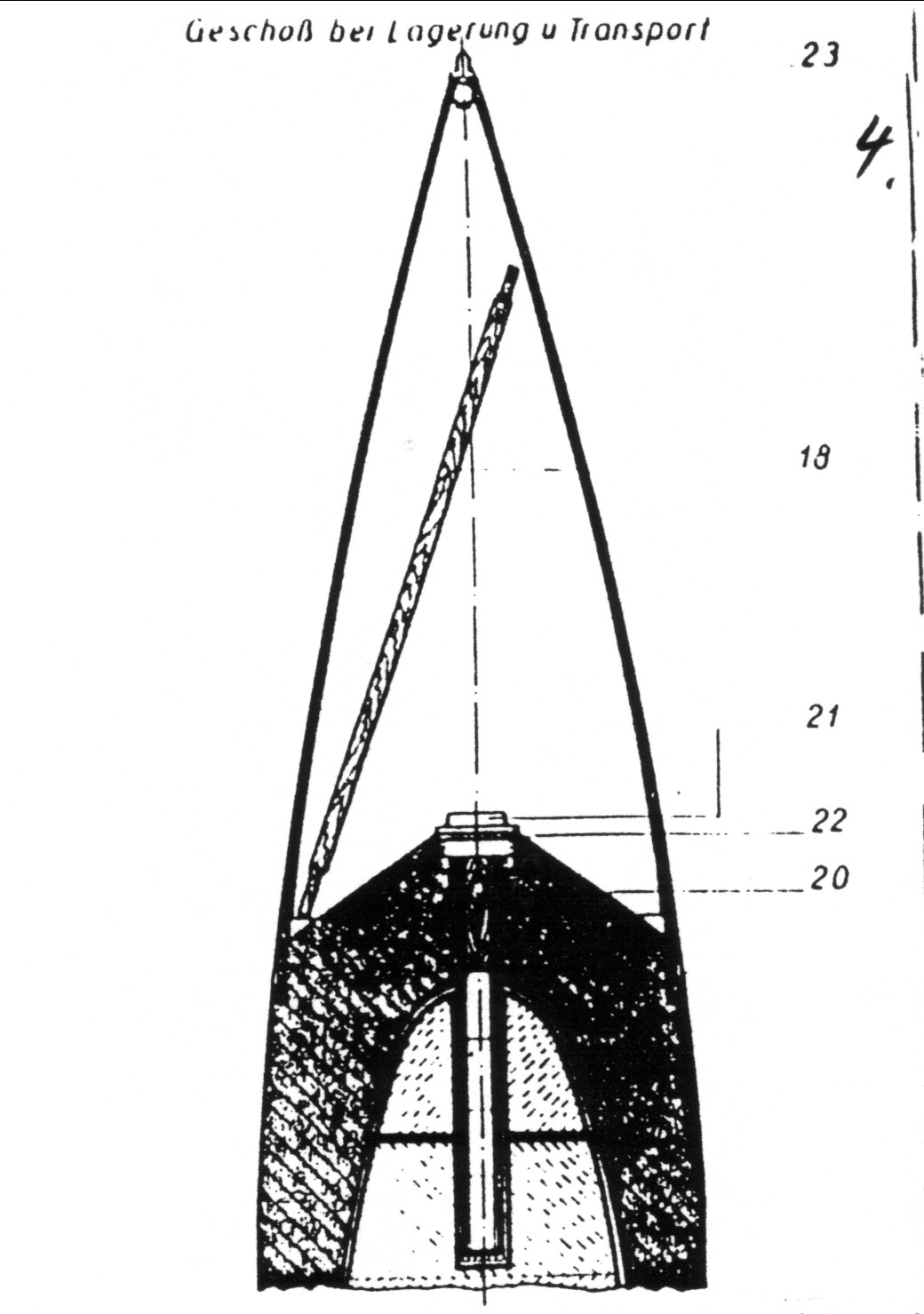
German naval guns during World War II between 12.7 cm and 40.6 cm were issued HE Nose Fuze projectiles that had ballistic caps [Spgr. Kz (m.Hb)]. Similarly, older naval guns now used for Coastal Defense were issued new HE Base and Nose fuzed projectiles with ballistic caps [Spgr. Bdz u. Kz (m.Hb)]. As can be seen in the sketch below at left, these projectiles had the impact fuze located on the head of the projectile body, not on the head of the projectile. While this approach improved and simplified the connection between the fuze and the burster, this design had a weakness in that the ballistic cap actually "protected" the fuze when the shell made a glancing blow on the target instead of a direct hit. If the fuze was not crushed from this kind of hit, then the shell would not detonate.
What the Germans did to improve the likelihood of detonation when the projectile made only a glancing hit was to insert a wooden rod, called the Stößel ("Ram") in these sketches, between the nose of the ballistic cap and the fuze. With this design, if the ballistic cap struck something hard enough to deform the cap, even if not a direct hit, then the rod would still be pushed into the fuze and initiate the detonation. Finally, in case of a highly oblique or "grazing" impact, the fuze was designed such that inertia would force the firing pin and primer holder together and still initiate the fuze detonation even if the rod was not pushed into the fuze.
For most projectiles with ballistic caps, the Stößel was placed sideways inside the cap during storage and transport so as to prevent damage. At least one projectile, the 24 cm Spgr. L/4,2 Bdz u. Kz (m.Hb) nA, was a later "New Art" design that did not need the Stößel moved from its ready position.
In regards to this German design, it should be noted that the 16" (40.6 cm) Mark I guns used on the HMS Nelson class battleships used similar HE projectiles with ballistic caps that had the fuze on the nose of the projectile body and not on the nose of the cap. However, unlike the German design, these lacked any connection between the fuze and the nose of the ballistic cap. HMS Rodney found during her bombardment of Oran in November 1942 that many of these projectiles failed to explode and they were withdrawn from service in 1943. A new HE projectile was issued later and this had a true nose fuze and was of better ballistic shape.

| Elevation | Range |
|---|---|
| Range @ 30 degrees | 19,030 yards (17,400 m) |
| Designation | Single Mount
Germany
Greece
Twin Mount 2b |
|---|---|
| Weight | LC/34: 22,487 lbs. (10,220 kg)
LC/38: 93,035 lbs. (42,200 kg) |
| Elevation | LC/34: -10 / +30 degrees
LC/38: -10 / +40 degrees |
| Elevation Rate | Hand operated, only |
| Train | 360 degrees |
| Train Rate | Hand operated, only |
| Gun recoil | N/A |
"Naval Weapons of World War Two" by John Campbell
"Jane's Ammunition Handbook: Ninth Edition 2000-2001" edited by Terry J. Gander and Charles Q. Cutshaw
"German Warships 1815-1945" by Erich Gröner
"The German Navy in World War II" by Robert Jackson
"Die Geschichte der deutschen Schiffsartillerie" by Paul Schmalenbach
"German Naval Guns: 1939 - 1945" by Miroslaw Skwiot
"German Warships of World War II" by J.C. Taylor
"German Destroyers of World War Two (2nd Edition)" and "Destroyers of World War Two: An International Encyclopedia" both by M.J. Whitley
---
"Merkbuch: über die Munition für die 12,7cm SKC/34 in 10,5cm MPL C/28 und 12,7cm MPL C/34" M.Dv. Nr. 170,27 by Oberkommando der Kriegsmarine
"Munitionsvorschriften für die Kriegsmarine - Panzersprenggranaten mit Haube - a) Psgr (m.Hb)" M.Dv. Nr. 190,1A1 by Oberkommando der Kriegsmarine
"Munitionsvorschriften für die Kriegsmarine - Hülsenkartusche" M.Dv. Nr. 190,4A1 by Oberkommando der Kriegsmarine
"Übersicht über die für die Marinegeschütze und deren Abk K zu verwendende Munition und ihre Einzelteile einschließlich Salut-
und Manöverladungen" M.Dv. Nr. 198 by Oberkommando der Kriegsmarine
---
Special help from Tony Williams and Thorsten Wahl
14 October 2008 - Benchmark
05 June 2011 - Minor additions
12 February 2014 - Changed burster weights
09 March 2019 - Converted to HTML 5 format, reorganized notes, added section on HE Nose Fuze with ballistic caps and
added ammunition information and sketches from M.Dv. Nr. 170,27, M.Dv. Nr. 190,1A1 and M.Dv. Nr. 190,4A1
25 August 2019 - Added link to AA Projectile section
18 April 2021 - Corrected typographical error
14 December 2022 - Corrected typographical error, minor formatting changes
29 March 2024 - Added photograph of fuzes
28 August 2024 - Added burster notes and propellant information
24 December 2024 - Added sketch of 12,7 cm Spgr. L/4,4 Kz (m.Hb)
01 March 2025 - Minor changes