
| Ship Class Used On | Aircraft
PT Boats |
|---|---|
| Date Of Design | 1930 (see Notes) |
| Date In Service | 1938 |
| Weight | Mod 0: 1,949 lbs. (884 kg)
Mod 10: 2,216 lbs. (1,005 kg) |
| Overall Length | Mod 0: 13 ft. 5 in (4.089 m)
Mod 10: 13 ft, 9 in (4.191 m) |
| Negative Buoyancy | 523 lbs. (237 kg) |
| Explosive Charge | Mod 0: 404 lbs. (183 kg) or 392 lbs. (178 kg) TNT
Mod 10: 603 lbs. (274 kg) TNT or 606 lbs. (275 kg) TPX or 600 lbs. (272 kg) HBX |
| Range / Speed | Mod 0: 5,700 yards (5,210 m) / 30 knots
Mod 10: 4,000 yards (3,660 m) / 33.5 knots |
| Power | Wet-heater steam turbine |
| Guidance | Mark 12 Mod 1 gyro |
Work on a specialized aircraft torpedo, known as "Project G-6", began in February 1925. This was discontinued in 1926 in favor of making additional modifications to the aerial version of the Mark 7. However, this did not prove advantageous and the G-6 program was resurrected in 1927. This was formally designated as Mark 13 in August 1930, but in October work was stopped again as the USN had now called into question the entire future of the torpedo bomber. Dive bombers were now in favor, so much so that the new USS Ranger (CV-4) was designed completely without torpedo storage. Interest in torpedo planes was not entirely lost and a new, lighter-weight 1,000 lbs. (454 kg) torpedo was considered for future planes. This design proved impractical, so the Mark 13 development project was revived once again in July 1931. The first successful run of a Mark 13 torpedo was made in March 1932 with the second prototype making 30 knots during a run of over 6,000 yards (5,500 m). Aerial testing followed in 1935 with at least 23 drops made between 27 May and 1 October and twenty more made in 1936. Finally, in 1938 the Mark 13 became the first specifically-designed aircraft torpedo accepted into service in the USN. This became the most common US airborne torpedo of World War II. Markedly different from airborne torpedoes of other navies in that it was short and fat vs. short and thin. Also different in its relatively low speed and long range.
Unlike other USN torpedoes developed during the 1930s, the Mark 13 was not equipped with a magnetic exploder at the start of the Pacific War. The original TNT charge used a Mark 4 Mod 1 contact exploder and the later Torpex charge used a Mark 8 contact exploder. A magnetic exploder designated as the Mark 9 was introduced about March 1945. This was also issued for submarine Mark 16 (Hydrogen Peroxide) and Mark 18 (electric) torpedoes (see below). As this was very late in the war, I am not certain if any of the Mark 13 torpedoes equipped with this exploder saw actual combat use. For example, the exploders used for the attacks on the battleship Yamato in April 1945 were apparently all contact-type.
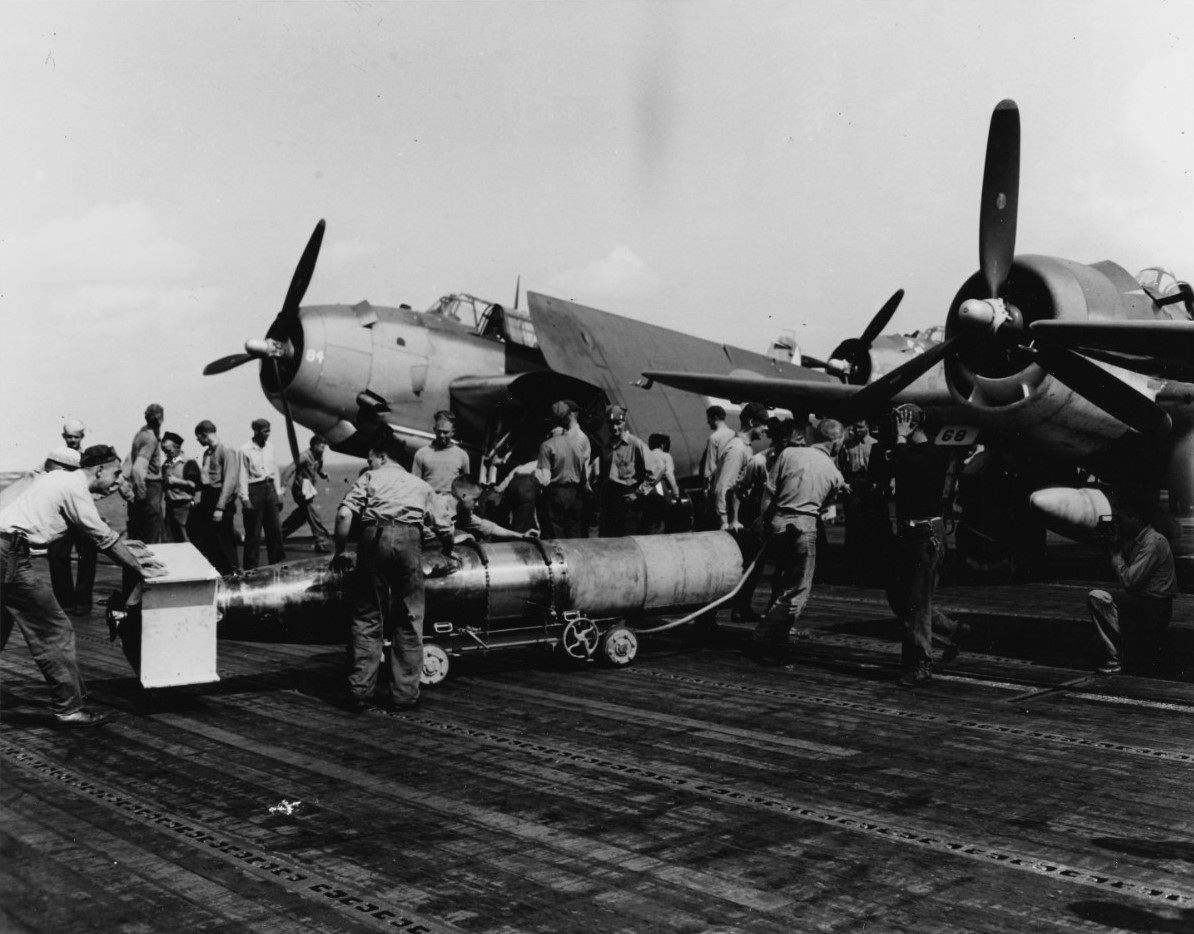
By the late 1930s, 156 Mark 13 Mod 0 torpedoes had been manufactured which was enough to provide two loads for each of the four 18-plane torpedo squadrons assigned to the pre-war carrier fleet plus a dozen spares. Mod 0 differed from later mods by having a rail-type tail in which the propellers were in front of the rudders. This was the only US torpedo to ever have this feature. The Newport Torpedo Station was unhappy with arrangement for reasons unknown and the Mod 1 entered service in 1940 with a conventional propeller arrangement, as can be seen in the photographs above. Unfortunately and unlike the Mod 0, the Mod 1 proved to be an unreliable weapon, with only one of ten torpedoes dropped by VT-6 during an exercise in July 1941 having a hot, straight and normal run. Of the others, four sank and could not be recovered while the other five experienced erratic runs.
These problems continued into the early war years, with a mid-1943 analysis of 105 torpedoes dropped at speeds in excess of 150 knots found that 36 percent ran cold (did not start), 20 percent sank, 20 percent had poor deflection performance, 18 percent gave unsatisfactory depth performance, 2 percent ran on the surface and only 31 percent gave a satisfactory run. The total exceeds 100 percent as many torpedoes had more than one defect. The early models were further handicapped by the need to drop them low and slow - typically 50 feet (15 m) and 110 knots which made the torpedo planes carrying them vulnerable to attack.
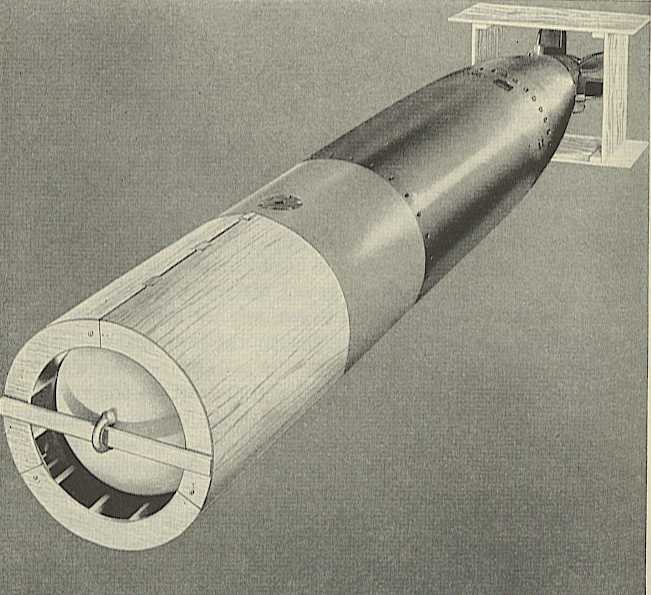
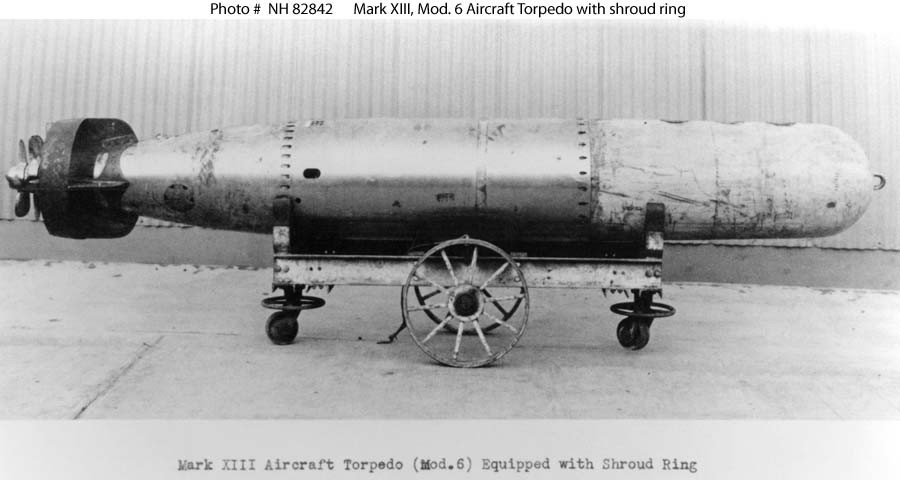
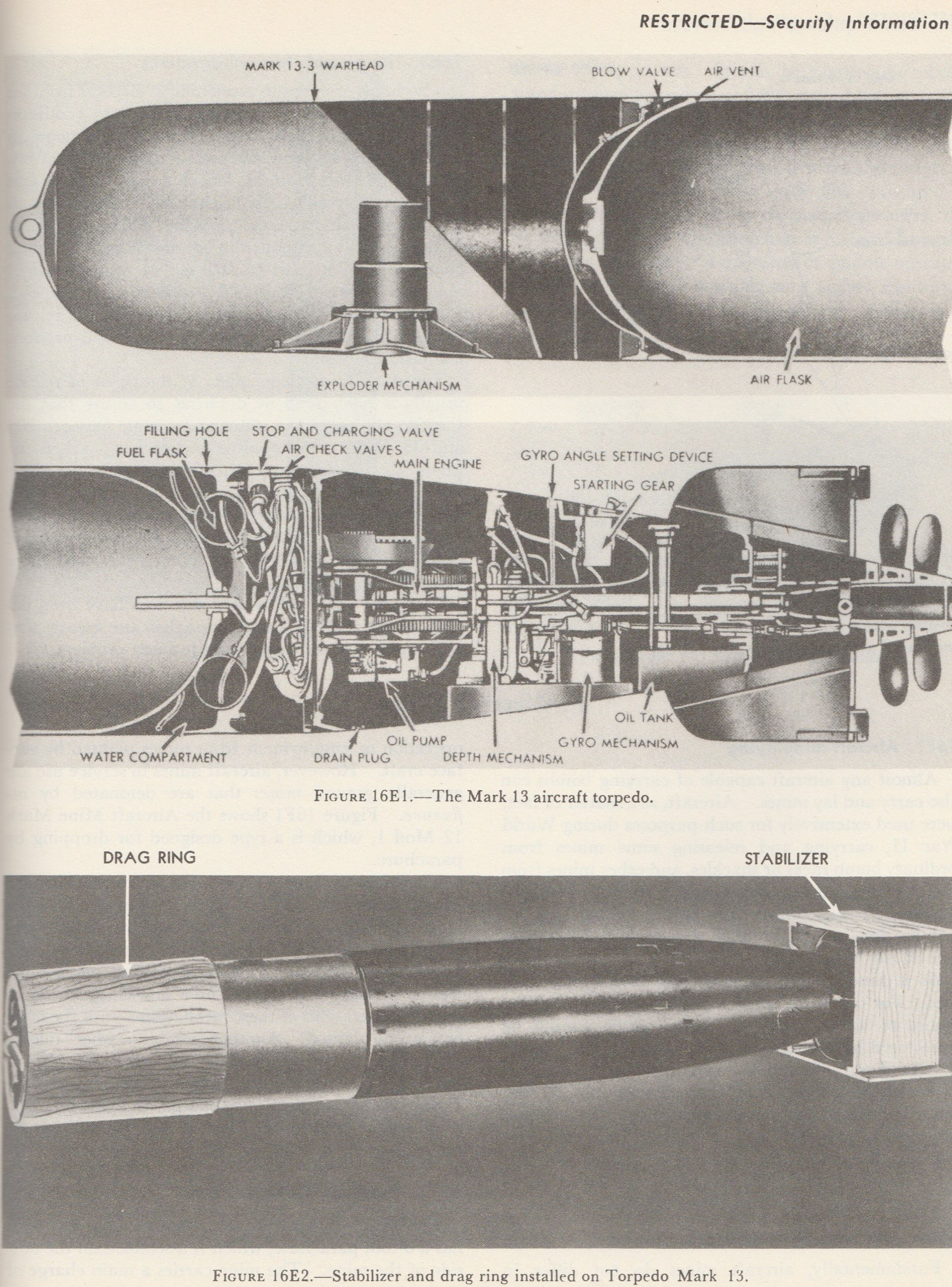
These problems were greatly reduced by the latter years of the war. Torpedoes had fin stabilizers, nose drag rings and tail shroud rings added, all of which worked to slow the torpedo after it was dropped so that it struck the water nose-first and at an acceptable speed. These improved the drop characteristics such that the recommended aircraft maximum launch parameters were increased to a height of 2,400 feet (730 m) and a speed of 410 knots.
A lanyard was attached to the tail of the torpedo. When dropped, the lanyard tripped a starting lever, but a water trip delay valve prevented the combustion flask from lighting off until the torpedo had entered the water. When dropped at 150 knots or more, the torpedo would enter the water at an angle of between 26 and 30 degrees. The water needed to be at least 150 feet deep (45 m) and the torpedo assumed its preset running depth after water travel of 300 yards (275 m). The exploder mechanism was armed after water travel of 200 yards (180 m). Depth could be set up to 50 feet (15 m).
The addition of the nose drag ring improved aerodynamic performance by stabilizing the torpedo in flight and reduced air speed by about 40 percent. It also acted as a shock absorber when the torpedo struck the water. The tail shroud ring improved the water run by reducing hooks and broaches and by eliminating much of the water roll which had characterized the earlier Mark 13s. Hot, straight and normal runs now approached 100 percent. To speed availability of the much improved torpedo, the Bureau of Ordnance had tail assemblies built with the shroud ring attached and then shipped these to the fleet for upgrading the existing inventory. By the fall of 1944, the modified torpedo was in general use by the front-line carrier units which were enthusiastic in their praise. On one occasion in early 1945, six torpedoes were dropped from altitudes between 5,000 and 7,000 feet (1,500 to 2,100 m). Five out of the six were observed to make their runs hot, straight and normal. By the end of the war, the USN considered the Mark 13 to be the best aircraft torpedo produced by any nation and it remained in service until 1951.
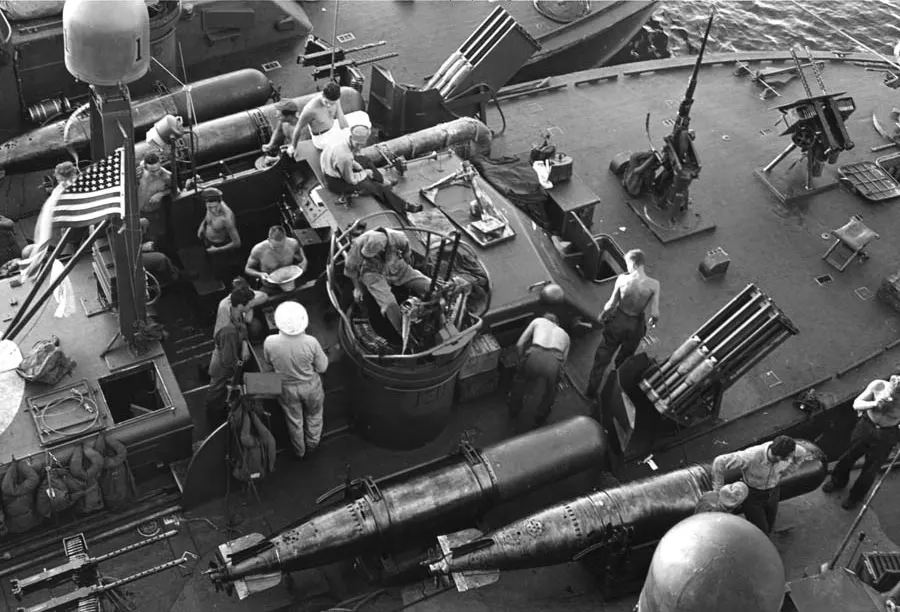
PT boats were originally armed with four Mark 8 torpedoes which used a heavy surface-ship torpedo tube to launch. In mid-1943, these started to be replaced with Mark 13 torpedoes which launched from a simple release mechanism. These freed up much weight which was used to give the PT boats a heavier gun armament.
The Mark 13 has the distinction of having been the last torpedo used by by the US Navy in combat and the world's last use of aerial torpedoes in combat (as of December 2010). On 1 May 1951, following the failure of conventional aerial attacks with bombs, the Navy decided to use torpedoes against the sluice gates of the Hwachon Dam, located on the Pukham River just north of the 38th parallel. The dam waters were being used by the North Koreans to aid their own troop movements and hinder those of the Allies. USS Princeton CV-37 sent five AD-4 and three AD-4N Skyraiders into action and these planes each launched a single Mark 13 torpedo against the dam. One torpedo was a dud and another ran erratic, but the other six blew open the flood gates, successfully ending the North Korean control of the river water.
A total of 17,000 Mark 13 torpedoes were produced during World War II.
Mod 1 - Improved tail, strengthened propellers, rudders moved in front of the propellers
Mod 2 - 40 knot experimental torpedo, development cancelled
Mod 2A - Mod 2 converted to 33.5 knots, water trip delay valve added to delay firing until water entry to prevent
turbine runaway when dropped from over 300 feet (910 m)
Mod 3 - External gyro setting added
Mod 4 - Experimental Model; 50 produced with strengthened after body
Mod 5 - Addition of water trip to Mod 1
Mod 6 - Addition of shroud ring to Mod 2A
Mod 7 - Addition of shroud ring to Mod 3
Mod 8 - Addition of shroud ring to Mod 4
Mod 9 - Addition of shroud ring to Mod 5
Mod 10 - Strengthened after body, shroud ring, suspension beam, gyro angle eliminated
Mod 11 - Mod 6 modified to accommodate suspension beam
Mod 12 - Mod 7 modified to accommodate suspension beam
Mod 13 - Mod 9 modified to accommodate suspension beam
From "US Naval Weapons" by Norman Friedman: This hit percentage is much too high, but illustrates the over claiming that was typical of all nation's pilots during the war.
Although not mentioned by Dr. Friedman, at least eight Japanese cruisers were struck by aircraft torpedoes during the war.
"A review of war experience showed a total of 1,287 attacks [this count only includes those launched by carrier-borne
aircraft, other US Navy aircraft launched another 150 torpedoes - TD], of which 40 percent (514) resulted in hits, including 50
percent hits on battleships and carriers (322 attacks, including Midway), 31 percent on destroyers (179 attacks), and 41 percent
(out of 445 attacks) on merchant ships."
| Ship Class Used On | Submarines |
|---|---|
| Date Of Design | 1930 |
| Date In Service | 1931 |
| Weight | Mod 0: 3,000 lbs. (1,361 kg)
Mod 3: 3,061 lbs. (1,388 kg) |
| Overall Length | 20 ft 6 in (6.248 m) |
| Explosive Charge | Mod 0: 507 lbs. (230 kg) TNT
Mod 3: 668 lbs. (303 kg) TPX |
| Range / Speed | All Mods: 4,500 yards (4,100 m) / 46 knots
Mod 0: 9,000 yards (8,200 m) / 31 knots Mod 3: 9,000 yards (8,200 m) / 30.5 knots |
| Power | Wet-heater steam turbine |
| Guidance | Mark 12 Mod 3 gyro |
Developed as a replacement for the Mark 10, this was the standard submarine torpedo of the World War II period. Modified versions stayed in US service until the 1970s. The 31 knot setting was rarely used during the war.
| Ship Class Used On | Destroyers and Atlanta (CL-51) Class Cruisers |
|---|---|
| Date Of Design | 1934 |
| Date In Service | 1935 |
| Weight | Mod 0: 3,438 lbs. (1,559 kg)
Mod 3: 3,841 lbs. (1,742 kg) |
| Overall Length | Mod 0: 22 ft 7 in (6.883 m)
Mod 3: 24 ft 0 in (7.315 m) |
| Negative Buoyancy | 1,260 lbs. (572 kg) |
| Explosive Charge | Mod 0: 494 lbs. (224 kg) TNT
Mod 3: 801 lbs. (363 kg) TNT or 823 lbs. (373 kg) HBX |
| Range / Speed | Mod 0:
6,000 yards (5,500 m) / 45 knots 10,000 yards (9.150 m) / 33.5 knots 15,000 yards (13,700 m) / 26.5 knots Mod 3:
|
| Power | Wet-Heater steam turbine |
| Guidance | Mark 12 Mod 3 gyro |
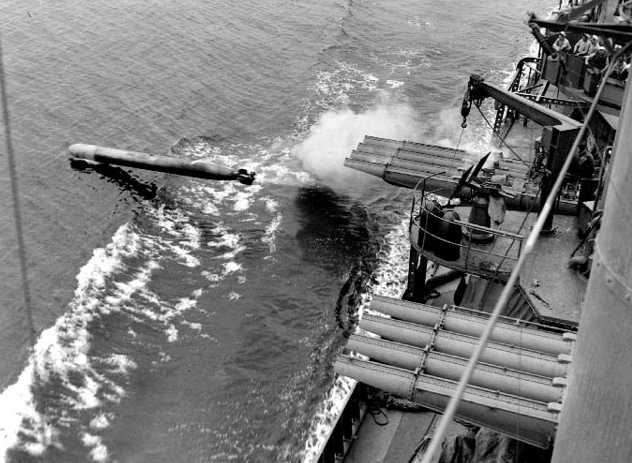
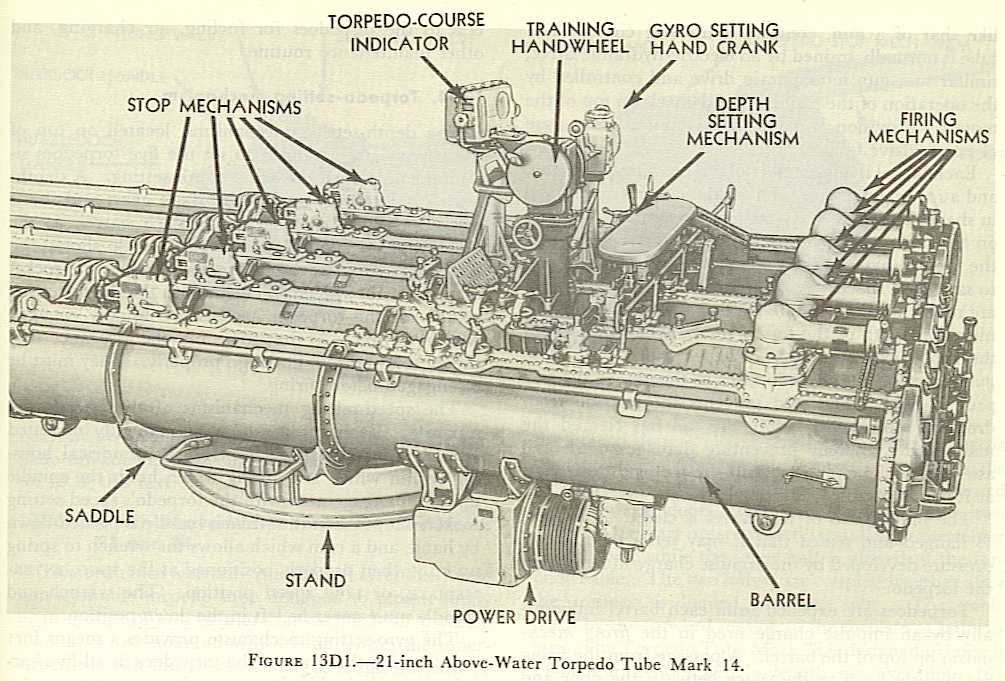
The standard destroyer weapon of World War II. Replaced the earlier Mark 11 and Mark 12. Remained in service as long as US destroyers carried 21" (53.3 cm) torpedo tubes. About 9,700 produced between 1940 and 1944.
| Ship Class Used On | Submarines |
|---|---|
| Date Of Design | 1944 |
| Date In Service | 1945 |
| Weight | Mod 0: 3,895 lbs. (1,766 kg)
Mod 1: 3,922 lbs. (1,799 kg) |
| Overall Length | 20 ft 6 in (6.248 m) |
| Explosive Charge | Mod 0: 1,260 lbs. (572 kg) TPX
Mod 1: 960 lbs. (435 kg) HBX |
| Range / Speed | Mod 0: 7,000 yards (6,400 m) / 46 knots
Mod 1: 11,500 yards (10,500 m) / 46 knots |
| Power | Hydrogen Peroxide (Navol) turbine |
| Guidance | Mark 12 Mod 3 gyro |
A high-performance but high-cost torpedo. Not used during the war but it remained in service until the mid-1970s. 1,700 produced.
| Ship Class Used On | Destroyers |
|---|---|
| Date Of Design | 1944 |
| Date In Service | 1945 |
| Weight | 4,800 lbs. (2,177 kg) |
| Overall Length | 24 ft 0 in (7.315 m) |
| Explosive Charge | 880 lbs. (399 kg) HBX |
| Range / Speed | 18,000 yards (16,500 m) / 46 knots |
| Power | Hydrogen Peroxide (Navol) turbine |
| Guidance | Mark 12 Mod 3 gyro |
Destroyer equivalent of the Mark 16. Development dropped in 1941, resumed in 1944 with 450 produced before the end of World War II. Not used in combat and removed from service in 1950.
| Ship Class Used On | Submarines |
|---|---|
| Date Of Design | 1943 |
| Date In Service | 1944 |
| Weight | Mod 0: 3,041 lbs. (1,379 kg)
Mod 2: 3,061 lbs. (1,388 kg) |
| Overall Length | 20 ft 6 in (6.225 m) |
| Explosive Charge | Mod 0: 600 lbs. (272 kg) TPX
Mod 1: 595 lbs. (270 kg) TPX or HBX |
| Range / Speed | 4,000 yards (3,650 m) / 29 knots |
| Power | Electric Battery |
| Guidance | Mark 12 Mod 3 gyro |
The Westinghouse version of the captured German G7e. Had the advantage of being trackless and only requiring about 70% of the labor needed to build a wet-heater torpedo. However, its poor performance and design flaws led to it being discarded in 1950 in favor of the Mark 14 and Mark 16. Until new guide studs were placed in the tubes, the Mark 18 was susceptible to damage upon launch because it accelerated much faster than did the conventional steam-powered torpedoes. By the end of the war, the Mark 18 made up 65 percent of all torpedoes fired by submarines. 8,500 produced.
An improved version of the Mark 18 under development in 1945 by Westinghouse, but abandoned in favor of the Mark 26. Range was 4,000 yards (3,660 m) at 29 knots. A total of ten were built.
Another improved version of the Mark 18 under development in 1945, but also abandoned in favor of the Mark 26. Range was 3,500 yards (3,200 m) at 33 knots. A total of twenty were built.
| Ship Class Used On | Aircraft |
|---|---|
| Date Of Design | 1944 |
| Date In Service | 1955 |
| Weight | 2,130 lbs. (966 kg) |
| Overall Length | 13 ft 5 in (4.089 m) |
| Explosive Charge | 350 lbs. (159 kg) TPX |
| Range / Speed | 6,300 yards (5,800 m) / 33.5 knots |
| Power | Steam Turbine |
| Guidance | Passive Acoustic Homing |
Originally a 25 knot electric anti-ship torpedo, but Mod 2 with turbine power was adopted for a homing version. This was unsuccessful until post-war modifications. Not in service until used as the payload for the Petrel AS Missile in 1955.
| Ship Class Used On | Submarines |
|---|---|
| Date Of Design | 1943 |
| Date In Service | 1944 |
| Weight | 3,060 lbs. (1,388 kg) |
| Overall Length | 20 ft 6 in (6.225 m) |
| Explosive Charge | N/A |
| Range / Speed | 4,000 yards (3,650 m) / 29 knots |
| Power | Electric Battery |
| Guidance | Passive Acoustic Homing |
A Bell/Westinghouse torpedo. Work started in 1944 but abandoned in 1945 in favor of the Mark 35. Two prototypes built.
| Ship Class Used On | Aircraft |
|---|---|
| Date Of Design | 1941 |
| Date In Service | 1943 |
| Weight | 680 lbs. (308 kg) |
| Overall Length | 7 ft 0 in (2.134 m) |
| Explosive Charge | 92 lbs. (42 kg) TPX or HBX |
| Range / Speed | 4,000 yards (3,660 m) / 12 knots |
| Power | Electric Battery |
| Guidance | Passive Acoustic Homing |
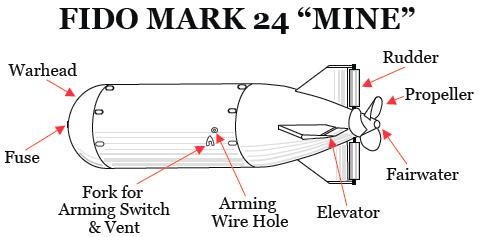
A very small anti-submarine homing torpedo. Also known as the Mark 24 Mine and as "Fido." Homing was by four crystal hydrophones arranged around the body with simple guidance system that steered towards the loudest noise. Launch parameters were 125 knots from 250 feet (76 m).
The following is from "US Navy Torpedoes" by Frederick J. Milford:
"340 [Fido] torpedoes [were] dropped in 264 attacks of which 204 were against submarines. In 142 attacks US aircraft sank 31 submarines and damaged 15; in 62 attacks against submarines other Allies, mainly British, sank six and damaged three. Most of these submarine sinkings were German U-boats in the Atlantic, but five Japanese submarines were sunk by Fidos, one, I-52, in the Atlantic and four in the Pacific. OEG Study No. 289, 12 August 1946, is the main source for this conclusion."
Fido was first used successfully by a British B-24 Liberator defending Convoy HX 237 on 12 May 1943, sinking U-456. This was followed by a USN PBY-5A from VP 84 which sank U-640 on 14 May 1943.
Fido would have been too slow to attack the Type XXI U-boats and could be avoided by going very deep.
| Ship Class Used On | Aircraft |
|---|---|
| Date Of Design | 1945 (see Notes) |
| Date In Service | Not in service |
| Weight | 2,306 lbs. (1,046 kg) |
| Overall Length | 13 ft. 5 in (4.089 m) |
| Negative Buoyancy | about 523 lbs. (237 kg) |
| Explosive Charge | 725 lbs. (329 kg) TPX |
| Range / Speed
(See Note on Sources) |
2,500 yards (2,300 m) / 40 knots |
| Power | Wet-heater steam turbine |
| Guidance | Mark 12 Mod 3 gyro |
An airborne wet-heater torpedo intended as a replacement for the Mark 13. Had the same dimensions as the earlier torpedo but had a more powerful, high temperature turbine that gave it much greater speed. Under development in 1945 but never mass produced because of large postwar stocks of other torpedoes.
Note on Sources: "Ship Killers" gives two different ranges for the 40 knot speed. I believe that the one given above to be correct and the other to be a misprint.
| Ship Class Used On | Submarines |
|---|---|
| Date Of Design | 1945 |
| Date In Service | Not in service |
| Weight | 3,200 lbs. (1,451 kg) |
| Overall Length | 20 ft. 6 in (6.248 m) |
| Negative Buoyancy | N/A |
| Explosive Charge | 900 - 1,000 lbs. (408 - 454 kg) TPX |
| Range / Speed | 6,000 yards (6,560 m) / 40 knots |
| Power | Seawater battery |
| Guidance | Gyro |
Designed as an improved Mark 18 torpedo with a seawater battery. Used electric "on-off" steering and depth control. First torpedo to use an explosive impulse start gyro. Twenty development models were built. Development halted in favor of the Mark 16.
| Ship Class Used On | Submarines |
|---|---|
| Date Of Design | 1941 |
| Date In Service | 1943 |
| Weight | Mod 0: 720 lbs. (327 kg)
Mod 4: 1,175 lbs. (533 kg) |
| Overall Length | Mod 0: 7 ft 6 in (2.286 m)
Mod 4: 10 ft 6.75 in (3.219 m) |
| Explosive Charge | Mod 0: 95 lbs. (43 kg) TPX or HBX
Mod 4: 128 lbs ( 58 kg) HBX |
| Range / Speed | Mod 0: 5,000 yards (4,570 m) / 12 knots
Mod 4: 6,200 yards / 15.9 knots |
| Power | Electric Battery |
| Guidance | Passive Acoustic Homing |
A variation of the airborne Mark 24 adapted for submarine use by Bell Laboratory. It was a passive homer intended for self-defense against ASW escorts. Used only against the Japanese. The Mark 27 Mod 4 was a larger version developed by the Ordnance Research Laboratory at Pennsylvania State College that was in service from 1946 to 1960. About 1,100 Mod 0 units were manufactured by Western Electric while about 3,000 Mod 4 were built. Nicknamed "Cutie."
| Ship Class Used On | Submarines |
|---|---|
| Date Of Design | 1943 |
| Date In Service | 1945 |
| Weight | 2,800 lbs. (1,270 kg) |
| Overall Length | 20 ft 6 in (6.248 m) |
| Explosive Charge | 585 lbs. (265 kg) HBX |
| Range / Speed | 4,000 yards (3,650 m) / 19.6 knots |
| Power | Electric-Battery, seawater |
| Guidance | Passive acoustic |
A passive homing torpedo developed from the Mark 18 which in turn was developed from captured German G7e torpedoes. The USN considered motor and gear noises to be the most troublesome problem with the homing torpedoes, unlike the Germans, who regarded propeller noises as the worst problem. The Mark 18 was not a quiet design, so the Mark 28 used only one propeller and eliminated the tail gearing. There were four hydrophones on the curved part of the nose. In production from 1944-52 and remained in service until 1960.
| Ship Class Used On | Submarines |
|---|---|
| Date Of Design | 1944 |
| Date In Service | Not in service |
| Weight | 3,200 lbs. (1,452 kg) |
| Overall Length | 20 ft 6 in (6.248 m) |
| Explosive Charge | 550 lbs. (249 kg) HBX |
| Range / Speed | 12,000 yards (10,970 m) / 21 knots
4,000 yards (3,660 m) / 28 knots |
| Power | Electric-Battery |
| Guidance | Passive acoustic |
Another passive homer developed from the Mark 18 with a two-speed contra-rotating motor directly driving the propellers. Three prototypes were built but the program was not successful and was cancelled at the end of World War II.
| Ship Class Used On | Submarines |
|---|---|
| Date Of Design | 1944 |
| Date In Service | Not in service |
| Weight | about 3,200 lbs. (1,452 kg) |
| Overall Length | 20 ft 6 in (6.248 m) |
| Explosive Charge | 600 lbs. (272 kg) HBX |
| Range / Speed | 4,000 yards (3,660 m) / 29 knots |
| Power | Electric-Battery |
| Guidance | Passive acoustic |
A wake-follower project of 1944-46, this did not enter service.
There was also a Mark 30 mine, which was actually a small, surface-ship launched torpedo intended as an alternative to the Mark 24 mine/torpedo, but this project was cancelled in 1942.
"The Mark 9 Torpedo Exploder Mechanism: A Contact-Influence Successor to the Mark 14 MOD 6 During WWII" in The Submarine Review October 2009  by Victor S. Alpher
"Torpedo: The Complete History of the World's Most Revolutionary Naval Weapon" by Roger Branfill-Cook
"Naval Weapons of World War Two" by John Campbell
"US Naval Weapons" by Norman Friedman
"U.S. Navy Bureau of Ordnance in World War II" by Lt. Cmdr. Buford Rowland, USNR, and Lt. William B. Boyd, USNR
"Ship Killers: A History of the American Torpedo" by Thomas Wildenberg and Norman Polmar
---
"United States Navy Torpedoes Mark 13 and Mark 13 Modification 1 and 2 - Ordnance Pamphlet No. 629A" by Bureau of Ordnance
---
"Six Decades of Guided Munitions" by Barry D. Watts, Center for Strategic & Budgetary Assessments, presented at the NDIA 2006 Precision Strike Association
"British Military Aviation in 1943" on line at RAF Museum
"US Navy Torpedoes" by Frederick J. Milford on line at Full Fathom Five
"A Brief History of U.S. Navy Torpedo Development" by E.W. Jolie
13 August 2008 - Benchmark
19 December 2010 - Updated data tables to include guidance systems and other information
10 November 2014 - Additional information
05 October 2019 - Converted to HTML 5 format, added Mark 26 torpedo, minor changes to other data
23 December 2020 - Corrected typographical error
17 May 2021 - Added photograph of Mark 13 Mod 6 torpedo
13 August 2022 - Added cut-away view of Mark 13 torpedo
09 May 2023 - Added information on exploders for the Mark 13 and corrected typographical error
13 August 2024 - Added use of Mark 13 by PT Boats