
Officially designated as the 12-in 'A' to conceal the increase in caliber size from the 12"/50 (30.5 cm) guns used on previous ships, this was the largest dreadnought battleship gun in the world at the time of its introduction. A Vickers design, these guns are sometimes suffixed as Mark V(L) and Mark V(H), which signified the weight of the projectiles fired. See below for further details.
The failure of the high-velocity 12"/50 (30.5 cm) Mark XI led to a reconsideration of how to achieve an increase in the destructive power of naval guns. As a result, instead of simply raising the muzzle velocity as had been done in the past, the Admiralty now decided to maximize the weight of the projectiles by increasing the gun caliber. In October 1908 the Admiralty requested Vickers to quote on new designs for 13" (33 cm), 13.5" (34.3 cm) and 14" (35.6 cm) guns. Part of the design requirements for these weapons was that their projectiles were to have the same nominal residual velocity of 1,640 fps (500 mps) at 8,000 yards (7,320 m) as did projectiles from the 12"/45 (30.5 cm) Mark X. The 13.5" (34.3 cm) design was selected in January 1909 and the first prototype was fired at Shoeburyness late that same year.
The greater momentum inherent in a heavier projectile means that it does not loose its velocity as quickly as does a lighter projectile. So, although the muzzle velocity of the 13.5" (34.3 cm) gun was equal to that of the 12"/45 (30.5 cm) Mark X and less than that of the 12"/50 (30.5 cm) Mark XI, the striking velocity and penetration power of the new gun at long ranges was much greater than that of either of the two smaller guns.
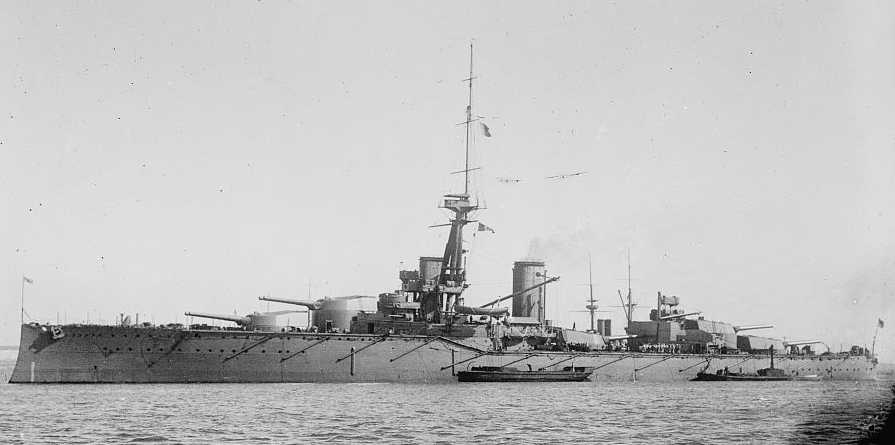
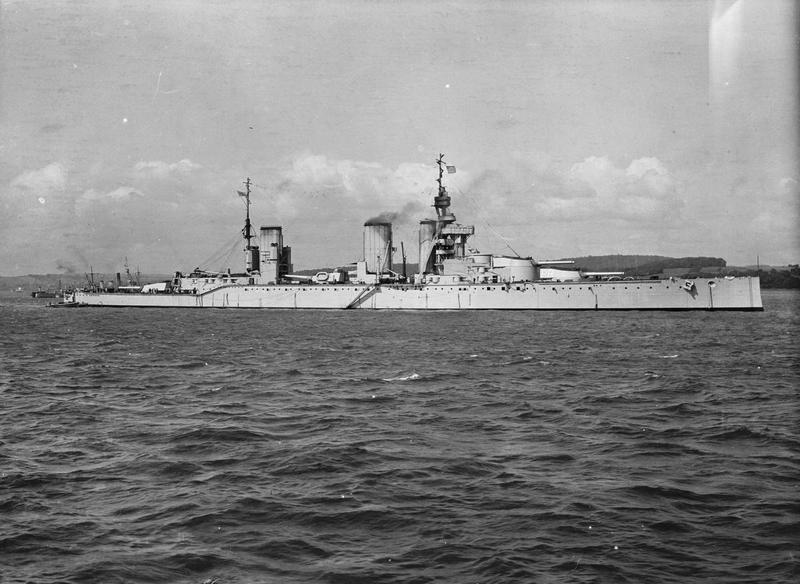
HMS Orion was the first ship armed with these weapons and was the first British dreadnought with all mountings on the centerline and with superfiring turrets fitted on the bow. These new 13.5" (34.3 cm) guns were found to be very reliable and accurate in service with exceptionally low barrel wear. As the design had been given a considerable safety margin, it was decided that later ships could use a heavier shell to increase their hitting power still further. No changes were made to the guns themselves to fire the heavier projectiles, the changes were limited to the shell handling equipment and hoists in the mountings. The guns and mountings were subsequently designated as "L" (Light) and "H" (Heavy) to indicate the type of shell they fired.
Although these guns had a maximum elevation of 20 degrees, as built the prisms in the director and turret sights were only good to slightly over 15 degrees. This was because prior to World War I it was expected that battles would be fought at relatively short ranges and thus the advantages of firing beyond 15,000 yards (13,700 m) were not appreciated. Auxiliary prisms that could be attached to the existing sights and which gave an extra 6 degrees of elevation were produced during World War I, but many ships still lacked these as late as the Battle of Jutland (Skagerrak).
At Dogger Bank two 13.5" (34.3 cm) APC projectiles hit German armor of 30 cm (12") without penetrating. A third shell of this caliber hit Seydlitz on her 23 cm (9") barbette armor at an angle of 33 degrees to the normal. Although this burst without any splinters entering the ship, flash and spalled armor fragments ignited 62 propellant charges and this fire burned out both stern turrets, killing 165 crewmen. Seydlitz was hit again by a 13.5" (34.3 cm) projectile almost the same way during the Battle of Jutland (Skagerrak) and this again holed the armor but was kept out except for flash which ignited four charges.
The "steel choke" problem first found on the 12"/35 (30.5 cm) Mark VIII guns was finally fixed in the later production units of these guns by the introduction of a slow taper fit between the inner A and A tubes. The locating shoulders, which in the earlier guns were well forward and overly concentrated longitudinal stress towards the muzzle, were moved well back in the new guns.
These guns were of the standard wire-wound construction and the first 67 of the 206 guns produced still had the forward locating shoulders and lacked the taper fit. 54 guns were still in existence in 1939 and 12 of them had fired less than 20 EFC. There were also six turrets removed from HMS Tiger and HMS Iron Duke which had been placed in storage at Rosyth. During World War II three of these guns were used as railway artillery in the Dover area and were supplied with super charges. A further three guns were relined to 8" (20.3 cm) as a "not very successful super-velocity gun - a remarkable waste of effort" (John Campbell).
In 1938 the British Government granted Turkey a £6 million credit to be used for buying armaments from Britain. The Turks ordered four destroyers and four submarines plus their armaments with part of this credit. In addition, the Turkish Government wished to modernize the coast defenses along the Dardanelles and requested to purchase 15" (38.1 cm) guns for this project. The Admiralty resisted this request and instead offered to sell three of the 13.5" (34.3 cm) twin mountings in storage along with ten guns and their ammunition. This was approved by both Governments in March of 1939 and Vickers-Armstrong was given a contract to recondition the mountings - this reconditioning was to leave the maximum elevation at 20 degrees. APC and CPC shells were still available but new propellant charges were needed. The contract stated that the first mounting was to be delivered in 15 months and the last in 24 months, which would have been March 1941. War intervened, slowing delivery and causing problems with transporting the mountings and guns to Turkey. As a result, the Turks lost interest in obtaining them and eventually all guns and mountings were scrapped post-war.
| Designation | 13.5"/45 (34.3 cm) Mark V(L)
13.5"/45 (34.3 cm) Mark V(H) |
|---|---|
| Ship Class Used On 1 | (L): Orion class, Lion and Princess Royal
(H): King George V class, Iron Duke class, Queen Mary 2 and Tiger |
| Date Of Design | 1909 |
| Date In Service | 1912 |
| Gun Weight | Without Breech: 167,776 lbs. (76,102 kg) |
| Gun Length oa | 625.9 in (15.900 m) |
| Bore Length | 607.5 in (15.431 m) |
| Rifling Length | 509.6 in (12.943 m) |
| Grooves | 68 |
| Lands | N/A |
| Twist | Uniform RH 1 in 30 |
| Chamber Volume | 19,650 in3 (322.0 dm3) |
| Rate Of Fire | 1.5 - 2 rounds per minute |
- ^As no spare Mark VI guns had been manufactured, one Mark V(H) gun was carried by HMS Erin for a short period while one of her guns was being relined.
- ^A note on Sources: "Naval Weapons of World War One" mistakenly says that Queen Mary carried "(L)" guns but all other sources say that she carried "(H)" guns. This and all other sources agree that she carried the BII* mountings, which were used only with "(H)" guns.
- Vickers original price including delivery to Woolwich was £11,400 for the gun and £1,250 for the breech mechanism.
| Type | Bag |
|---|---|
| Projectile Types and Weights 1a 2a | Light 3a APC Mark IIa: 1,266.5 lbs. (574.5 kg) APC Mark IVa (Greenboy) 4a - 1,257 lbs. (570.2 kg) APC 8/16crh: 1,250 lbs. (567.0 kg) CPC Mk Ia: 1,250 lbs. (567.0 kg) HE Mk Ia: 1,250 lbs. (567.0 kg) Shrapnel: 1,250 lbs. (567.0 kg) Heavy
Railway Projectile
|
| Bursting Charge | Light
APC Mark IIa: 40 lbs. (18.1 kg) Lyddite APC Mark IVa: 29.5 lbs. (13.4 kg) Shellite APC 8/12crh: N/A [probably 29.5 lbs. (13.4 kg) Shellite] CPC Mark Ia: 117.4 lbs. (53.3 kg) Black Powder HE Mark Ia: 176.5 lbs. (80.1 kg) Lyddite 5a Heavy
|
| Projectile Length 2a | Light
N/A Heavy
|
| Propellant Charge - Ships | APC (Light): 293 lbs. (133 kg) MD45
APC (Heavy): 297 lbs. (135 kg) MD45 |
| Propellant Charges - Railway | Standard Charge
299 lbs. (135.6 kg) SC 280 Super Charges 6a |
| Muzzle Velocity - standard charges 7a 8a | APC (Light) New gun: 2,582 fps (787 mps)
APC (Light) Average gun: 2,550 fps (777 mps) APC (Heavy) New gun: 2,498 fps (761 mps)
|
| Muzzle Velocity - super charges 6a | APC (Light): 2,950 fps (899 mps)
APC (Heavy): 2,830 fps (863 mps) |
| Working Pressure | Light - 18 tons/in2 (3,150 kg/cm2)
Heavy: 20 tons/in2 (2,835 kg/cm2) |
| Approximate Barrel Life | Light: 450 rounds
Heavy: 300 - 350 rounds |
| Ammunition stowage per gun 9a | Orion, Lion, Queen Mary and Tiger classes: 80 rounds
King George V class: 100 rounds Iron Duke: 100 rounds |
- ^Projectiles were nominally 4crh. The railway guns used a new 1,250 lbs. (567 kg) AP shell of 8/16crh which achieved a much greater range.
- ^2.12.2There were as many as five different vendors for these munitions - Hadfield, Vickers, Firth's, E.O.C. and Cammell Laird - each producing a slightly different projectile from the others. Their APC projectiles had the same burster and total weights, but differed in internal design and had AP caps of different designs and weights. The projectile lengths given above are average numbers.
- ^Although most secondary sources quote a 1,250 lbs. (567.0 kg) weight for the "Light" APC, both the APC Mark IIa (pre-Greenboy) and the APC Mark IVa (Greenboy) actually weighed more than this value as can be seen in the table above. My supposition for this discrepancy is that, like the earlier 12-inch APC Mark VIa, the 13.5-inch APC Mark IIa was originally designed as a 2crh projectile but was later redesigned and changed the ballistic cap to 4crh. This changeover was apparently performed before any of the ships were commissioned.
- ^"Greenboys" were issued starting in 1918.
- ^5.15.2HE shells with Lyddite bursters were withdrawn from service after the Jutland (Skagerrak) battle as it was found that they were inadequate against ships and their Mark 13 fuze could detonate if it suffered a hard knock in handling. They were still issued for ships participating in shore bombardments but the crews were warned not to store them in the turret or working chamber. It has been speculated that when HMS Audacious exploded after capsizing that the cause was an HE shell falling out of its bin and landing on its nose fuze.
- ^A Note on Sources: The published works cited below disagree as to the muzzle velocity for these guns. I have chosen to use those values given in "British Naval Guns 1880-1945 No 2."
- ^When worn and due for replacement, the Mark V(L) gun had a muzzle velocity of 2,100 fps (640 mps).
- ^Ammunition storage given above are the design figures. When the war started the outfit was increased to about 110 rounds per gun in most ships at least partly by stowing "Ready Rounds" in the turrets and handling rooms. Lion was originally given 24 APC, 28 CPC, 28 HE and 6 shrapnel or 86 rounds total per gun. During the early part of the war, this was changed to 110 rounds per gun of 33 APC, 38 CPC and 39 HE. By the time of Jutland (Skagerrak), she carried 66 APC, 22 CPC and 22 HE. The final war outfit was 77 APC (Greenboys) and 33 CPC per gun. The outfits for the other 13.5" (34.3 cm) battlecruisers had similar changes. I do not have the breakdown for battleships, but they were probably similar to the earlier Bellerophon class which upon completion carried 24 APC, 40 CPC and 16 HE per gun.
- Heavy APC rounds were priced at £142 each in 1938.
| Elevation | Range | Striking Velocity | Time of Flight | Angle of Fall | Maximum Ordinate |
|---|---|---|---|---|---|
| 2.42 degrees | 5,000 yards (4,570 m) | 2,117 fps (645 mps) | 6.48 seconds | 2.73 degrees | 168 feet (51.2 m) |
| 5.55 degrees | 10,000 yards (9,140 m) | 1,760 fps (536 mps) | 14.28 seconds | 7.08 degrees | 820 feet (250 m) |
| 9.64 degrees | 15,000 yards (13,720 m) | 1,487 fps (453 mps) | 23.80 seconds | 12.78 degrees | 2,296 feet (700 m) |
| 14.78 degrees | 20,000 yards (18,290 m) | 1,332 fps (406 mps) | 34.98 seconds | 22.73 degrees | 4,986 feet (1,520 m) |
| 15.36 degree 4b | 20,500 yards (18,745 m) | 1,323 fps (403 mps) | 36.20 seconds | 23.72 degrees | 5,320 feet (1,622 m) |
| 20.00 degrees 5b | 23,820 yards (21,780 m) | N/A | N/A | N/A | N/A |
- ^Data from Range Table No. 55, Dated 1913, courtesy of Neil Stirling. Additional data from Data from "Shell Committee: Reports 1917 and 1918" ADM 186/169.
- ^Charges were adjusted to give an MV of 2,852 fps (869 mps) at 80 degrees F in a new gun using proof shot.
- ^The temperature correction per 10 degrees F (6 degrees C) change was 18 fps (5.5 mps).
- ^This is the maximum gun elevation found in Range Table No. 55.
- ^This range from "Shell Committee: Reports 1917 and 1918" ADM 186/169 which agrees with Range Table No. 55 for the shorter ranges.
| Elevation | Range | Striking Velocity | Time of Flight | Angle of Fall | Maximum Ordinate |
|---|---|---|---|---|---|
| 2.48 degrees | 5,000 yards (4,570 m) | 2,117 fps (645 mps) | 6.48 seconds | 2.75 degrees | 169 feet (51.5 m) |
| 5.61 degrees | 10,000 yards (9,140 m) | 1,783 fps (543 mps) | 14.30 seconds | 7.03 degrees | 820 feet (250 m) |
| 9.64 degrees | 15,000 yards (13,720 m) | 1,524 fps (465 mps) | 23.65 seconds | 13.42 degrees | 2,251 feet (686 m) |
| 14.75 degrees 4c | 20,000 yards (18,290 m) | 1,365 fps (416 mps) | 34.72 seconds | 22.00 degrees | 4,903 feet (1,494 m) |
| 20.00 degrees 5c | 23,820 yards (21,780 m) | N/A | N/A | N/A | N/A |
- ^Data from Range Table No. 50, Dated 1913, courtesy of Neil Stirling. Additional data from "Shell Committee: Reports 1917 and 1918" ADM 186/169.
- ^Charges were adjusted to give an MV of 2,498 fps (761 mps) at 80 degrees F in a new gun using proof shot.
- ^The temperature correction per 10 degrees F (6 degrees C) change was 12.5 fps (3.8 mps).
- ^This is the maximum gun elevation found in Range Table No. 50.
- ^This range from "Shell Committee: Reports 1917 and 1918" ADM 186/169 which agrees with Range Table No. 50 for the shorter ranges.
| Elevation | Range with Supercharges |
|---|---|
| 40 degrees | 48,900 yards (44,700 m) |
Ranges with standard charges for the older 1,250 lbs. (567 kg) 4crh shells would be equivalent to those given in the 1,250 lbs. (567 kg) range table.
| Elevation | Range with Supercharges |
|---|---|
| 40 degrees | 40,600 yards (37,120 m) |
Ranges with standard charges for the 1,400 lbs. (635 kg) shells would be equivalent to those in the 1,400 lbs. (635 kg) range table.
| Range | KC-type Side Armor | Deck Armor | Striking Velocity |
|---|---|---|---|
| 0 yards (0 m) | 17.3" (439 mm) | --- | 2,700 fps (823 mps) |
| 10,000 yards (9,144 m) | 12.2" (310 mm) | --- | 1,900 fps (579 mps) |
| Range | KC-type Side Armor | Deck Armor | Striking Velocity |
|---|---|---|---|
| 0 yards (0 m) | 17.3" (439 mm) | --- | 2,500 fps (762 mps) |
| 10,000 yards (9,144 m) | 12.5" (318 mm) | --- | 1,850 fps (564 mps) |
- Data in both tables is from "British Battleships of World War Two."
- The penetration figures in these tables are for an uncapped AP shell striking the plate at 90 degrees, i.e., with the axis of the shell perpendicular to the face of the plate. A capped shell would give about 10 to 20% improvement at low velocities and about 30 to 50% at high velocities.
- Note that the muzzle velocity for these tables is much higher than that given in most references. For that reason, I believe that these to be proofing values and not what would be achieved in service.
- It should be noted here that British APC projectiles before the introduction of the "Greenboy" design were prone to breaking up and suffering premature detonation upon striking thick armor plates.
| Designation 1e | Two-gun Turrets
Orion [except Conqueror] (5), Lion (4) and Princess Royal (4): Mark II 2e Queen Mary (4) and King George V [except Ajax] (5): Mark II* Iron Duke [except Benbow] (5) and Tiger (4): Mark II** 3e Conqueror (5): Mark III 4e Ajax (5): Mark III* 4e Benbow (5): Mark III** 4e |
|---|---|
| Weight | Mark II: 600 tons (610 mt)
Others: N/A |
| Elevation 5e | Ships: -3 / +20 degrees
Railway: 0 / +40 degrees |
| Rate of Elevation | Mark II and Mark II*: 3 degrees per second
Mark II**, Mark III and Mark III*: 5 degrees per second |
| Train 6e 7e | Forward and aft turrets: about -150 / +150 degrees
Q turret: about 30 to 150 degrees on either side |
| Rate of Train | 2 degrees per second |
| Gun Recoil | N/A |
| Loading Angle | Any 8e |
- ^Guns in all mountings were individually sleeved. Mountings with a single asterisk (*) after the Mark Number indicate that they were modified to handle the 1,400 lbs. (567 kg) projectiles. Mountings with a double asterisk (**) after the Mark number indicate a further modification to increase the elevation speed by enlarging the elevation cylinder. These mountings were equipped with the newly invented swashplate training engine which gave them smoother training movements. Two 7-cylinder swash plate engines were provided for each mounting.
- ^The Mark II turrets were very similar to the previous BXI mountings used for the 12"/50 (30.5 cm) guns of the St. Vincent class. As the designers of the Mark II mounts kept approximately the same dimensions as those for the BXI, the Mark II mounts were cramped and compromises in shell handling were accepted. For example, the projectiles in the Mark II were hoisted at a 38 degree angle in order to maintain about the same hoist dimensions as in the earlier mounting, although the projectiles entered and exited the cage hoist horizontally. Auxiliary supply propellant was eliminated and in their place were secondary projectile and cage hoists outboard of the guns. Stowage for eight rounds per gun were provided in the Mark II and II* gunhouse, with two powered derricks provided to lift the shells. These derricks also lifted shells from the secondary supply hoists mentioned above. Bins for six rounds per gun were arranged in the working chamber below the gunhouse and an emergency shell and cordite supply route was built into the main trunk. The main hoists combined the projectile and propellant cages such that when at the lowest level, the shell cages were in line with the shell bogies in the shell room and the propellant cage was in line with the cordite hoppers in the magazine. When the cage reached the working chamber, the projectile and propellant cartridges were automatically tipped onto loading trays where powered rammers pushed them into the gunloading cage. The Mark II* had improved chain rammers and breech mechanisms and a new type of shell room bogie was introduced that eased moving shells from storage into the hoists. Previously, shells were simply rolled over to the hoists.
- ^The Mark II** turrets had a wider hoist trunk which allowed the shells to be hoisted horizontally.
- ^4.14.24.3The Mark III series turrets were the first large-caliber mountings to be designed by the Coventry Ordnance Works. These differed considerably from the Elswick and Vickers designs with the main differences in the elevating hydraulics, the gun loading cage and hoist, the training engine, the rammer control, the depression control and the shield. In these mountings, the hydraulic cylinder worked directly on the slide and two seven-cylinder engines replaced the swashplate. The shells were hoisted horizontally from the magazines to the handling room, but they were hoisted inclined in the upper hoist as in the Mark II. It is noted in "The Big Gun" that the ammunition supply arrangements reflected the inexperience of the Coventry designers and that this resulted in more hand work being necessary than in the Mark II mountings. From "British Naval Gun Mountings:"
An official manual criticized the gun loading cages: "The whole system is heavy and clumsy and involves many almost unavoidable accidents during loading."
These problems were almost certainly the result of the Admiralty specifically requiring that Coventry was not to get technical help from the more experienced firms of Armstrong and Vickers but were instead to use their own designs.
The differences between the Mark III, Mark III* and Mark III** mountings are not known at this time, but presumably the latter versions were fixes for some of the problems found with the Mark III. Coventry made only eight more heavy mountings, which were all copies of the Elswick 15-inch (38.1 cm) design.
- ^As built the prisms in the director and turret gunsights controlling these mountings allowed ranging only up to an elevation of +15' 21". By the time of Jutland (Skagerrak), some ships had been given removable "super elevation" prisms that increased the usable elevation by 6 degrees and which could be attached to the existing director sights and to the center position turret sights, but this process was not completed until 1917.
- ^The turrets on these ships used sighting periscopes in small, open hoods in place of the open sights used on earlier ships. This was an improvement first prototyped on HMS Neptune. 'A' turret on HMS Tiger was to an experimental design whereby the two sighting hoods for the gunlayers were replaced by armored horizontal periscope sight ports on the turret sides. The center sighting hood used by the turret trainer was left in place. These side ports were not repeated on later ships as it was found that they wooded earlier than the sighting periscopes on the roof.
- ^"Q" turret on Tiger was in a more favorable position which increased its firing arc to 60 degrees before the beam and 90 degrees abaft it on either side, although it could not fire directly aft below about 10 degrees of elevation. Firing aft at angles between about 170 to 190 degrees would also affect wireless antennas on any British capital ship of this era.
- ^Although these mountings were designed to be loaded at any elevation angle, it was found that HMS Lion and HMS Princess Royal, which were equipped with two hydraulic run-out pumps to operate all four turrets, "stalled" at high elevations which slowed their reloading cycles. As a result, loading for these ships was normally performed at a low angle. The later Orion class battleships and the battlecruisers Queen Mary and Tiger were given three pumps and the later battleships were given four pumps. At the Dogger Bank battle it took the battlecruisers 11 seconds to run their guns out at high elevations and the guncrews adapted by lowering the guns before reloading. This would have "unsighted" the gun layers, which must have caused difficulties in maintaining target lock.
- From "The Grand Fleet" by Brown regarding modifications made to all battleships and battlecruisers following the Jutland (Skagerrack) battle:
"Within days of the return from Jutland, Whale Island issued sketches of measures to prevent the spread of flash. By the spring of 1917 fearnought and leather screens had been installed and better working practices introduced. Handling rooms had been fitted to the secondary armament supply and their cartridges were carried in leather Clarkson cases. A trial was arranged in the fore turret of the old battleship Vengeance which was quite similar to modern designs and had been given all the latest modifications. The first series in August 1917 showed that the improvements had been successful [in] resisting the flash from two full charges set off in the handling room. Later that month, a further trial with two 15in charges showed that the doors were still too weak and could distort sufficiently for flash to enter the magazine. A further trial in July 1919 using the Prince of Wales showed that this problem had been overcome. There were a number of other tests at Wale Island in which a flash-tight scuttle was developed and proven. It was found that molten lead dripping from burning cables could ignite charges and such cables were removed from magazines (it was noted the Lion's cables were so burnt)."
- The gun axes were 90 in (228.6 cm) apart on all mounting types.
- Armor thickness for battleships as given in "Naval Weapons of World War One" by Norman Friedman:
Face: 10.78 in (27.4 cm) (440 lbs.)
Sides: 10.78 in (27.4 cm) (440 lbs.)
Rear: 10.78 in (27.4 cm) (440 lbs.)
Front Roof: 3.92 in (10.0 cm) (160 lbs.)
Rear Roof: 2.94 in (7.5 cm) (120 lbs.)
Floor: 1.96 in (5.0 cm) (80 lbs.) + 1.96in (5.0 cm) (80 lbs.) splinter protection on overhanging floorArmor thickness for battlecruisers as given in "British Battleships of World War One" by R.A. Burt:
Face: 8.82 in (22.4 cm) (360 lbs.)
Sides: 8.82 in (22.4 cm) (360 lbs.)
Rear: 7.84 in (19.9 cm) (320 lbs.)
Front Roof: 3.19 in (8.1 cm) (130 lbs.)
Rear Roof: 2.45 in (6.2 cm) (100 lbs.)
Floor: 1.96 in (5.0 cm) (80 lbs.) + 1.96 in (5.0 cm) (80 lbs.) splinter protection on overhanging floor.Face, Sides and Rear used KC armor while the roofs used KNC armor.
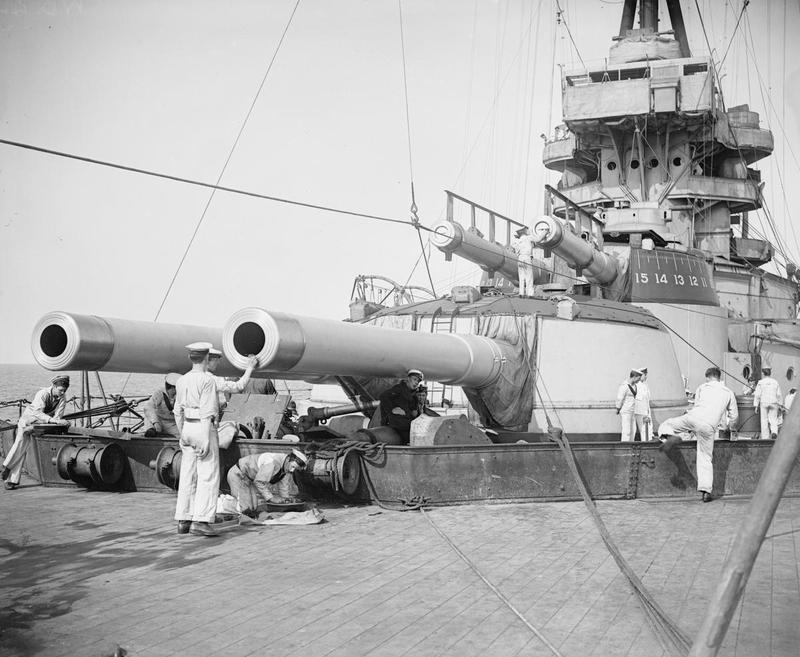
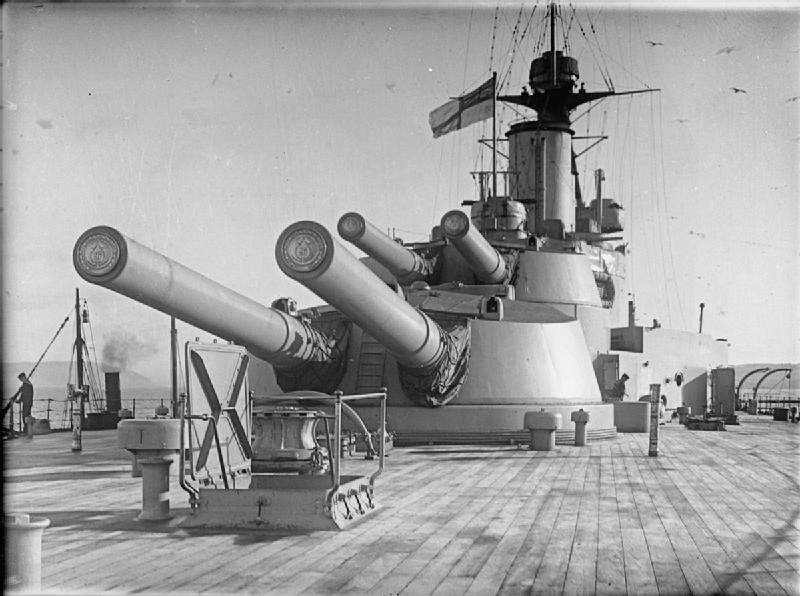
Following the Jutland (Skagerrak) battle, surviving battlecruisers and at least some battleships had 1 in (2.54 cm) armor plates added to their turret roofs and magazine crowns. See photograph of HMS Benbow below.


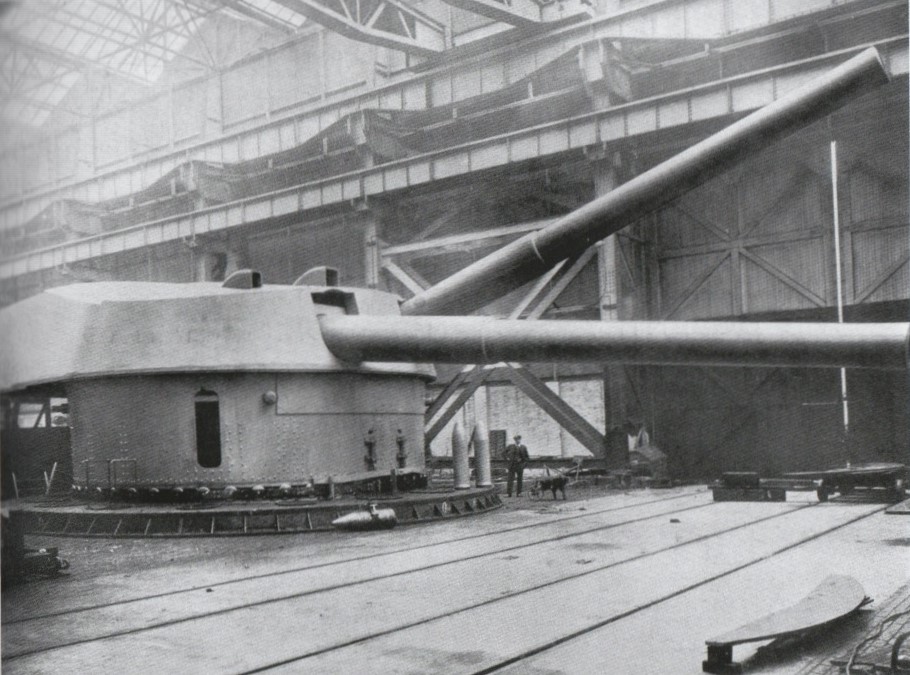
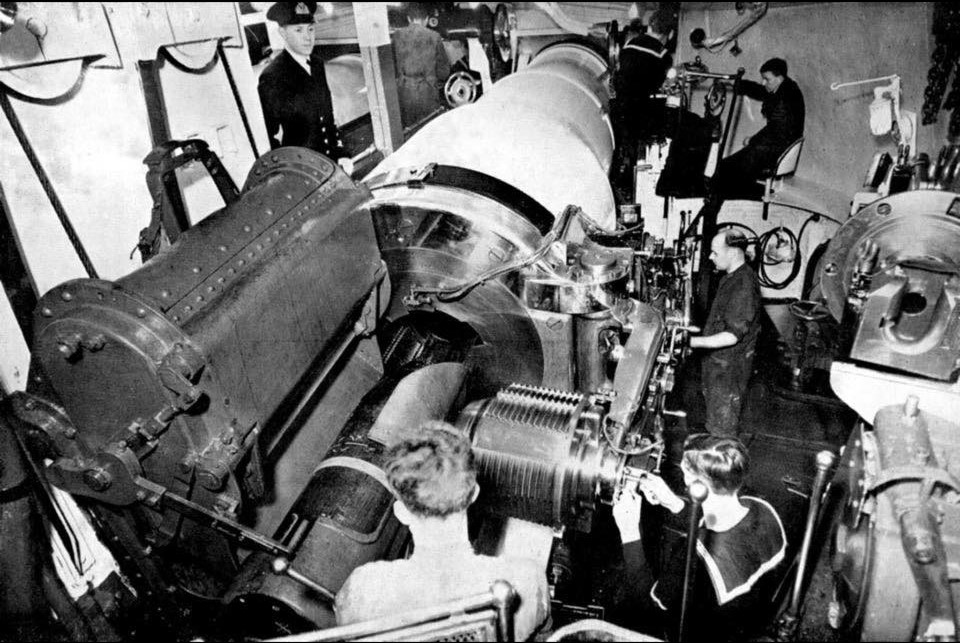
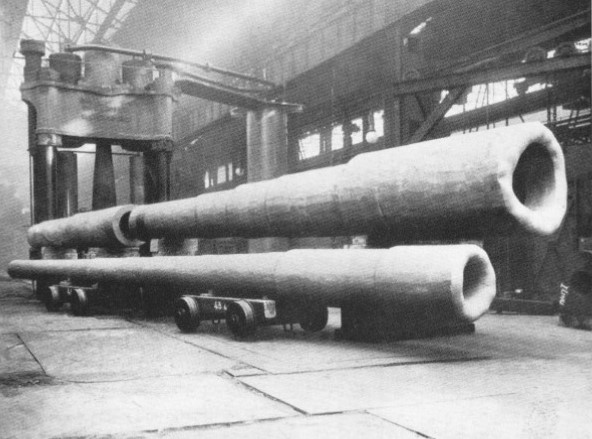
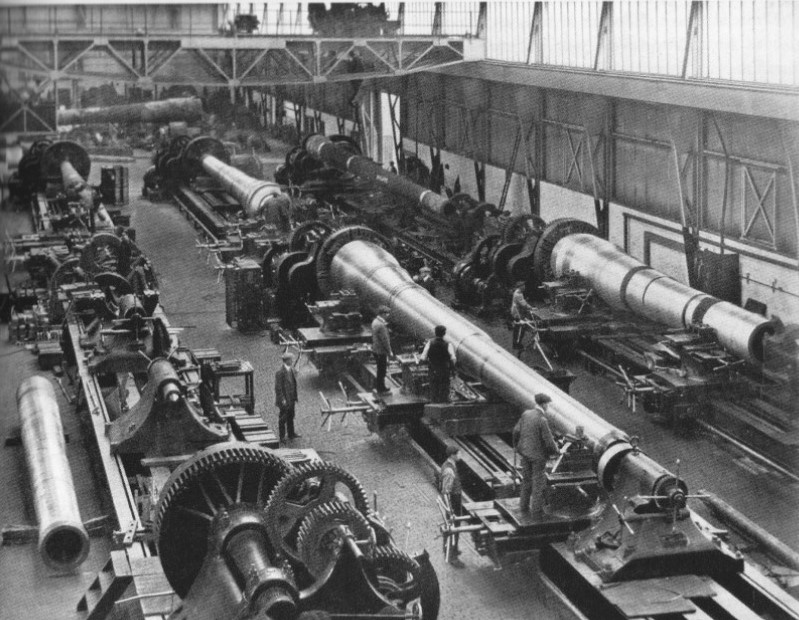
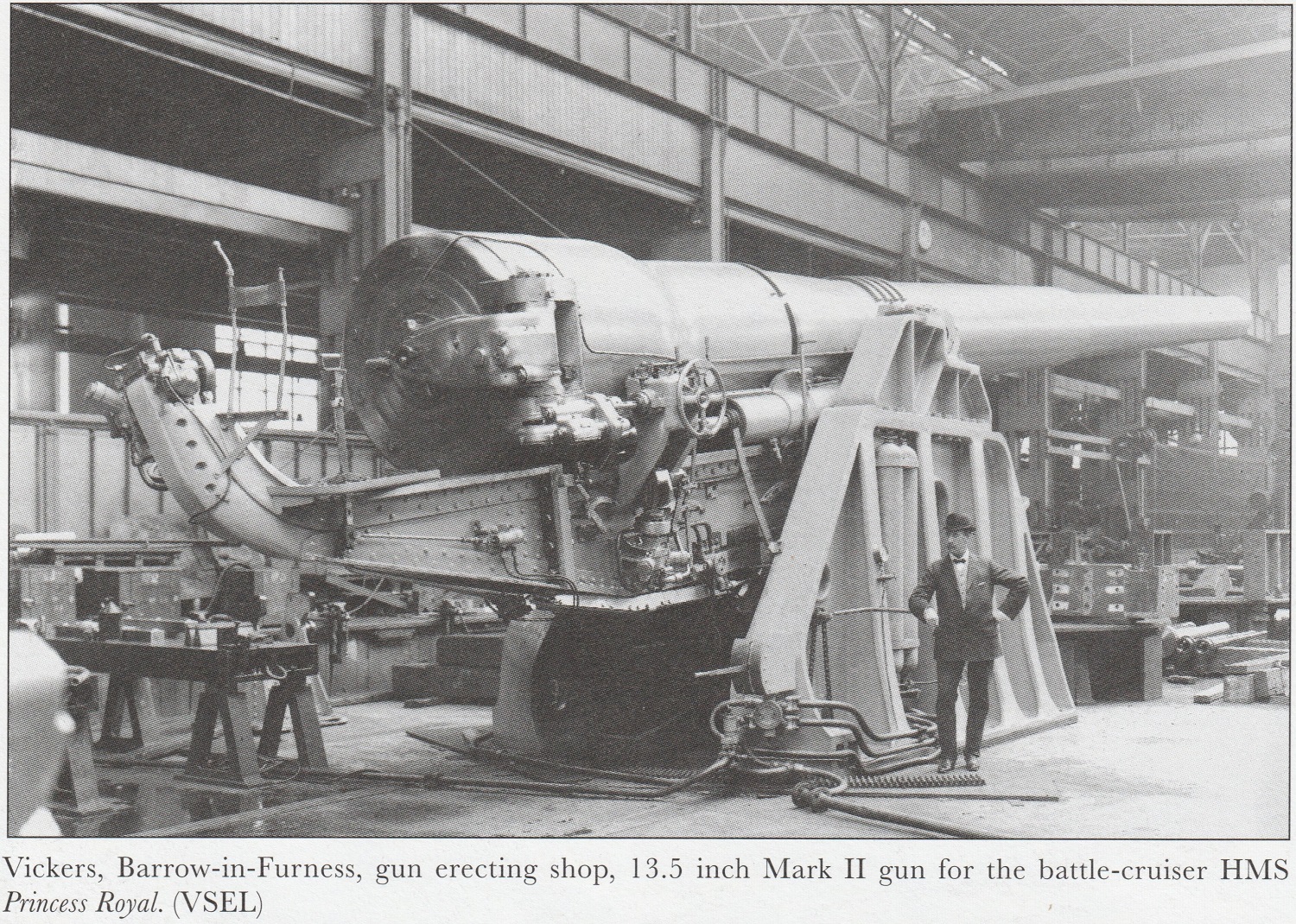
Images at The Vickers Photographic Archive
"The Grand Fleet: Warship Design and Development 1906-1922" by D.K. Brown
"British Battleships of World War One" by R.A. Burt
"British Naval Gun Mountings: From 1890: 18-inch to 4.5-inch Mark 8" by Ian Buxton
"Naval Weapons of World War Two," "Jutland: An Analysis of the Fighting," "The Battle of Tsu-Shima" article in "Warships Volume II," "Warship Special 1: Battle Cruisers" and "British Naval Guns 1880-1945 No 2" article in "Warships Volume V" all by John Campbell
"Battleship Design and Development 1905-1945," "The British Battleship: 1906 - 1946" and "Naval Weapons of World War One" all by Norman Friedman
"The Big Gun: Battleship Main Armament 1860-1945" by Peter Hodges
"The Battleship Builders: Constructing and Arming British Capital Ships" by Ian Johnson & Ian Buxton
"The Admiralty Regrets: British Warship Losses of the Twentieth Century" by Paul Kemp
"British Battleships: 1860 - 1950" by Oscar Parkes
"British Battleships of World War Two" by Alan Raven and John Roberts
"Battlecruisers" by John Roberts
"Dreadnoughts in Camera: Building the Dreadnoughts 1905-1920" by Roger D. Thomas and Brian Patterson
"The Royal Navy in Old Photographs" by Wilfrid Pym Trotters
---
ADM 186/169 "Shell Committee: Reports 1917 and 1918"
ADM 186/236 "Range Tables for HM Fleet: 9.2" guns and above"
---
Special help from Neil Stirling and Anthony Lovell of
Dreadnought Project
04 December 2006 - Benchmark
01 May 2009 - Added picture of HMS Monarch
29 December 2011 - Added information about hits on Seydlitz and ammunition outfits on battlecruisers
11 February 2012 - Updated to the latest template
25 November 2012 - Corrected comment about auxiliary prisms
26 November 2015 - Added mounting note about "A" turret on HMS Tiger
02 December 2015 - Changed Vickers Photographic Archive links to point at Wayback Archive
22 February 2016 - Added ammunition details, armor thickness and information about reloading at high elevations
16 September 2016 - Converted to HTML 5 format
02 January 2020 - Added information on remaining guns and turrets in 1939, added note regarding "(H)" guns on
HMS Queen Mary, reorganized notes, minor formatting changes
29 February 2020 - Added note regarding weight of Light APC
01 May 2021 - Added photographs of 13.5"/45 Mark V guns being manufactured
22 August 2022 - Added photograph of 13.5"/45 Mark V gun in workshop
27 May 2023 - Added photograph of HMS Iron Duke turret interior
14 November 2024 - Added note regarding extra armor protection added to battlecruisers following the Jutland (Skagerrack) battle
10 March 2025 - Added mounting notes on Coventry designs,battleship ammunition stowage and photograph of HMS Conqueror turret
21 July 2025 - Added Average gun muzzle velocity to Ammunition tables, added MV to Armor Penetration tables, added to description
of program for Turkey
31 May 2026 - Added comment about turret sighting periscopes, modifications after Jutland (Skagerrack), updated range table and
added Note about HE Lyddite shells being withdrawn
12 August 2026 - Added comment about cause of HMS Audacious explosion and corrected typographical errors