
Sometime during the 1890s, the USN purchased two 4.7"/47 (12 cm) and one 4.7"/42 (12 cm) "small case" guns from Vickers & Sons. The USN designated these as 4.7"/47 (12 cm) Mark I (S/N 1 and 2) and 4.7"/42 (12 cm) Mark II (S/N 3), the latter of which used a Welin breech block. These guns were purchased only for evaluation and comparison purposes with USN weapons and were not used on USN ships.
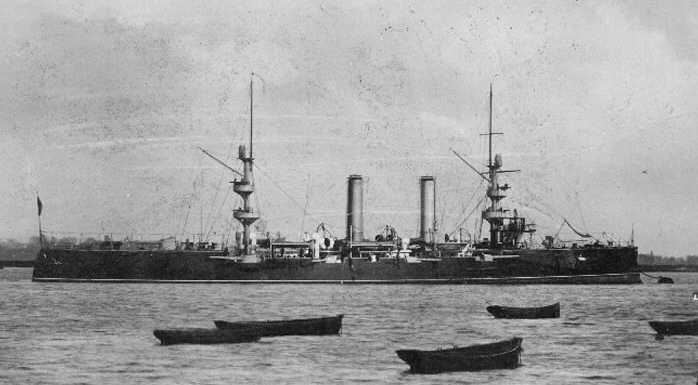
In 1895, the Brazilian Navy ordered four cruisers from the British firm of Armstrong, Mitchell and Co., Newcastle-on-Tyne. Brazil took delivery of only one of these, Almirante Barroso, while another was sold to Chile and renamed Ministro Zenteno. In March 1898 the remaining two cruisers were sold to the USA, which was interested in obtaining them in order to prevent their sale to Spain. These two warships were then rated as Protected Cruisers and renamed New Orleans (ex-Amazonas) and Albany (ex-Almirante Abreu) and were colloquially known in the USN as the "Elswick Cruisers."
As a result of this purchase, twelve 6"/50 (15.2 cm) and eight 4.7"/50 (12.7 cm) Armstrong/Elswick guns wound up in USN service. The smaller guns were designated as the 4.7"/50 (12.7 cm) Mark III (S/N 4 to 11). These Mark III guns were known as "large case" guns, apparently to distinguish them from the earlier "small case" guns described above. These guns were not well liked in the USN as they used non-standard ammunition and spare parts. For those reasons, the 4.7" (12 cm) guns were replaced in 1903 and the 6"/50 (15.2 cm) guns followed in 1907. At that point these ships had a uniform battery of ten 5"/50 (12.7 cm) guns. In 1907 the removed British guns were emplaced in the Philippines on Grande Island and at the mouth of the harbor at Subic Bay. One of the 4.7"/50 (12.7 cm) guns made its way back to Britain where it was used on the armed yacht HMS Eileen during World War I.
The 4.7"/50 (12.7 cm) Mark III was constructed of tube, jacket, four hoops and was hooped from breech to muzzle. Actual bore length was 48.9 calibers.
There were two other 4.7" (12 cm) guns, designated as Mark IV S/N 12 and 13. These were apparently obtained shortly after 1906, but no details about them survive.
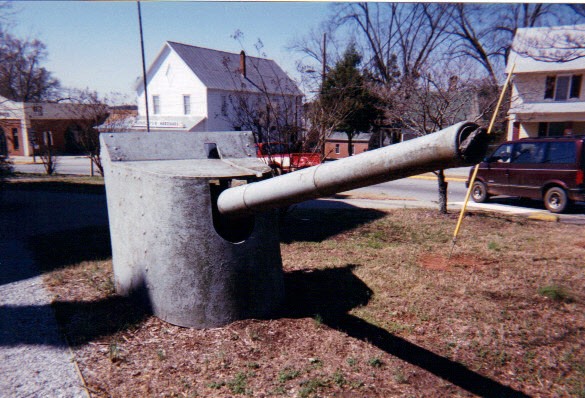
All of these 4.7" (12 cm) guns still in USN service were "surveyed and condemned" sometime prior to 1924 but one Mark I gun still survives as a memorial as shown in the photographs below.
The data tables below are specifically for the 4.7"/50 (12 cm) Mark III guns as used in USN service, but the guns used on the Brazilian and Chilean ships should be identical.
Other 4.7" (12 cm) guns in US service: The USN purchased a number of US Army 4.7"/27.5 (12 cm) Model 1906 M.I. land guns for the Marines. The US Army purchased about 40 Armstrong/Elswick 4.7"/50 (12 cm) guns for use in the "Endicott" series of Coastal Fortifications.
Actual bore diameter of all British 4.7" guns was 4.724" (12 cm).
| Designation | 4.7"/50 (12 cm) Mark III |
|---|---|
| Ship Class Used On | USA: New Orleans Class Protected Cruisers (later PG-34 and PG-36, later still CL-22 and CL-23)
Brazil: Almirante Barroso Chile: Ministro Zenteno |
| Date Of Design | about 1895 |
| Date In Service | 1898 |
| Gun Weight | about 2.1 tons (2.2 mt) |
| Gun Length oa | 236.2 in (m) |
| Bore Length | 231.1 in (4.801 m) |
| Rifling Length | N/A |
| Grooves | N/A |
| Lands | N/A |
| Twist | N/A |
| Chamber Volume | N/A |
| Rate Of Fire | about 5 - 6 rounds per minute |
| Type | Separate |
|---|---|
| Projectile Types and Weights | Common, AP, HE, CP, Shrapnel: 45 lbs. (20.4 kg) 1 |
| Bursting Charge | Common: 6.84 lbs. (3.1 kg)
Others: N/A |
| Projectile Length | N/A |
| Propellant Charge | N/A |
| Muzzle Velocity | about 2,215 fps (675 mps) |
| Working Pressure | N/A |
| Approximate Barrel Life | N/A |
| Ammunition stowage per gun | N/A |
- ^This table assumes that standard British projectiles were imported for these guns.
| Elevation | Distance |
|---|---|
| 20 degrees | about 9,900 yards (9,050 m) |
| Designation | Single CP type Mounts: New Orleans Third Class Cruisers (4) |
|---|---|
| Weight | about 8 tons (8.1 mt) |
| Elevation | -3 / +20 degrees |
| Elevation Rate | Manually operated, only |
| Train | N/A |
| Train Rate | Manually operated, only |
| Gun recoil | N/A |


4.7” Maxim 45pdr QF No.2
W.S.
Wt 1374lbs
1898
"W.S." are the initials of the proving inspector.
Photograph copyrighted by Kevin Kuhn and used here by his kind permission.

4.7” R F Gun
Mark I
1901
E.H.C.L.
L.M.G.
No.2 Wt 5721lbs
"E.H.C.L." means that at one point this gun was located at the Washington Navy Yard when it was commanded by Rear Admiral Eugene Henry Cozzens Leutz. "L.M.G." are the initials of the proving inspector.
Photograph copyrighted by Kevin Kuhn and used here by his kind permission.
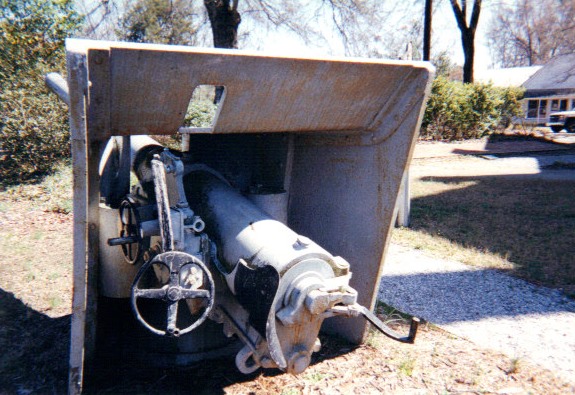
Additional photographs of Camp Dennison gun
"Camp's Loose Cannon" by Phillip Obermiller
"American Seacoast Defenses: A Reference Guide" Edited by Mark A. Berhow
"British Naval Guns 1880-1945 No 15" article in "Warship Volume IX" by John Campbell
"US Naval Weapons" and "US Cruisers: An Illustrated Design History" both by Norman Friedman
"Seacoast Fortifications of the United States: An Introductory History" by Emanuel Raymond Lewis
---
Letter published in "Warship International" No. 2, 1986 by Nelson H. Lawry
"United States Naval Guns: Their Marks and Modifications" Ordnance Pamphlet No. 127, December 1916, Second Revision June 1924
"Modern American Seacoast Defense" Revised 04 February 2013 on line at The Coast Defense Study Group, Inc.
---
Gene Slover's Navy Pages
24 January 2008 - Benchmark
03 January 2008 - Corrected number of Mark III guns in US service
30 April 2013 - Added photographs of guns at Danielsville
08 June 2022 - Converted to HTML 5 format
10 February 2025 - Added link to Danielsville gun
22 August 2026 - Added photographs of Camp Dennison gun