
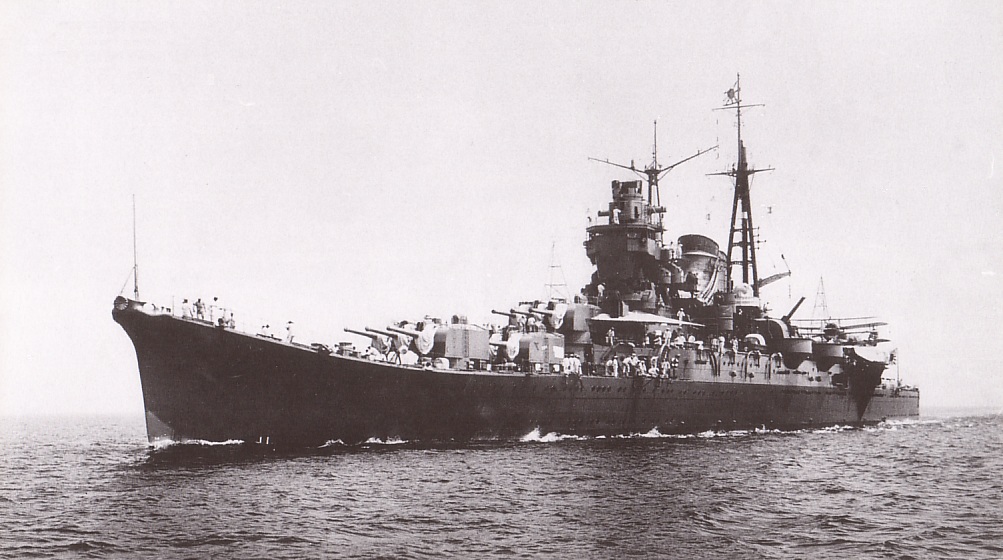
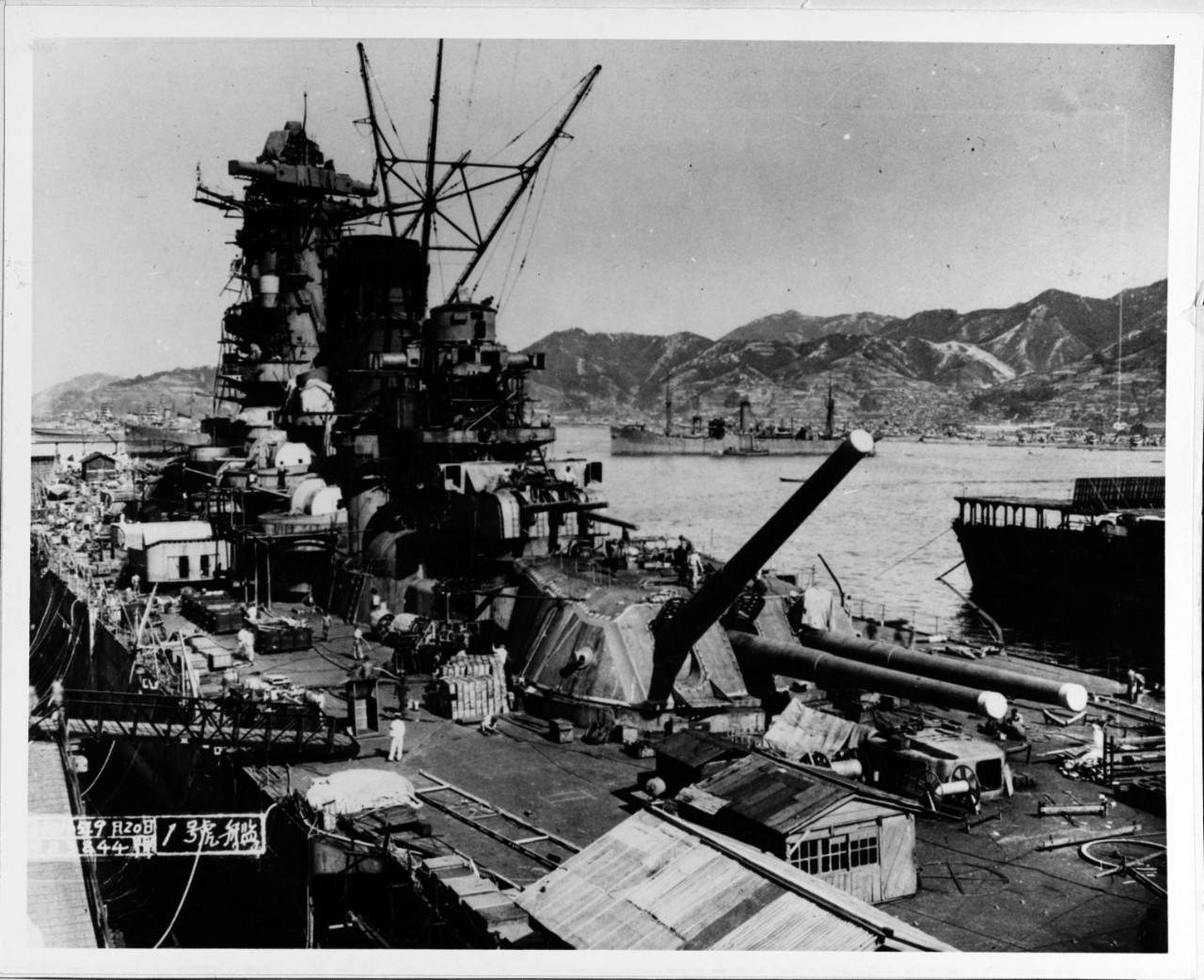
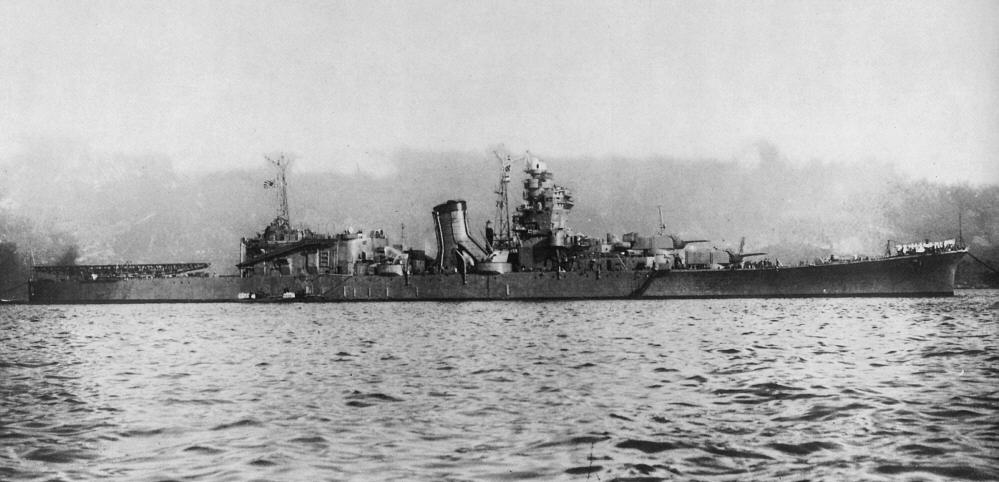
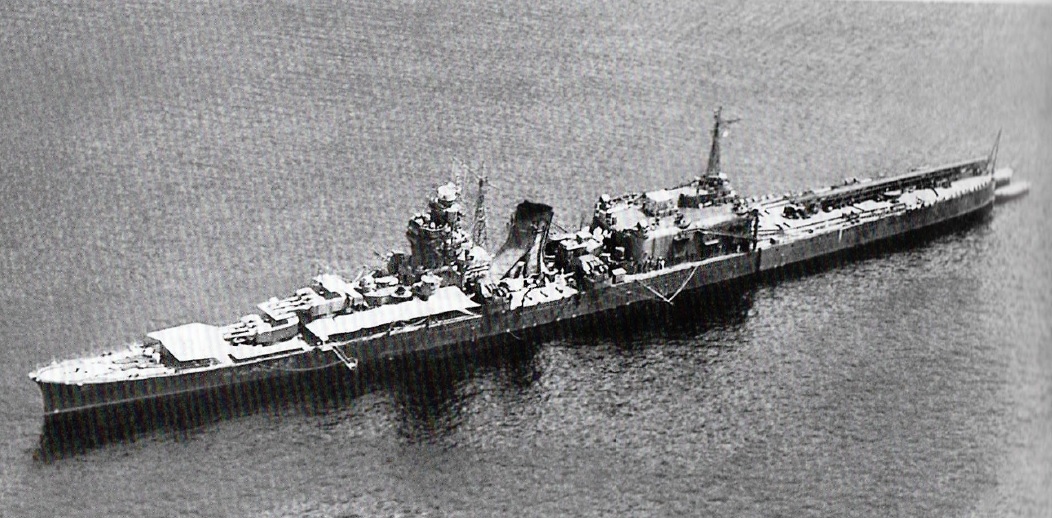
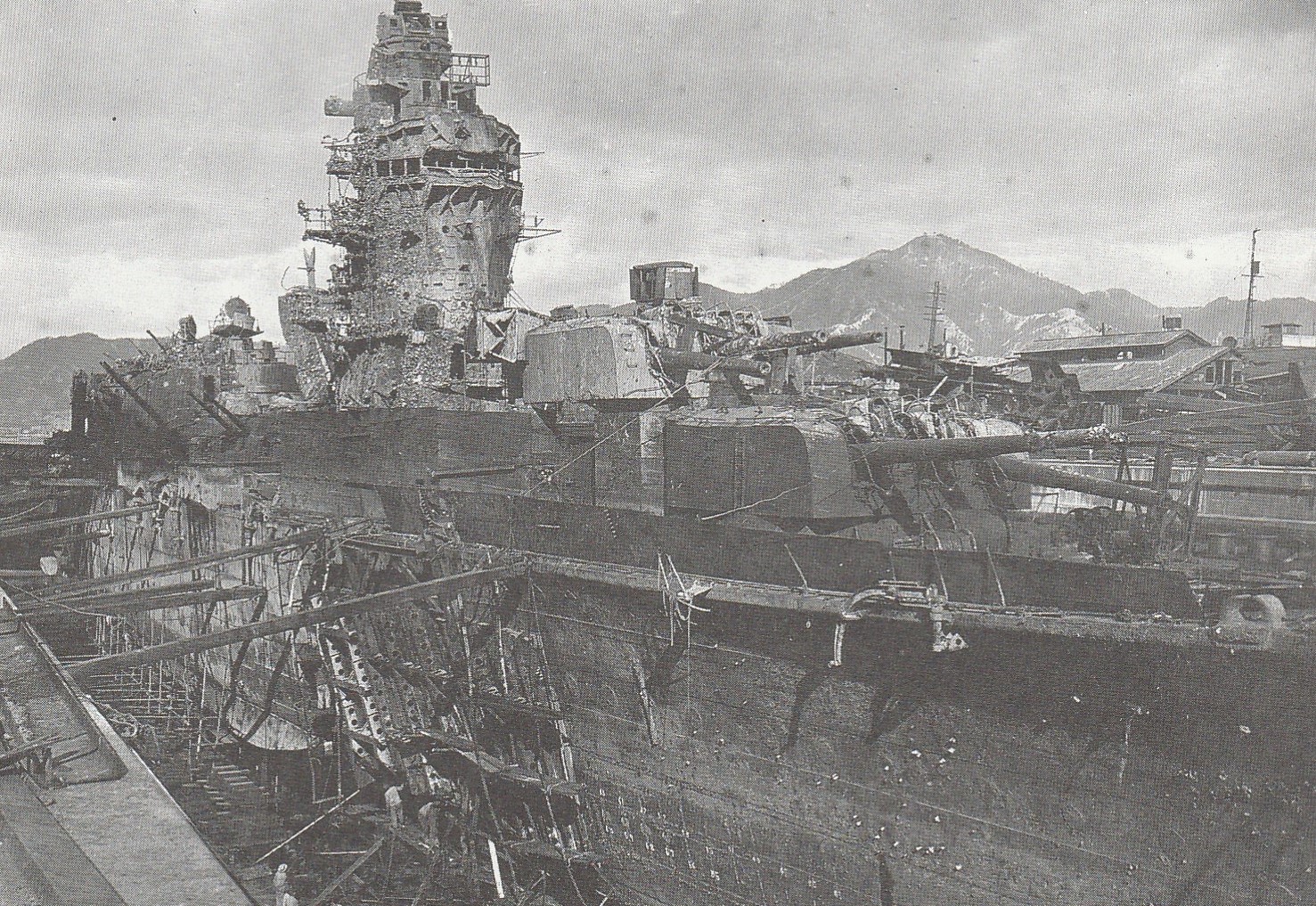
Developed as a Dual Purpose gun for the "B" type cruisers of the Mogami and Tone classes. The Mogami class had these guns replaced with 20 cm/50 (8") 3rd Year Type No. 2 guns when they were reconstructed in 1939 - 1940. Their 155 mm (6.1") mountings were then reused on the Yamato class battleships and on the light cruiser Ôyodo well as in coastal batteries. The design of the Tone class was changed while under construction and they were completed with the 20 cm/50 (8") 3rd Year Type No. 2 guns.
The slow rate of fire and limited elevation of these 155 mm/60 (6.1") guns made them unsuitable for the AA role, but they were an excellent anti-ship weapon.
In an effort to reduce dispersion, turrets 3 and 4 on the Mogami class "were integrated with the superstructure deck. This arrangement subjected the barbettes to powerful internal stresses, which at times caused the turrets to jam. For example, during the official gun trials of Mogami, turrets [3] and [4] could not be trained. It eventually proved possible to solve this problem by simply improving the method of fixing the barbette structure to the ship's hull." - Hans Lengerer in "Warship Volume VII" article. These modifications resulted in considerably tighter patterns than those achieved by the older cruisers equipped with 20 cm (8").
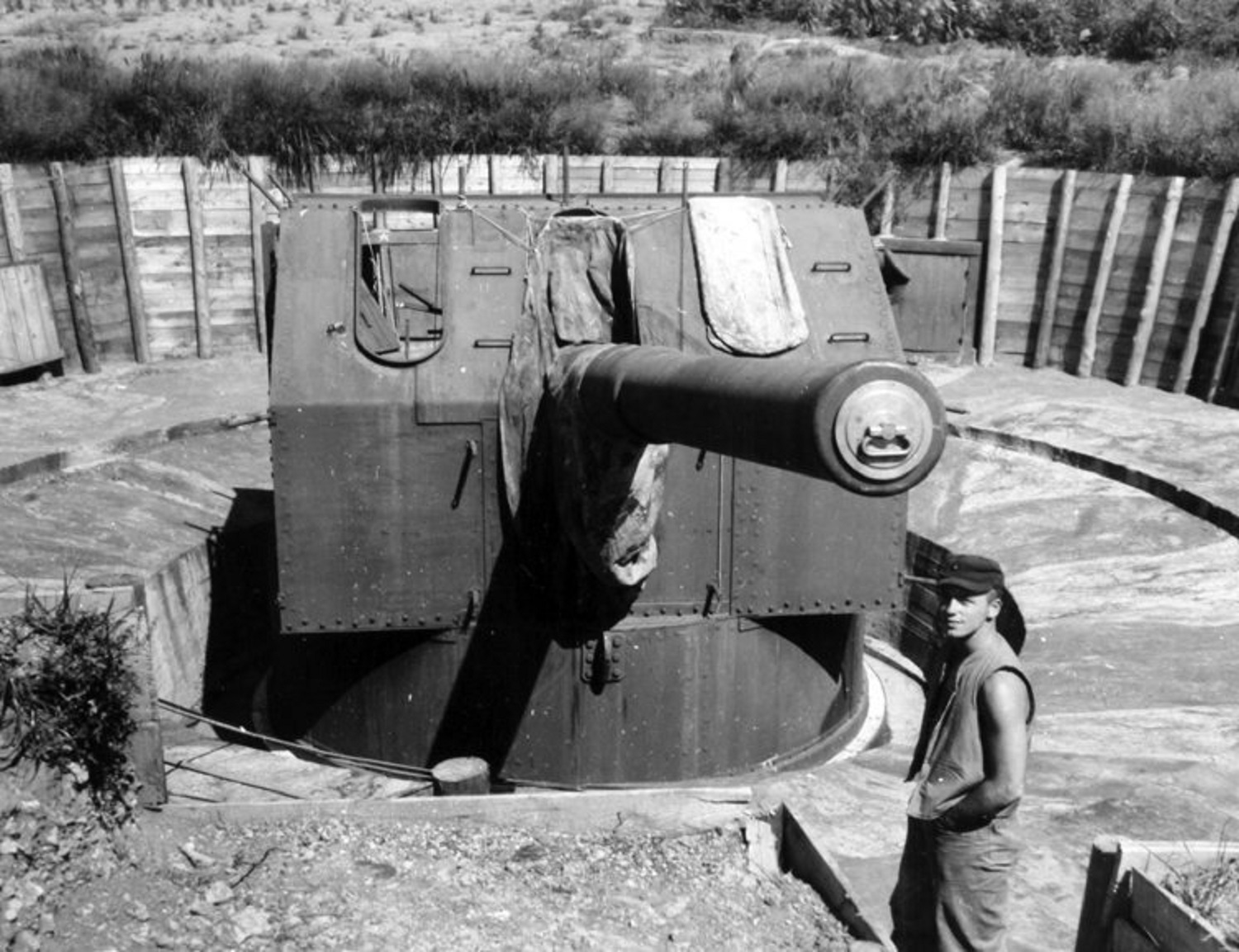
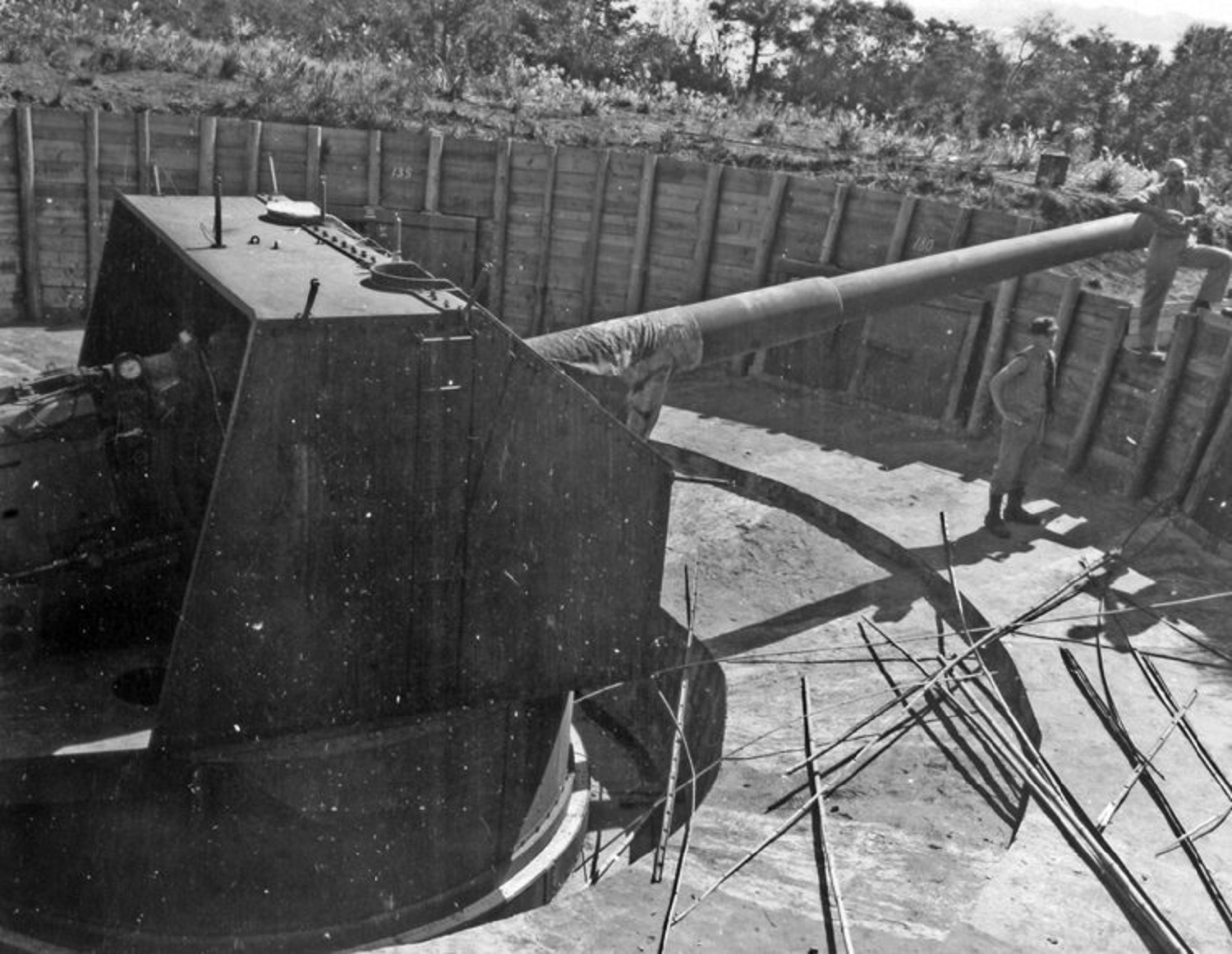
A triple turret was mounted at Kure and another at Sasebo for AA purposes. Japanese sources say that about 24 guns were used in single mountings for AA and coastal defense. Two were mounted near Tokyo, four near Nagasaki and about six on Okinawa. Locations of the other guns is unknown at this time.
Construction was of the monobloc type with autofretting and used a Welin screw block with a three-motion breech mechanism operated by hydraulic power or by hand.. A total of approximately 80 guns were manufactured at Kure.
| Designation | 15.5 cm/60 (6.1") 3rd Year Type (Model 1914)
Official Designation: 60 Caliber 3rd Year Type 15.5 cm Gun |
|---|---|
| Ship Class Used On | Mogami class (replaced 1939 to 1940)
Planned for the Tone class Reused on the Yamato and Ôyodo classes |
| Date Of Design | 1930 |
| Date In Service | 1935 |
| Gun Weight | 12.5 tons (12.7 mt) |
| Gun Length oa | 378.5 in (9.615 m) |
| Bore Length | 366.1 in (9.300 m) |
| Rifling Length | 315.9 in (8.025 m) |
| Grooves | (40) 0.710 in deep x 0.296 in (1.80 mm x 7.514 mm) |
| Lands | 0.183 in (4.66 mm) |
| Twist | Uniform RH 1 in 28 |
| Chamber Volume | 2,319 in3 (38.0 dm3) |
| Rate Of Fire 1 | 5 - 6 rounds per minute |
- ^The theoretical rate of fire was 7 rounds per minute, but this was not achieved in practice. The shell hoists could supply a maximum of six rounds per minute but the powder hoists could supply no more than five bags per minute. "Naval Weapons of World War Two" says that "the rate of fire did not exceed five rounds a minute" which agrees with "US Naval Technical Mission to Japan report O-47(N)-1".
| Type | Bag |
|---|---|
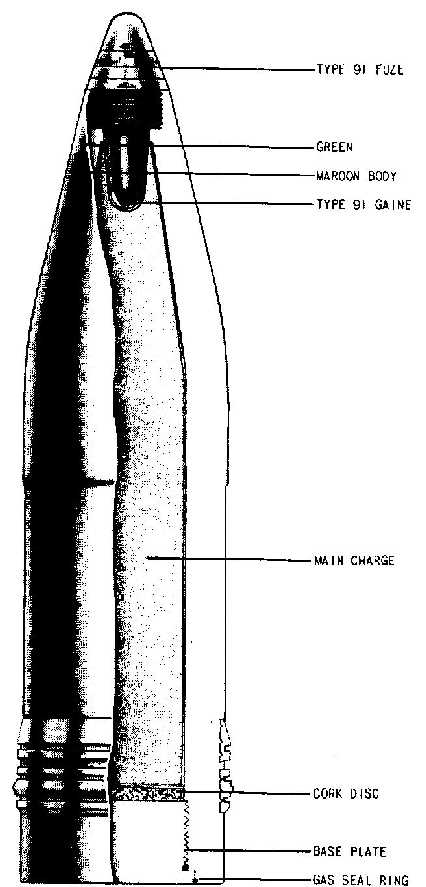
| Projectile Types and Weights 1a | AP Type 91 2a 3a: 123.2 lbs. (55.87 kg)
Common Type 0 HE 4a: 123.2 lbs. (55.87 kg) Illum 5a: 123.2 lbs. (55.87 kg) |
| Bursting Charge | AP Type 91: 2.5 lbs. (1.15 kg)
Common Type 0 HE: 6.8 lbs. (3.1 kg) |
| Projectile Length | AP Type 91: 26.7 in (67.8 cm)
Common Type 0 HE: 25.6 in (65.0 cm) Illum: 25.6 in (65 cm) |
| Propellant Charge 6a | Standard charge: 43.0 lbs. (19.5 kg) 36 DC2
Reduced charge: 27.1 lbs. (12.3 kg) 50 DC2 |
| Muzzle Velocity 7a | AP and HE: 3,018 - 3,035 fps (920 - 925 mps)
Illum: 2,461 fps (750 mps) |
| Working Pressure | 21.5 tons/in2 (3,400 kg/cm2) |
| Approximate Barrel Life | 250 - 300 Rounds |
| Ammunition stowage per gun | 150 rounds |
- ^Besides the projectile types listed above, there was also an Exercise training projectile along with a lighter charge of 30 DC propellant (weight unavailable) for firing it.
- ^AP Type 91 shells were all 6 / [infinity] crh with boat tail and two copper driving bands. The diameter of the bourrelet was 6.07 in (15.418 cm). These 15.5 cm (6.1") Type 91 shells were not true "APC" projectiles as they lacked a cap, having only a cap head and windshield. Weight of cap head and windshield is not available. There were true APC projectiles, designated as AP Type 91 Mod 1, but these were used only for armor penetration experiments and were not in service.
- ^It is reported in US Naval Technical Mission to Japan report O-19 that AP Type 91 projectiles for these guns had not been in production since about 1935 as the conversion of the Mogami class cruisers had left large stocks on hand. Although O-19 seems to state that AP projectiles were not carried by capital ships, the Yamato's ammunition expenditure log for 24 - 26 October 1944 shows that she expended 127 rounds of AP Type 91 during that time along with 383 Common Type 0 rounds.
- ^Common Type 0 HE was supplied with time fuzes for AA defense. US Naval Technical Mission to Japan report O-19 says that this round had an effective radius of 25.2 yards (23 m) but this seems to be optimistic.
- ^Illumination rounds introduced in 1938 and these were rated at 950,000 candle power and had a maximum range of 23,600 yards (21,580 m).
- ^The propellant charge was in one bag with a 2.6 oz (75 gm) black powder igniter.
- ^The muzzle velocity is occasionally quoted as high as 3,215 fps (980 mps), but Japanese sources give the lower values used above. Even at these lower values, the barrel life was quite short.
- During maneuvers in August 1938 Mikuma fired several salvos at about 21,870 yards (20,000 m) and achieved a mean dispersion of about 304 yards (278 m), much tighter than the patterns achieved by the "A" cruisers armed with 20 cm/50 (8") Type No. 2 guns.
| Elevation | Distance | Striking Velocity | Angle of Fall |
|---|---|---|---|
| 2.3 degrees | 5,470 yards (5,000 m) | 2,175 fps (663 mps) | 3.0 |
| 5.4 degrees | 10,940 yards (10,000 m) | 1,526 fps (465 mps) | 7.7 |
| 11.2 degrees | 16,400 yards (15,000 m) | 1,115 fps (340 mps) | 16.5 |
| 20 degrees | 21,870 yards (20,000 m) | 1,050 fps (320 mps) | 33.0 |
| 35 degrees | 27,340 yards (25,000 m) | 1,148 fps (350 mps) | 56.0 |
| 45 degrees | 29,965 yards (27,400 m) | --- | --- |
| 55 degrees | 27,340 yards (25,000 m) | --- | --- |
| AA Ceiling
45 degrees |
31,330 feet (9,500 m) | --- | --- |
| AA Ceiling
55 degrees |
39,370 feet (12,000 m) | --- | --- |
| AA Ceiling
75 degrees |
59,050 feet (18,000 m) 1b | --- | --- |
- ^The AA Ceiling figure for 75 degrees elevation quoted above is a theoretical value based upon the original mounting design.
- The illumination round had a maximum range of 23,600 yards (21,600 m).
| Range | Side Armor | Deck Armor | Striking Velocity | Angle of Fall |
|---|---|---|---|---|
| 16,400 yards (15,000 m) | 4.2" (108 mm) | --- | 2,224 fps (678 mps) | 60 |
| 21,870 yards (20,000 m) | 3.9" (100 mm) | --- | --- | --- |
- This data is from "Japanese Cruisers of the Pacific War" and refers to NVNC plate.
| Designation | Three-gun turrets 1d 2d Mogami (5), Tone (4) and Ôyodo (2) 3d: N/A (possibly "Mogami Model") Yamato (4): "Yamato Model" 3d 4d 5d |
|---|---|
| Weight 6d | Cruisers: About 177 tons (180 mt)
Battleships: About 190 tons (194 mt) |
| Elevation | Naval Turrets: -7 / +55 degrees
Coast Defense Single Mountings: -5 (?) / +60 degrees |
| Elevation Rate | 10 degrees per second 7d |
| Train | About +150 / -150 degrees |
| Train Rate | 5 - 6 degrees per second |
| Gun recoil | N/A |
| Loading Angle | +7 degrees |
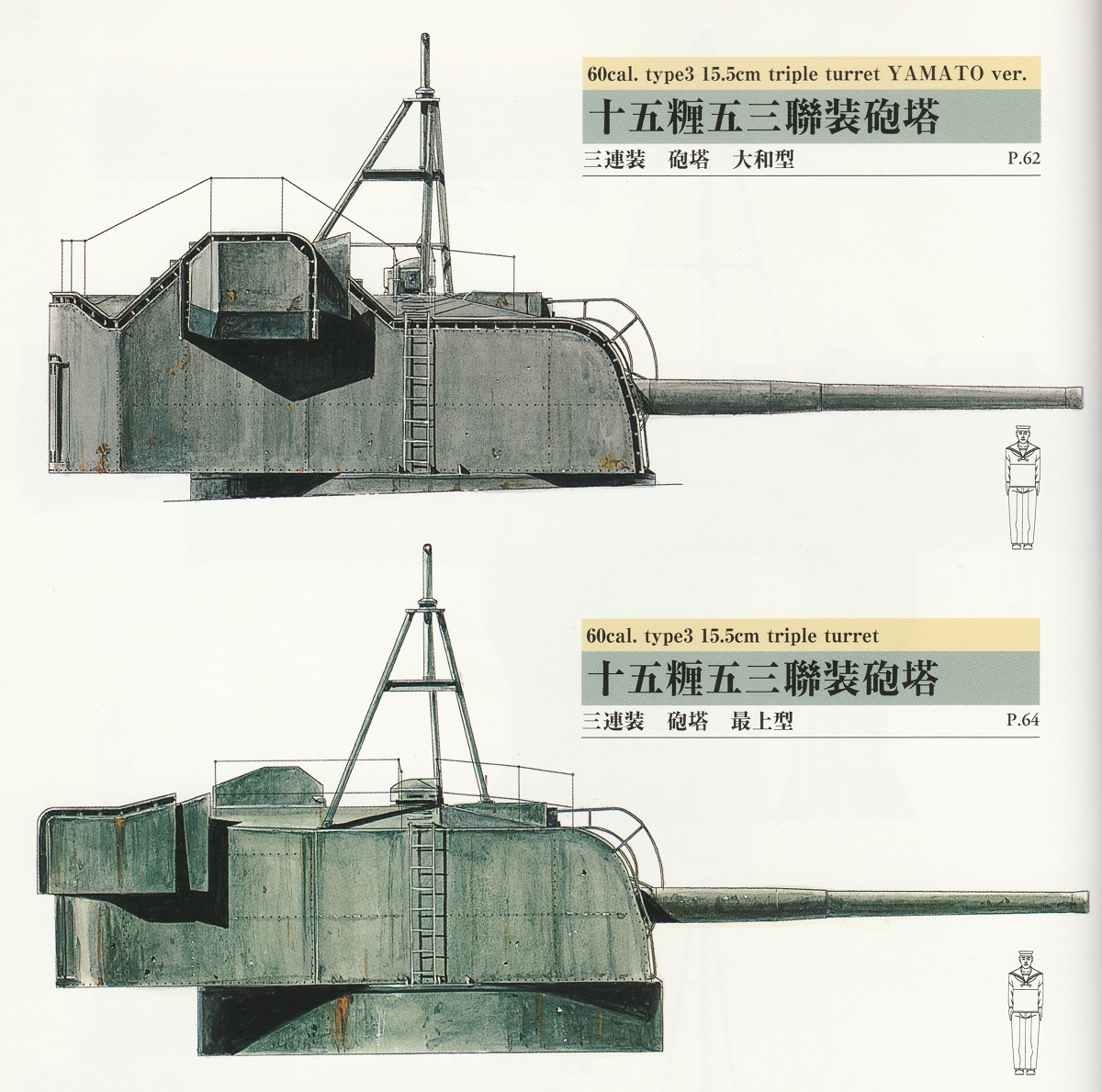
- ^These mountings generally resembled the 20 cm (8") twin mount adapted for holding three guns. To reduce lateral spacing, the breech for the center gun opened upwards at a 45 degree angle, the weight being balanced by springs. The guns were originally intended to have a +75 degree maximum elevation for AA fire, but analysis showed that their slow elevation and depression speeds with a fixed angle loading system coupled with the inefficient hoist supply would have meant that the firing rate would be too low to be effective. In addition, this high of an elevation would have overstressed the somewhat delicate recoil and elevating mechanisms, similar to the problems found with the 20 cm (8") mountings. For these reasons, the final design limited elevation to +55 degrees.
- ^The mountings were operated by electro-hydraulic pressure with mineral oil used as the pressure medium. Each mounting had two 100 hp electric motors, each driving a hydraulic pump located outside of the turret in order to reduce noise. Normally, one motor was in use while the other was in standby. Each gun had its own shell hoist and powder hoist. Projectiles were brought from the shell rooms to a circular track around the base of the revolving structure and then placed into pusher shell hoists that delivered them directly to the gunhouse at a rate of six a minute. The shell hoists came up to the right of the left gun breech and to the left of the other two guns. Powder bags were brought from the magazines through flashtight drums into a powder handling room. The bags were then delivered through double flashtight doors to bucket hoists similar in design to those for the 20 cm mountings. These bags were delivered at a rate of five per minute to the gunhouse. Hoists were hydraulically powered by the ring main. Projectiles were hydraulically rammed first, and then the powder bags were manually loaded into the breech and then hydraulically rammed. Ready-use AA shells were stowed in the rear of the gunhouse.
- ^The gunhouses on the Yamato class were modified such that the rangefinders were now located towards the middle of the gunhouse rather than at the rear as on the cruiser mountings. See sketch below.
- ^Yamato and Musashi had their two amidships mounts removed in 1944. Yamato had these replaced with twelve additional 12.7 cm/40 (5") AA guns. It had been planned that Musashi would be similarly rearmed, but the additional 12.7 cm mountings were not available prior to her loss.
- ^The weight figures above are for mountings without rangefinders. Weight with rangefinders is not available, but I would estimate that these would have added about 5 tons (5.1 mt) to the mountings.
- ^Guns were individually sleeved. It had originally been planned that the elevation rate would be 16 degrees per minute to aid in AA fire but this was reduced to 10 degrees per minute in service.
- Complement per mounting was twenty-four officers and men in the gunhouse, seven men in the shell room and ten men in the powder room.
- Thin steel lagging used around most of the gunhouse provided about a 10 cm (3.9 in) air space which shaded the mount for tropical service. Protection for cruisers was 25 mm (1.0") NVNC-steel plates on the front, sides, back and roof. Battleship turrets had 50 mm (1.97") protection.
- The gun axes were 61 in (155 cm) apart.


"Naval Weapons of World War Two" by John Campbell
"Battleships: Axis and Neutral Battleships in World War II" by W.H. Garzke, Jr. and R.O. Dulin, Jr.
"Japanese Naval Vessels at the End of World War II" compiled by Shizuo Fukui
"The Heavy Cruiser Mogami Type - Pacific Ocean War History Series (38)" by Gakken (Publisher)
"The Japanese Warships of the Pacific War" by The Koku-Fan
"Japanese Cruisers of the Pacific War" by Eric Lacroix and Linton Wells II
"The Japanese Super Battleship Strategy" article in "Warship Volume VII" and "The IJN Light Cruiser Ôyodo article
in "Warship 2018" both by Hans Lengerer
"Cruisers of World War Two" by M.J. Whitley
"All about Japanese Naval Shipboard Weapons" by Yamamoto Yoshihide and Yoshihara Ganya
---
US Naval Technical Mission to Japan report O-19: Japanese Projectiles General Types
US Naval Technical Mission to Japan report O-47(N)-1: Japanese Naval Guns and Mounts-Article 1, Mounts Under 18"
"Yamato Ammunition Expenditure Log" for 24 - 26 October 1944
---
Special Help by Rob Lundgren
09 October 2006 - Benchmark
15 June 2010 - Added picture of Type 0 Common projectile
28 November 2011 - Added information for AP projectiles on Yamato class
27 May 2012 - Updated to latest template
03 September 2012 - Added ammunition and mounting information
19 December 2015 - Minor additions
17 December 2018 - Converted to HTML 5 format, reorganized notes, added overhead photograph of Ôyodo
21 March 2019 - Added note regarding time fuzes on Common Type 0 HE
20 September 2020 - Added photograph of wreck of Ôyodo
31 July 2021 - Corrected typographical error
02 October 2022 - Corrected typographical error, added information on coastal artillery, added photographs of single mountings and comparison sketch
28 October 2023 - Added comment on breech mechanism
04 September 2025 - Added sketch of Ôyodo