
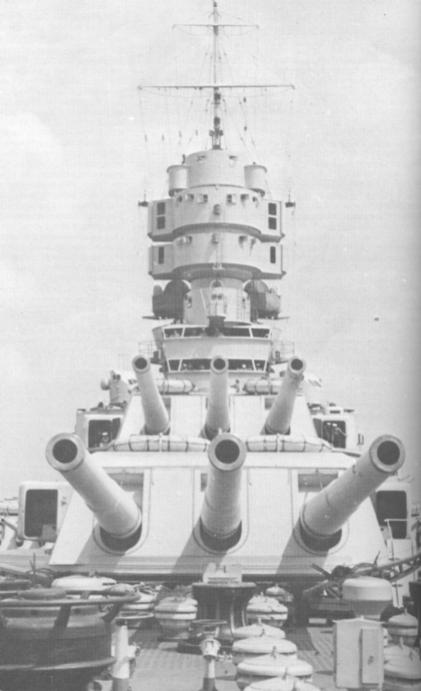
A powerful weapon for its caliber, with a maximum range exceeding that of all other battleship guns despite its modest maximum elevation. This superb performance had a price in that they suffered from excessive dispersion and a very short barrel life, which was only about half that of other nation's large-caliber guns.
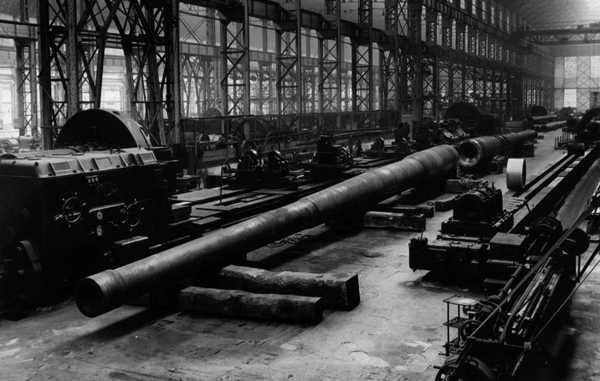
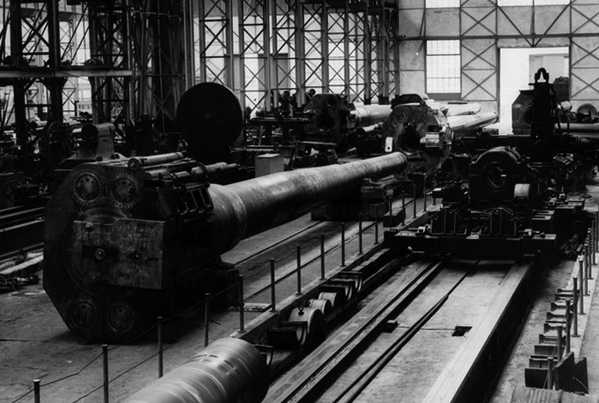
The guns were built in two batches of twenty guns each with the Model 1934 guns arming Littorio and Vittorio Veneto and the Model 1939 guns arming Roma and Impero. Ansaldo built the guns for Littorio and Impero and three guns for Roma. Odero-Terni-Orlando (OTO) built the guns for Littorio and six guns for Roma. The guns made for Littorio differed in that there were six major components rather than the four components of the other guns. There were small differences between models and manufacturers, but all except those for Littorio were constructed of an A tube in two layers over the chamber and part of the rifled bore, the outer layer continuing to the muzzle. There was a jacket over about 72% of the total length and a breech bush screwing into the jacket. These later guns were equipped with a loose liner which could apparently be removed from the breech end of the rifle. All guns used a Welin breech-block that was hydro-pneumatically operated and opened to the left in the left gun and to the right in the center and right gun. A compressed-air smoke scavenging system was used to remove propellant gasses after the guns fired.
Unlike French and German 38 cm (14.96") guns, the bore of the Italian guns was actually 381 mm (15.0").
| Designation | 381 mm/50 (15") Model 1934 |
|---|---|
| Ship Class Used On | Italia (ex Littorio) class |
| Date Of Design | 1934 |
| Date In Service | 1940 |
| Gun Weight | 109.9 tons (111,664 kg) |
| Gun Length oa | 778.8 in (20.720 m) |
| Bore Length | 750.0 in (19.050 m) |
| Rifling Length | 624.0 in (19.781 m) |
| Grooves | (96) 0.122 in deep x 0.333 in (3.1 mm x 8.458 mm) |
| Lands | 0.157 in (4.0 mm) |
| Twist | Uniform RH 1 in 30 |
| Chamber Volume | 27,840 in3 (456.22 dm3) |
| Rate Of Fire | 1.3 rounds per minute |
| Type | Bag |
|---|---|
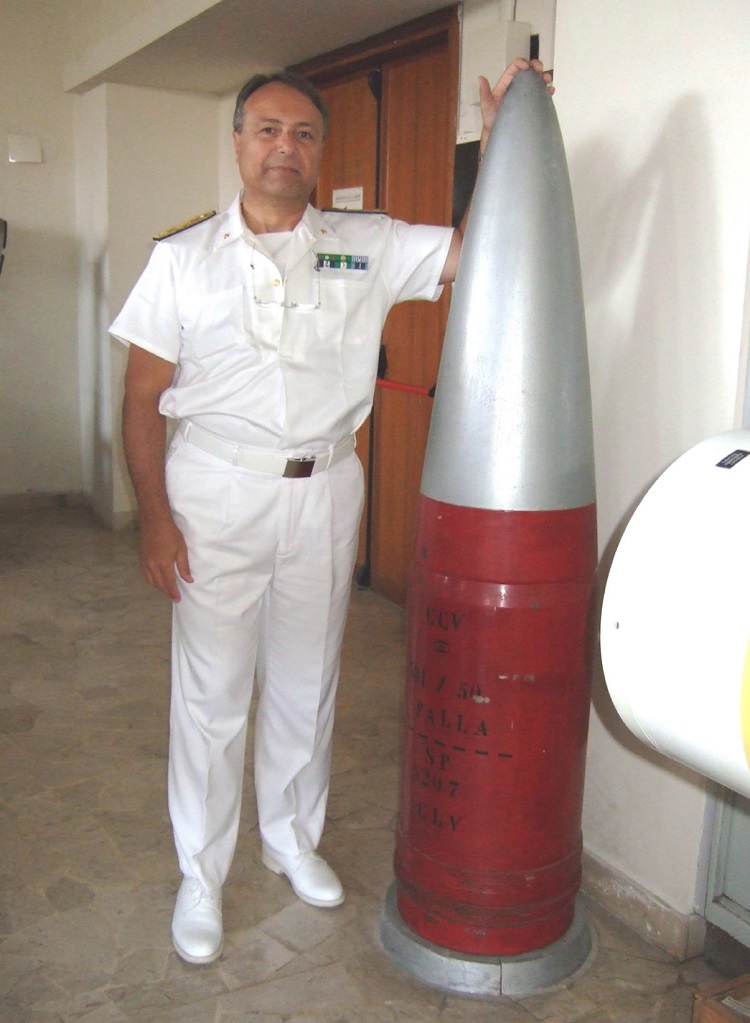
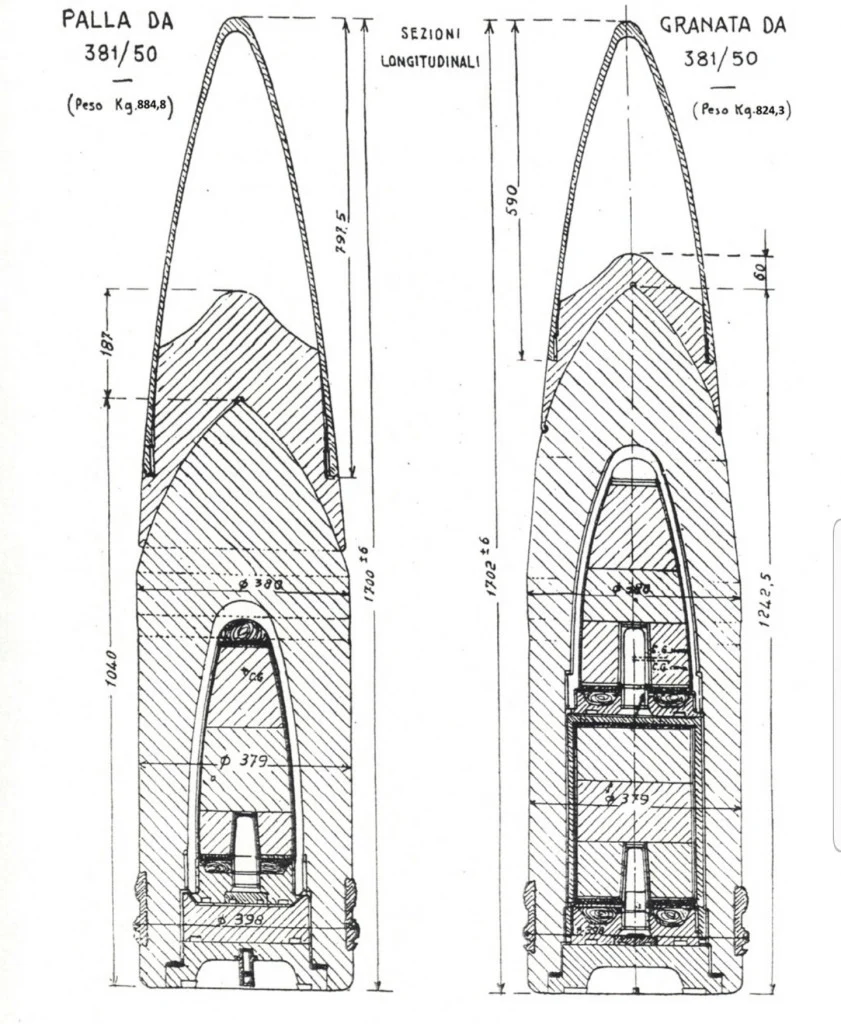
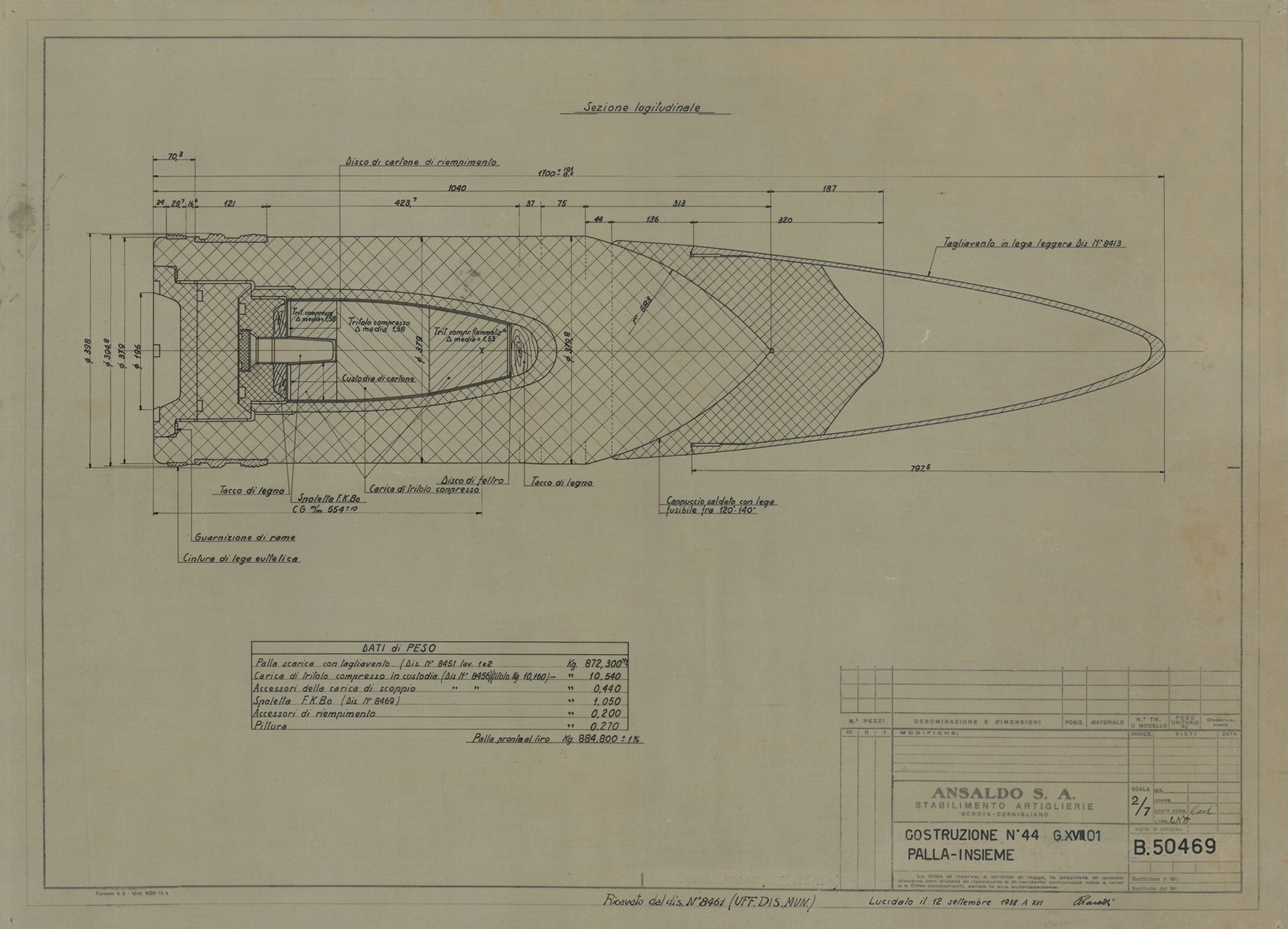
| Projectile Types and Weights 1 | APC - 1,951 lbs. (884.8 kg)
SAPBC - 1,817 lbs. (824.3 kg) 2 3 |
| Bursting Charge | APC - 22.4 lbs. (10.16 kg) Cast TNT
SAPBC - 65.1 lbs. (29.51 kg) Cast TNT |
| Projectile Length | APC - 66.9 in (170.0 cm)
SAPBC - 67.0 in (170.2 cm) |
| Propellant Charge 4 | 490 lbs. (222.2 kg) NAC or F.C. 4 5 |
| Muzzle Velocity | APC - 2,789 fps (850 mps) 6 SAPBC - 2,887 fps (880 mps) |
| Working Pressure | 20.3 ton/in2 (3,200 kg/cm2) |
| Approximate Barrel Life | 110 - 130 rounds |
| Ammunition stowage per gun | 74 rounds 7 |
- ^
Actual Italian designations APC Palla [Ball] da 381/50 SAPBC Granata [Grenade] da 381/50 - ^A Note on Sources - The SAPBC projectile figures given above are from "The Littorio Class" by Aldo Fraccaroli and are repeated in "The Littorio Class - Italy's Last and Largest Battleships 1937 - 1948" by Erminio Bagnasco and Augusto de Toro. However, John Campbell in "Naval Weapons of World War Two" does not show this projectile but instead lists an HE projectile weighing 1,706 lbs. (774 kg) and a muzzle velocity of 2,854 fps (870 mps). This HE shell is not mentioned in any of the other references listed below. It is possible that this shell was developed at some point but it did not enter service.
- ^A reduced charge for practice shoots or coastal bombardments and a training charge was also provided.
- ^The propellant charge was in six bags which were rammed three at a time.
- ^APC muzzle velocity was originally 2,854 fps (870 mps) but this was reduced to 2,789 fps (850 mps) in an effort to reduce dispersion and increase barrel life.
- ^Outfit was 495 APC and 171 SAPBC projectiles.
- "The Model 1934 was extremely accurate and was able to deliver very consistent and predictable patterns with devastating hitting power - with the ammunition used for trials. Unfortunately, the materials and supply process in Italy works differently than it does in most other countries. In the U.S., for example, if one wished to test a sample of 16" shells, they might pull an example from stock, and inspect it directly. In Italy, the firm producing the equipment would have the advantage of providing the item for test, thereby possibly delivering an example which would be of atypically good quality with respect to serialized units. This was the problem with the Model 1934 - the firms producing the ammunition did not all produce projectiles of proper quality. [Admiral Angelo] Iachino complained about this in post-war books. Some actions showed a run of good projectiles, where others were plagued by terribly bad examples. Possibly the greatest contrast was seen between the shooting of Littorio in the first battle of Sirte Gulf and that of Vittorio Veneto in the 28 March Guado encounter. Despite the fact that Littorio was shooting at targets 32,000 yards away while Veneto was attacking at first Orion and afterwards Gloucester at only 24,000 yards, the Littorio's shot groups were significantly more consistent, despite the greater range, doubtlessly owing to a batch of properly fabricated 381-mm projectiles." - Comments by Maurizio Di Sciullo
| Elevation | Distance | Striking Velocity | Angle of Fall |
|---|---|---|---|
| 4.3 degrees | 10,936 yards (10,000 m) | 2,254 fps (687 mps) | 5.0 |
| 7.2 degrees | 16,404 yards (15,000 m) | 2,034 fps (620 mps) | 8.7 |
| 10.6 degrees | 21,872 yards (20,000 m) | 1,847 fps (563 mps) | 13.4 |
| 14.5 degrees | 27,340 yards (25,000 m) | 1,719 fps (524 mps) | 19.3 |
| 19.2 degrees | 32,808 yards (30,000 m) | 1,634 fps (498 mps) | 26.1 |
| 24.7 degrees | 38,276 yards (35,000 m) | 1,585 fps (483 mps) | 37.6 |
| 35.0 degrees | 46,216 yards (42,260 m) | --- | --- |
| 36.0 degrees | 46,807 yards (42,800 m) | --- | --- |
| Elevation | Distance | Striking Velocity | Angle of Fall |
|---|---|---|---|
| 35.0 degrees | 48,820 yards (44,640 m) | --- | --- |
The sources listed below differ about the maximum range of this weapon. It is possible that the maximum elevation of the mounting was 36 degrees and the maximum range usually given for the APC projectile is for that elevation. The APC range table shown above is from "Naval Weapons of World War Two." The figures for the SAPBC projectile are from "Warship Volume I" articles by Aldo Fraccaroli and are for a muzzle velocity of 2,887 fps (880 mps).
During gunnery trials at the Cottrau firing ground, near Viareggo, at 45 degree elevation the APC projectiles reached 50,610 yards (46,280 m) and SAPBC projectiles reached 52,790 yards (48,270 m).
| Range | Side Armor | Deck Armor |
|---|---|---|
| 0 yards (0 m) | 32.07" (814 mm) | --- |
| 19,685 yards (18,000 m) | 20.06" (510 mm) | 2.86" (73 mm) |
| 30,621 yards (28,000 m) | 14.93" (380 mm) | 5.11" (130 mm) |
This data is from "Battleships: Axis and Neutral Battleships in World War II" for a muzzle velocity of 2,789 fps (850 mps) and is based upon the USN Empirical Armor Penetration Formula.
| Range | KC Armor 90 degree Impact Angle | Deck Armor |
|---|---|---|
| 20,780 yards (19,000 m) | 16.4" (416 mm) | 2.6" (67 mm) |
| 21,870 yards (20,000 m) | 15.8" (402 mm) | 2.9" (74 mm) |
| 26,250 yards (24,000 m) | 13.7" (348 mm) | 4.1" (105 mm) |
| 28,430 yards (26,000 m) | 12.8" (325 mm) | 4.9" (124 mm) |
This data is from "The Littorio Class: Italy's Last and Largest Battleships 1937 - 1948" for a muzzle velocity of 2,789 fps (850 mps) and is taken from official documents dated September 1942. I have corrected for typographical errors in the data table.
| Designation | Three-gun turrets
Littorio (3): Ansaldo 1934 |
|---|---|
| Weight | 1,570 tons (1,595 mt) |
| Elevation | -5 / +35 degrees (possibly -5.5 / +36 degrees) |
| Elevation Rate | 6 degrees per second |
| Train 1a | No. 1: -145 / + 145 degrees
No. 2: -141 / +141 degrees No. 3: -160 / +160 degrees |
| Train Rate | 6 degrees per second |
| Gun recoil | 39.4 in (1.00 m) |
| Loading Angle | +15 degrees 2a |
- ^Train angles given above are the maximum possible. However, at the extreme angles, Turrets #2 and #3 would be firing directly overhead of the secondary 152 mm (6") batteries. After 1942, instructions were issued to limit firing at low elevations between 0 and +2 degrees. In order to reduce blast effecct on the weather deck, firing at these low elevations was restricted to train angles on either side of between 50 and 120 degrees for Turret #1, between 45 and 120 degrees for Turret #2 and between 70 and 135 degrees for Turret #3.
- ^An auxiliary rammer was available in case of damage to the primary rammer. The loading angle for this was -2 degrees.
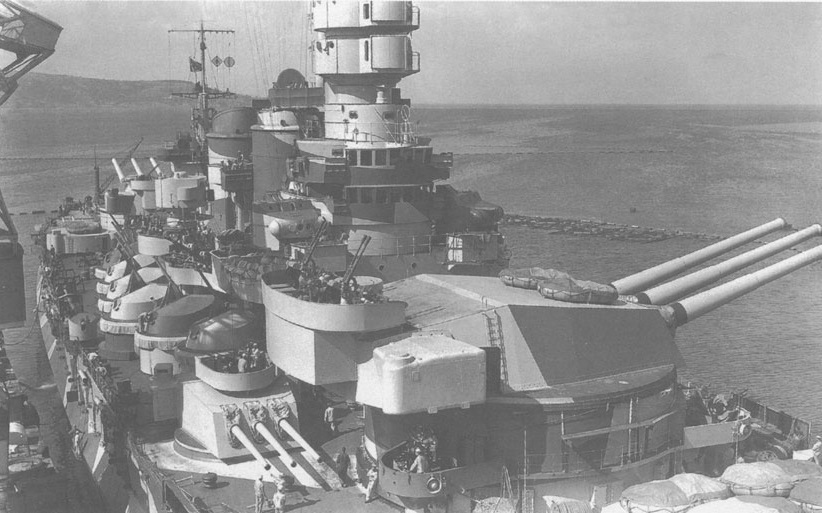
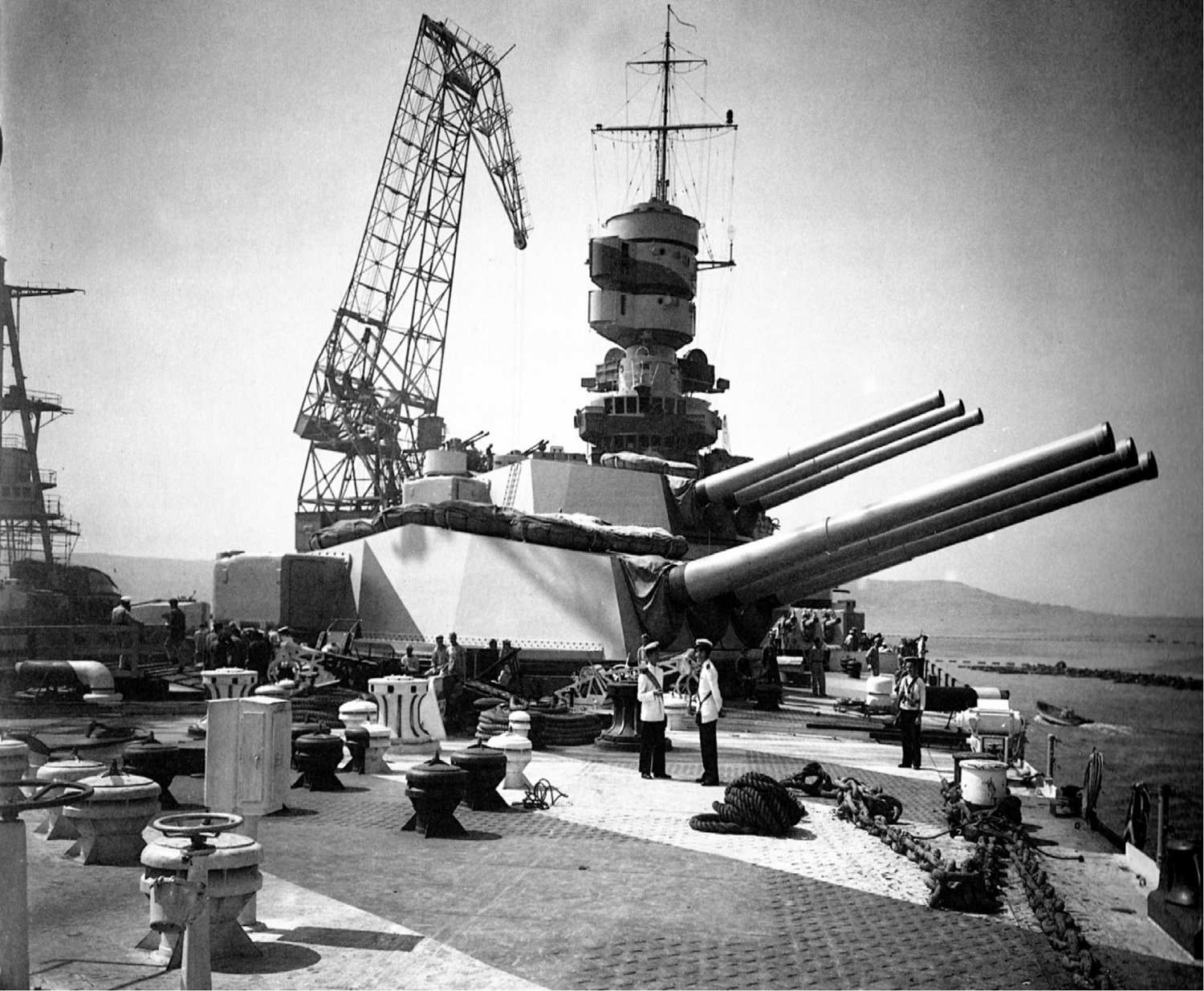
- The mountings were of Ansaldo design, but the ones on Littorio and two of those on Roma were manufactured by OTO. Elevation, training and hoisting was performed by electric motors working through reduction gears.
- Guns were mounted in individual cast steel cradles and separated by splinter bulkheads. The rangefinder in the rear of the turret was also separated by a splinter bulkhead from the guns.
- The turrets were supported by 72 tapered rollers organized in groups of four, the lower roller path being flat while the upper was tapered. Immediately below this was a ring of 24 spring loaded vertical rollers and there were eight centering rollers at the lower end of the turret axis.
- Aim in both training and elevation was "follow the pointer" although the elevation could be controlled by the layer through "stabilized aiming."
- The turret stalk had an upper and lower ring carousel at the lowest levels. Shell rooms were below the magazines and projectiles were moved by overhead gear to a ring conveyor on rails in the shell room. This conveyor then took the shells down an inclined ramp to the lower ring carousel which fed the lower projectile hoists. Projectiles were then raised horizontally to a working chamber located directly below the gunhouse. Propellant bags were transferred through scuttles to the upper ring carousel and then manually loaded into bucket hoists which ran up to the working chamber. From there, the projectiles and propellant bags were loaded into a interesting combination cage used for the upper hoists. This was a pair of three-level cages for each gun, one in the up position loading the gun while the other in the down position being stocked from the lower hoist. The upper two levels of the cage each held three propellant bags while the lower compartment held the projectile. Power was supplied by electric winches. In the working chamber, the three cage levels were loaded from vertically arranged transfer trays, but in the gunhouse the shell compartment was brought in line with the gun axis to be rammed and then the two charge compartments were lowered and rammed in succession. The upper hoists were set back 14 degrees from the vertical. The 1 degree difference between the loading angle and the cages was to ensure that the rammer chain was rigid along its entire run. Auxiliary hoists were also provided which ran from the magazine and shell rooms directly to the gunhouse.
- The gun axes were 103.5 in (264 cm) apart.

"The Littorio Class: Italy's Last and Largest Battleships 1937 - 1948" by Erminio Bagnasco and Augusto de Toro
"Naval Weapons of World War Two" by John Campbell
"Italian Warships of World War II" and "The Littorio Class" articles in "Warship Volume I" all by Aldo Fraccaroli
"Battleships: Axis and Neutral Battleships in World War II" by W.H. Garzke, Jr. and R.O. Dulin, Jr.
---
"La letalità dei proietti tattici sparati dai cannoni da 381/50 Ansaldo-OTO delle RRNN classe 'Littorio'"
[The lethality of tactical shells fired from 381/50 Ansaldo-OTO cannons of the RRNN class 'Littorio'] article by Marco Santarini,
published in
Bollettino D'Archivio, Dell'ufficio Storico Della Marina Militare, Anno XXXIII, Settembre/Dicembre 2019, a publication of the
Italian Navy
---
OTO-Melara Press Releases and Photographs
---
Special help from Robert Lundgren, Zhu Shipeng and Maurizio Di Sciullo
31 July 2006 - Benchmark
26 May 2012 - Updated to latest template
17 December 2012 - Added information on guns and mountings
12 January 2013 - Added information on ammunition
10 January 2015 - Added projectile photograph
11 November 2019 - Converted to HTML 5 format and reorganized notes
03 April 2020 - Corrected error in range table
20 May 2020 - Redid photograph of Roma
02 October 2020 - Added sketches of APC and SAPBC projectiles and confirmed that SAPBC was issued
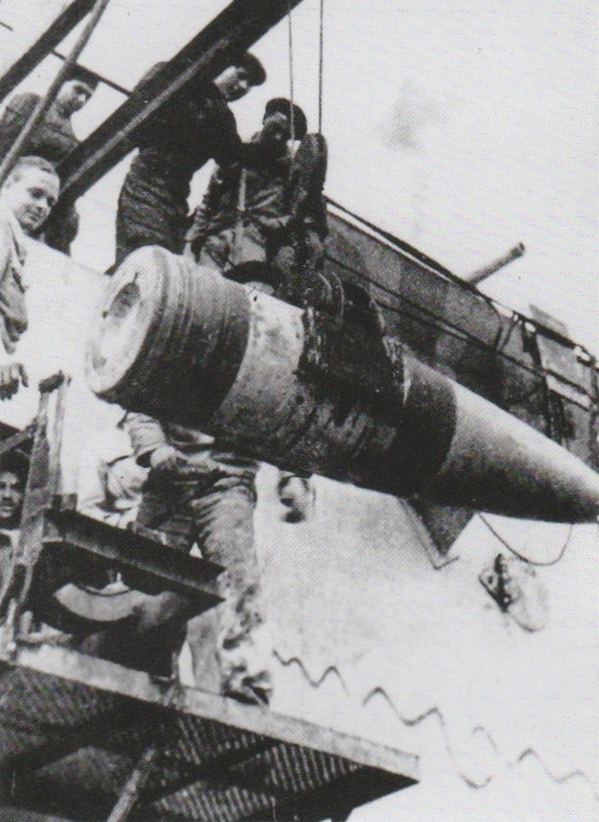
09 January 2021 - Added note regarding SAPBC burster cavities, photographs of Roma and Palla projectile being hoisted
10 December 2022 - Minor changes for clarity
09 February 2023 - Corrected formatting problem, minor changes
26 December 2023 - Added Palla projectile sketch
20 December 2024 - Corrected typographical error