
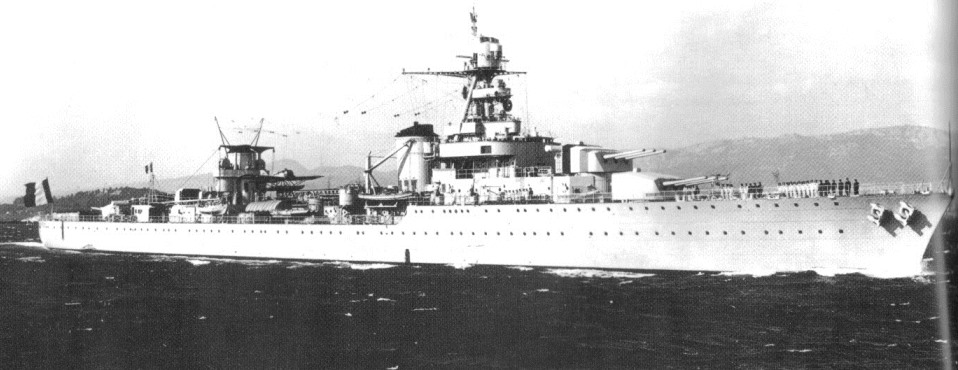
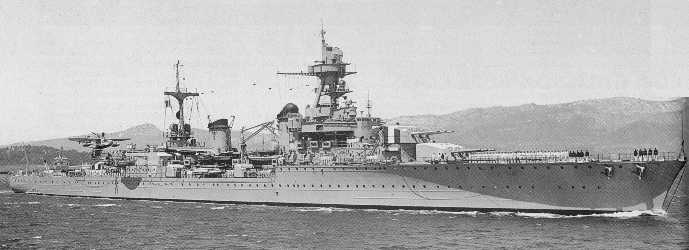
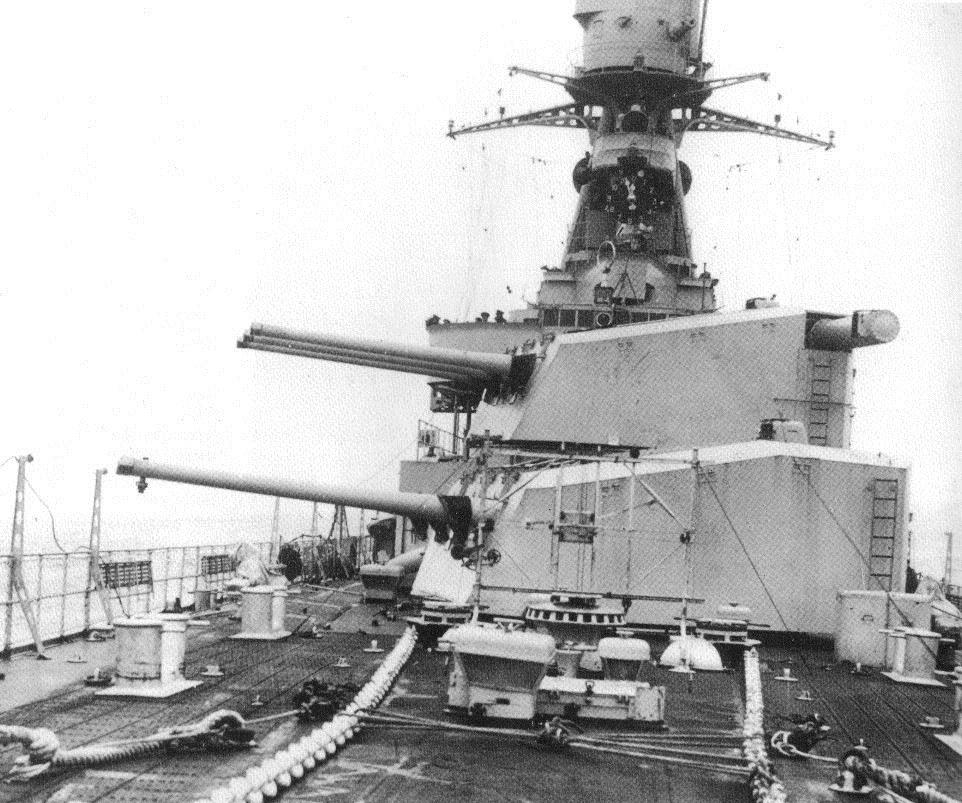
The first French cruiser guns to use cased ammunition, these were introduced as SP guns on light cruisers and proved to be quite successful in that role. However, the DP version built for the Richelieu class battleships was too ambitious for its time and was generally conceded to be a failure, with some of the mountings being replaced by smaller AA weapons.
The guns were in individual cradles, with training and elevation supplied by electric motor with hydraulic drive and RPC.
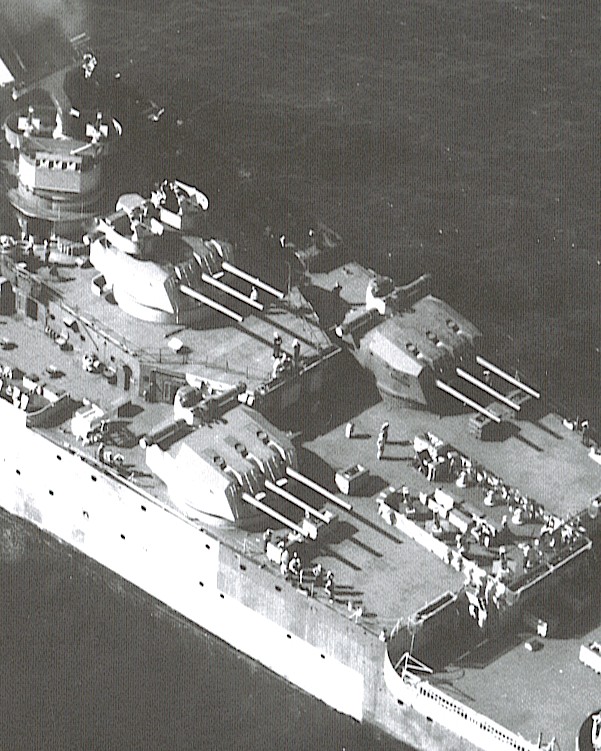
The DP mountings for the battleships were designed to load at any angle and were provided with triple-hoist systems, one for surface projectiles,one for AA and one for cartridges, so that the weapons could quickly convert between the different shell types. Unfortunately, this system proved to be a source of jamming and the planned ROF figure, low as it was, could not be maintained. The low train and elevation rates of these mountings meant that they could not track fast-moving aircraft targets, further degrading their usefulness in the AA role. In 1939, it was decided to replace some of Richelieu's DP mounts with 100 mm (3.9") guns in order to improve her mid-range AA capability.
These guns were built with autofretted jacket, breech ring and loose barrel and used a vertical sliding block.
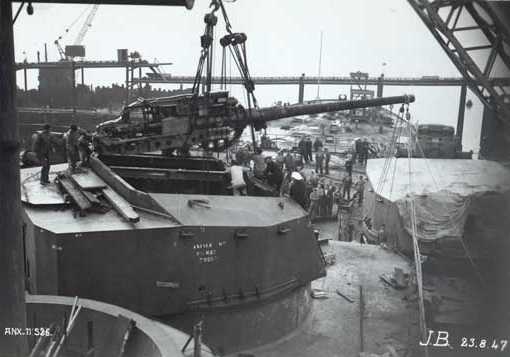
During the war guns of monobloc construction were manufactured in Canada to rearm cruisers and three of these were used post-war on Richelieu in Turret VII. The six remaining guns in her Turrets V and VI were relined at Ruelle.
Actual bore size was 15.24 cm (6.0").
| Designation | 152 mm/55 (6") Model 1930 |
|---|---|
| Ship Class Used On | Emile Bertin, La Galissonnière, De Grasse and Richelieu Classes |
| Date Of Design | 1930 |
| Date In Service | 1935 |
| Gun Weight | 7.657 tons (7.780 mt) |
| Gun Length oa | 348.8 in (8.860 m) |
| Bore Length | 330.3 in (8.390 m) |
| Rifling Length | 282.1 in (7.166 m) |
| Grooves | (46) 0.59 in deep x 0.290 in (1.5 mm x 7.37 mm) |
| Lands | 0.118 in (3.0 mm) |
| Twist | Uniform RH 1 in 25.59 |
| Chamber Volume | 1,775 in3 (29.09 dm3) |
| Rate Of Fire 1 | Battleships 2
AA: 5.0 rounds per minute ASu: 6.5 rounds per minute Cruisers
|
- ^The planned ROF for cruisers and battleships was 8 rounds per minute. The above figures represent the typical wartime experience.
- ^
Postwar, modifications to the gunnery systems were carried out on Richelieu in 1946, 1947 and 1950-51 and on Jean Bart during 1951-55.
ROF after modifications Role Expected rounds per minute Actual AA 8.6 about 6.0 ASu 7.5 - ^The ammunition supply system for Gloire was "simplified" in 1938, which probably means that ammunition was moved more by hand than by mechanical means. As a result of these modifications, she was able to attain a ROF of 9 rounds per minute at +8 degrees, which was probably the loading angle. However, I suspect that the crew would tire quickly and this high ROF could not be maintained for extended periods. No other cruiser was modified in this manner. Montcalm is said to have achieved a ROF of 8 rounds per minute for a short period during the Dakar battle.
| Type | Separate |
|---|---|
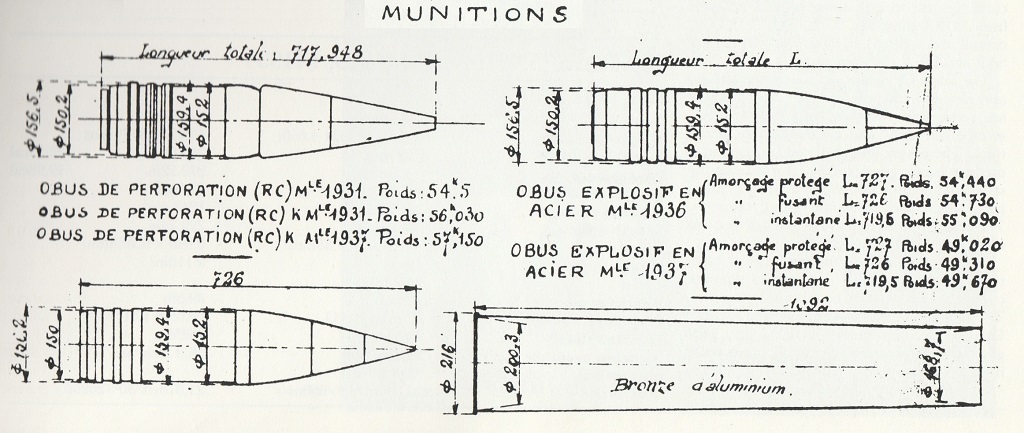
| Projectile Types and Weights 1a 2a 3a 4a | SAPC M1931 w/o dye: 120.2 lbs. (54.5 kg)
SAPC M1931 with dye: 123.5 lbs. (56.0 kg) SAPC M1937 with dye: 125.9 lbs. (57.1 kg) HE M1936: 120.2 - 121.3 lbs. (54.5 - 55.0 kg) 5a USN supplied AP: 129.6 lbs. (58.8 kg)
|
| Bursting Charge | SAPC M1931: 3.8 lbs. (1.7 kg) Mélinite
USN AP: about 1.95 lbs. (0.9 kg) Explosive D
Others: N/A |
| Projectile Length | SAPC M1931: 28.3 in (71.8 cm)
SAPC M1937: 28.6 in (72.6 cm) HE M1936: 28.6 in (72.6 cm)
USN AP: N/A (possibly 27 in (68.6 cm) or 28.6 in (72.6 cm))
|
| Propellant Charge 6a | SAPC M1931 and HE M1937: 38.1 lbs. (17.3 kg) BM11
HE M1936 and Starshell: 19.2 lbs. (8.7 kg) BM7 |
| Cartridge Case Type, Size and Empty Weight 6a | Brass, 152 x 1092 mm, 37.7 lbs. (17.1 kg) |
| Muzzle Velocity | French SAPC: 2,854 fps (870 mps)
French HE: N/A USN AP: 2,756 fps (840 mps) USN HE: 2,953 fps (900 mps) |
| Working Pressure | 20.3 tons/in2 (3,200 kg/cm2) |
| Approximate Barrel Life 7a | 300 - 350 rounds |
| Ammunition stowage per gun 8a | Emile Bertin: 145 rounds
La Galissonnière: 205 rounds De Grasse: 290 rounds Richelieu: 400 rounds |
- ^A Note on Sources: The sources listed below disagree on almost all aspects of the ammunition for these weapons. For the most part, I have relied upon the information in the more recent John Jordan and Robert Dumas books on French Battleships and Cruisers along with my personal correspondence with Mr. Jordan.
- ^As in many French weapons, there were several different kinds of AP and HE shells provided. During World War II, the USN provided modified versions of their 6"/47 (15.2 cm) AP and HE projectiles for use on Richelieu. Externally these shells resembled French AP and HE shells but internally they resembled the USN shells.
- ^
Actual French designations SAPC M1931 OPf RC Mle 1931 SAPC M1931 with dye OPfK RC Mle 1931 (one source says Mle 1936, which is probably the service date with dye) SAPC M1937 with dye OPfK RC Mle 1937 HE M1936 OEA Mle 1936 HE M1937 OEA Mle 1937 Starshell OEcl Mle 1936 USN AP OPf Mle 1943 USN HE OEA Mle 1943 - ^
"K" dye SAP shells were introduced during the 1930s. Colors were assigned as follows:
Georges Leygues red La Galissonnière green or yellow Montcalm green or yellow Richelieu yellow Jean Bart assigned orange, but this does not appear to have ever been implemented - ^Barrel life became a problem for the ships still active after 1943 as the original manufacturing sites were under the control of the Germans. By the end of April 1944, Georges Leygues had fired about 540 rounds per gun and her guns were fairly worn out. New monobloc guns were built in Canada as replacements.
- ^Ammunition outfits:
De Grasse Type Number of Rounds SAPC 900 HE and practice 1080 Other cruisers: N/A
Richelieu Pre-War Type Number of Rounds SAPC 978 HE 1,956 Illumination 656 rounds (as mentioned above, this shell may not have gone into production) Jean Bart Post-War Type Number of Rounds SAPC 750 HE 2,250 - There is a mention in "French Battleships: 1922 - 1956" that new regulators were installed during the 1950-51 refit to allow the use of German fuzes.
| Elevation | French AP M1931 w/o dye | French HE M1937 | USN AP |
|---|---|---|---|
| 45 degrees | 28,950 yards (26,474 m) | 26,465 yards (24,200 m) | 29,480 yards (26,960 m) |
| Ceiling @ 80 degrees | --- | --- | about 46,000 feet (14,000 m) |
| Designation | SP Triple Mount
Emile Bertin 1b and La Galissonnière (3): Model 1930 2b 3b DP Triple Mount
|
|---|---|
| Weight 9b | Model 1930
Emile Bertin: 110 tons (112 mt) La Galissonnière: 169 tons (172 mt) Model 1936
|
| Elevation | Model 1930
-10 / +45 degrees Battleship Model 1936
Post-World War II
Cruiser Model 1936
|
| Rate of Elevation | 8 degrees per second |
| Train | Model 1930
about +150 / -150 degrees Battleship Model 1936
Cruiser Model 1936
|
| Rate of Train | 12 degrees per second |
| Gun Recoil | 29.5 in (75 cm) |
| Loading Angle | Model 1930: -5 to +15 degrees
Battleship Model 1936: -5 to +45(?) degrees 4b Cruiser Model 1936: -5 to +75 degrees |
- ^Emille Bertin lost her Turret II center gun during a 1943 refit in the USA to allow trials with the new USN projectiles and propellants. It is not clear if this gun was ever replaced as photographs of her in late 1944 show that the gun is still missing.
- ^The Model 1930 mountings were built by FAM Homécourt and largely automated. However, there were many teething problems during the early cruiser gunnery trials, with numerous jams related to the hoists, loading systems, safety interlocks, firing gear and breech mechanisms. Emile Bertin conducted 24 gunnery trials between 1934 and 1938 and there were many more gunnery trials for the La Galissonnière class before the war. The problems were mainly resolved before the start of the war, but the practical ROF was only about half of what had been expected.
- ^Shell rooms and magazines were on the same level and shared a common handling room. Each handling room had stowage for 7 complete rounds. Shell and cartridge hoists to each gun were on the rotating stalk and ran directly from the handling room up to the gunhouse. At the top of the hoists the projectiles were tipped into a slide which transferred them to the loading gear. The breech mechanism opened automatically. A catapult rammer loaded the projectiles while a chain rammer was used for the cartridges, with both of these mounted on arms to the gun and which elevated with it. RPC for both training and elevation was installed starting in 1938.
- ^4.14.2The battleship Model 1936 mountings had complex loading arrangements and used hydro-pneumatic chain rammers on extensions from the cradles. These were intended to permit loading at any angle over the full elevation range of -10 / +90 degrees, but in fact loading was difficult or impossible beyond +45 degrees. As a result, the maximum elevation was reduced to +75 degrees and the guns probably needed to be lowered to +45 degrees to be loaded. Postwar modifications increased the maximum elevation to +85 degrees.
- ^There were separate pusher hoists for the AA and SAPC shells which came up to the left of each gun. A separate cartridge hoist came up on the right of each gun. These hoists and rotated with the gunhouse and ran down to a handling room where rotating transfer mechanisms were installed for moving ammunition from the fixed structure. The two forward mountings that were never installed would have been 77 feet (28 m) from their magazines and shell rooms, which would have required a long horizontal transfer mechanism.
- ^The two amidships DP mountings on Richelieu were were located 28 m (92 ft) from their magazines and would have required some sort of horizontal transport between the armored decks. They were removed prior to completion and replaced with 100 mm guns.
- ^Richelieu had delay coils fitted to the center gun of each mount around 1948 in an effort to reduce dispersion. Ward Léonard RPC systems were fitted post-war to Richelieu and Jean Bart.
- ^The Model 1936 DP mountings intended for the De Grasse class were similar in design to the battleship mountings but had significant differences. They had a lower maximum elevation, which reduced the depth of the gun wells and thus made the mountings more compact. The three hoists for each gun were oriented longitudinally, which meant the guns could be closer together, thus reducing the width of the gunhouse.
- ^The weight differences are mainly due to armor thickness, which "French Battleships: 1922 - 1956" and "French Cruisers: 1922 - 1956" list as follows:
Emile Bertin La Galissonnière De Grasse Richelieu Front Splinter protection only 3.9 in (10 cm) 3.9 in (10 cm) 5.1 in (13 cm) Sides 1.96 in (5 cm) 1.6 in (4 cm) 2.8 in (7 cm) Roof 1.8 in (4.5 cm) 1.6 in (4 cm) 2.8 in (7 cm) Rear 1.6 in (4 cm) 1.6 in (4 cm) 2.4 in (6 cm)

"Naval Weapons of World War Two" by John Campbell
"Les Cuirassés: Dunkerque, Strasbourg, Richelieu & Jean Bart" by Robert Dumas
"Battleships: Allied Battleships in World War II" by W.H. Garzke, Jr. and R.O. Dulin, Jr.
"French Battleships: 1922 - 1956" by John Jordan and Robert Dumas
"French Cruisers: 1922 - 1956" by John Jordan and Jean Moulin
"Richelieu" by René Sarnet and Eric Le Vaillant
"Battleships of World War Two" and "Cruisers of World War Two" both by M.J. Whitley
---
Ministère de la défense
---
Special help by Vincent Perdrix and Matthew Rodchenko
22 July 2007 - Benchmark
28 November 2009 - Added information on projectiles
07 April 2013 - Added information on guns, armor and cruiser mountings, additional pictures page
14 February 2022 - Rationalized ammunition table, reorganized notes, added munition sketch
20 September 2023 - Minor changes for clarity
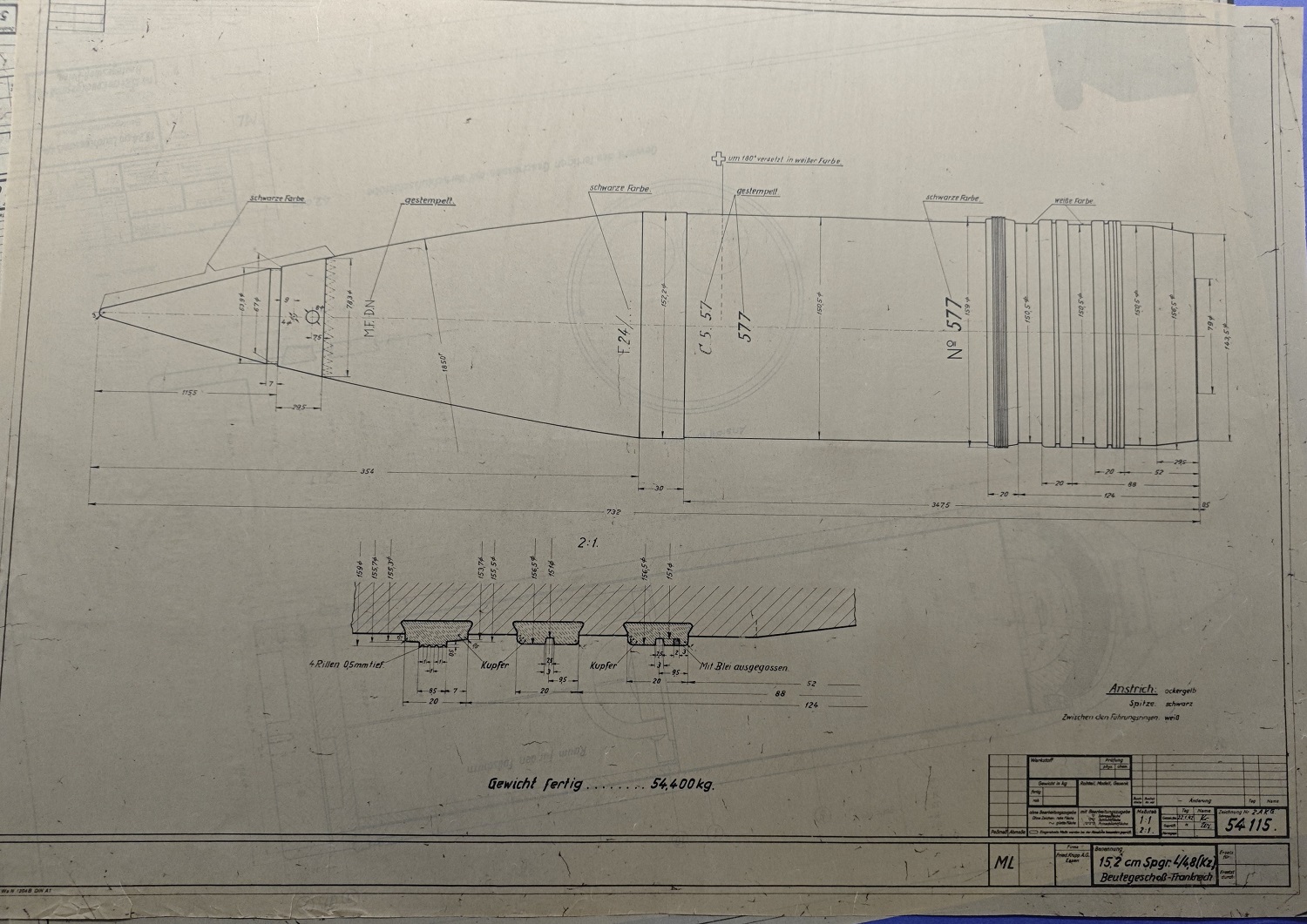
18 December 2024 - Redid turret and ammunition sketch, minor other changes for clarity, added German sketch of OEA Mle 1936