
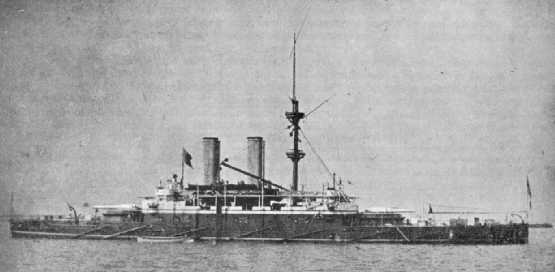
Early breech loaders using black powder for propellant. Replaced the 12"/25 (30.5 cm) Mark II after those guns failed during testing and early deployment.
Mark III was an Elswick design originally intended as a trunnioned coast defense gun without chase-hooping, but the guns were completed with chase hooping and had a collar in place of the trunnions so that they could be used on ships. Construction was A tube, a breech piece which took the breech block and 27 hoops in five layers. Mark IV was a Woolwich design and differed in having only fourteen hoops in three layers locked together with bayonet joints. These were later chase-hooped. Mark V was another Woolwich design and had a liner and inner A tube (alpha tube) with a breech piece, B tube and five hoops in two layers over it. As the liner was in two layers, this design was not chase-hooped. Mark Vw was a Whitworth design that did not have a liner or inner A tube and added two B hoops to extend the B layer to the muzzle.
All marks had a screw breech with four interruptions that was hydraulically operated and completely detached from the gun when the breech was open. Six Mark III, four Mark IV, seven Mark V and five Mark Vw were manufactured. Although different in construction, all of these Marks were interchangeable with each other.
Actual bore length was 25.25 calibers.
Nomenclature note: The 12"/25 (30.5 cm) Mark VI and Mark VII were coast defense guns for "No Man's Land" and Horse Sand forts. The Mark VI was a trunnioned version of the Mark V while the Mark VII resembled the Mark Vw with the addition of a jacket. Four Mark VI and three Mark VII were completed. Performance of these guns was similar to the naval versions.
| Designation | 12"/25 (30.5 cm) Marks III, IV, V and Vw |
|---|---|
| Ship Class Used On | Mark III: Colossus
Mark IV: Edinburgh Mark V: Hero Mark Vw: Collingwood |
| Date Of Design | about 1890 |
| Date In Service | 1892 |
| Gun Weight | 45 tons (46 mt) inc. breech |
| Gun Length oa | 328.5 in (8.344 m) |
| Bore Length | 303 in (7.696 m) |
| Rifling Length | N/A |
| Grooves | N/A |
| Lands | N/A |
| Twist | N/A |
| Chamber Volume | N/A |
| Rate Of Fire | 0.3 - 0.5 rounds per minute |
| Type | Bag |
|---|---|
| Projectile Types and Weights | AP - 714 lbs. (324 kg) |
| Bursting Charge | N/A |
| Projectile Length | N/A |
| Propellant Charge | 295 lbs. (134 kg) P.Br. (Prismatic Brown - cocoa) |
| Muzzle Velocity | 1,914 fps (583 mps) |
| Working Pressure | N/A |
| Approximate Barrel Life | N/A |
| Ammunition stowage per gun | Collingwood: 85 rounds
Others: N/A |
| Designation | Twin Turret
Colossus (2), Conqueror (1) and Edinburgh (2) Twin Barbette
|
|---|---|
| Weight | N/A |
| Elevation | Marks III, IV and V: 0 / +12.5 degrees
Mark Vw: 0 / +13 degrees |
| Rate of Elevation | N/A |
| Train 1 | Colossus: 0 / about 170 degrees
Conqueror: -45 / +45 degrees Collingwood: -90 / +90 degrees |
| Rate of Train | N/A |
| Gun Recoil | N/A |
| Loading Angle | 13 degrees |
- ^The Colossus class had their guns in an amidships citadel with the turrets staggered. This allowed them to fire across the beam, although it is not clear if blast effects limited their use in such a manner. They could also fire directly ahead but not directly astern. For the Conqueror class, owing to blast effects on the bridge, it was found to be inadvisable to fire these guns abaft the beam, so the arcs of fire were limited to the figures above. It is noted that Collingwood had no problems from blast effects when firing abaft the beam.
- The guns on these ships could only be loaded when the turret was trained to 0 degrees. The breech end of the weapons were lowered below the deck level by a hydraulic ram and then the charges were rammed into the breech from a compartment outside of the rotating structure.
- Collingwood had her guns in two armored barbettes 22 feet (6.7 m) above the waterline vs. 12 feet (3.7 m) in earlier ships. This extra height gave her better command of fire and the wide separation of the self-contained redoubts eliminated the possibility of having both pairs of guns put out of action by a single hit. The ammunition trunk could be used to create an updraft to ventilate the loading chamber after firing, clearing it of propellant fumes.
"British Battleships 1889-1904" by R.A. Burt
"British Naval Guns 1880-1945 No 3" article by John Campbell in "Warship Volume V"
"The Big Gun: Battleship Main Armament 1860-1945" by Peter Hodges
"British Battleships: 1860 - 1950" by Oscar Parkes
19 October 2007 - Benchmark
30 January 2009 - Added Nomenclature note on the Mark VI and Mark VII guns, added construction details and corrected typographical errors
30 August 2010 - Added details on Collingwood mountings
23 September 2016 - Converted to HTML 5 format
31 January 2022 - Additional ammunition data, reorganized notes