

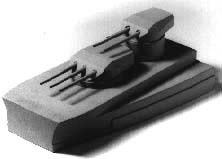
Intended for the Ersatz Monarch (improved Tegetthoff) battleships, these guns were used as land artillery when those ships were cancelled.
The Austro-Hungarian Navy drew up the first specifications for these battleships on 3rd June 1911. The Marinetechnische Komitee or MTK (Naval Technical Committee) presented two series of designs: A 21,650 ton (22,000 mt) warship with 30.5 cm (12") guns and a 23,000 ton (23,400 mt) ship with 34.5 cm (13.6") guns. In February and March 1912, the Navy made a series of displacement calculations with different armament and belt armor. Beside the 34.5 cm caliber, the Navy studied the possibility of introducing the 35.5 cm (14") caliber and ordered Škoda to work on a design for turrets for this caliber with any-angle loading, similar in concept to contemporary British designs. On the basis of these calculations, on 11th March 1912 the Navy drew up new specifications for the battleships.
On 1 April 1912, Škoda submitted drawings for 34.5 cm (13.6") twin and triple gun turrets to three shipyards and to the MTK, but the 35.5 cm (14") drawings were not finished in time. These 34.5 cm (13.6") turrets were poorly protected and they had a complicated design, due to the any-angle loading system which was more complex than those on British battleships. The shipyards and the MTK presented a total of 25 battleship designs ranging from 23,000 to 26,600 tons (23,400-27,000 mt) and armed with eight to thirteen 34.5 cm (13.6") guns.
On 25th June 1912 a board headed by Vice-Admiral Karl Kailer von Kaltenfels reviewed these designs and found them unsatisfactory. The board decided to instead pursue a new design for a battleship of about 24,100 tons (24,500 mt) armed with ten heavy guns. The board decided that these guns would be yet another new size, 35 cm (13.8"), and that they would have a simpler, fixed loading angle. In July 1912 the Navy asked Škoda to work out the designs for 35 cm (13.8") twin and triple turrets.
The first tests with the prototype, Rohr Nr. 1 (Barrel No 1), were executed in Pilsen on 20-21 November 1914. During these tests, the gun fired eight 1,400 lbs (635 kg) projectiles at muzzle velocities between 2,687 and 2,700 fps (819 to 823 mps). The test committee recommended reducing the muzzle velocity down to 2,625 fps (800 mps) in order to reduce wear and improve barrel life.
Including the prototype, a total of four guns were made. The second gun was delivered to Trieste on 16 June 1916 and the third gun was delivered to Trieste on 31 December 1917. These three guns were used as land artillery during the war. The fourth gun had not left the factory at the time of the armistice and was taken over by the French when they became co-owners of Škoda after the war.
Actual bore size was 349.5 mm (13.76").
| Designation | 35 cm/45 (13.79") K14 |
|---|---|
| Ship Class Used On | Ersatz Monarch (improved Tegetthoff) class |
| Date Of Design | 1912 |
| Date In Service | 1916 (as artillery) |
| Gun Weight | 163,140 lbs. (74,000 kg) including breech 1 |
| Gun Length oa | about 620 in (15.750 m) |
| Bore Length | N/A |
| Rifling Length | N/A |
| Grooves | (90) 0.079 in (2.0 mm) |
| Lands | N/A |
| Twist | N/A |
| Chamber Volume | N/A |
| Rate Of Fire | about 2 rounds per minute |
- ^Recoiling mass was 166,000 lbs. (75,300 kg).
| Type | Cartridge - Bag |
|---|---|
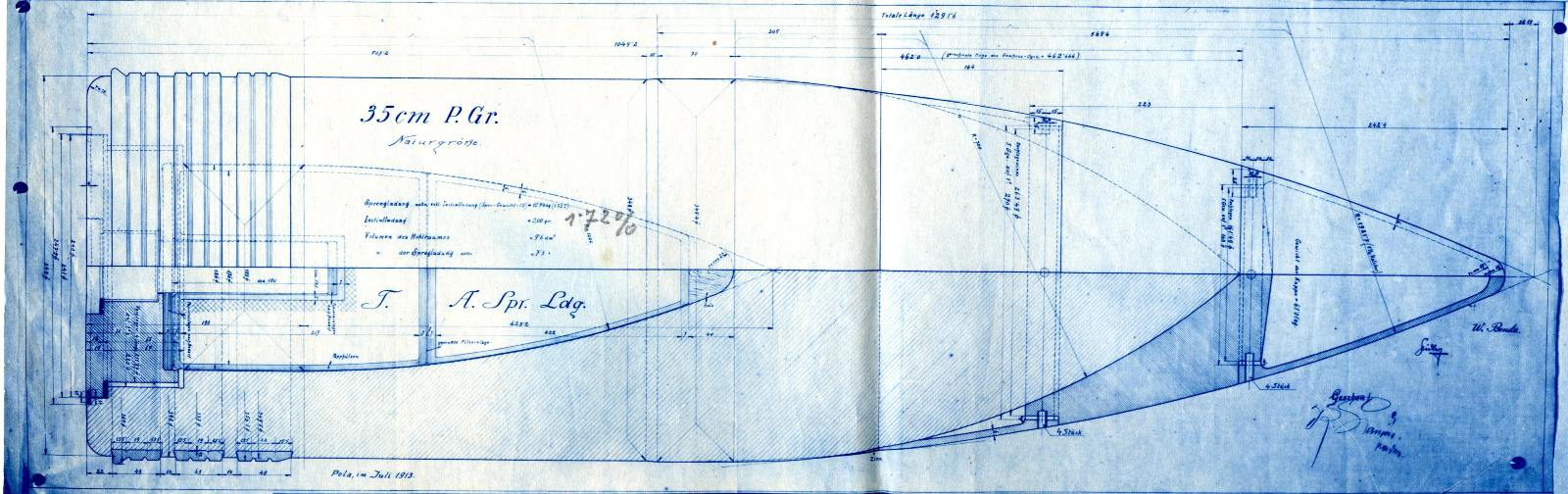
| Projectile Types and Weights 1a 2a | APC - 1,400 lbs. (635 kg)
SAPC Type 1 - 1,400 lbs. (635 kg) SAPC Type 2 - 1,400 lbs. (635 kg) Common - 1,400 lbs. (635 kg) |
| Bursting Charge | APC - 24.0 lbs. (10.9 kg)
SAPC Type 1 - 93.7 lbs. (42.5 kg) SAPC Type 2 - 83.1 lbs. (37.7 kg) Common - 40.8 lbs. (18.5 kg) |
| Projectile Length | APC - 50.85 in (129.16 cm)
SAPC Type 1 - 59.06 in (150.0 cm) SAPC Type 2 - 57.84 in (146.93 cm) Common - N/A |
| Propellant Charge | 452 lbs. (205 kg) RP M/97 3a |
| Propellant Container Type and Weight 4a | Main cartridge - 347.9 x 1450 mm
Actual dimensions: 57.1 in (145 cm) long x 14.4 - 15.35 in (36.6 - 39.8 cm) diameter, total weight 485 lbs. (220 kg) Fore cartridge: 110 lbs. (50 kg) |
| Muzzle Velocity | 2,700 fps (820 mps) |
| Working Pressure | N/A |
| Approximate Barrel Life | about 100 rounds 5a |
| Ammunition stowage per gun 6a | 76 normal
88 maximum |
- ^
Actual designations for Austro-Hungarian Projectiles APC 35 cm Panzergranate SAPC 35 cm Zündergranate Common 35 cm Einheitsgranate
These shells were sometimes called "bekappte Panzergranate" (AP shell with AP Cap) and "bekappte Zündergranate" (SAP shell with AP Cap). - ^Projectiles were all 5.25crh and the APC and SAPC used both armor piercing and ballistic caps.
- ^The Main charge held 344 lbs. (156 kg) of propellant while the Fore charge held 108 lbs. (49 kg). It is noted that the propellant tubes for these charges were longer and thicker than those used for the 30.5 cm guns.
- ^Forward charge was in a thin brass casing which burned during firing. The forward charge had a 50 gm igniter at both ends. The main charge was in a thicker brass casing and had a 250 gm igniter. This casing weighed 172 lbs. (78 kg) empty.
- ^One gun used as land artillery fired 122 rounds before needing to be relined.
- ^12 practice rounds per gun were to be carried.
| Range | 1,400 lbs. (635 kg) AP | 1,400 lbs. (635 kg) Common |
|---|---|---|
| 5,550 yards (5,000 m) | 23.2 in (590 mm) | 21.6 in (550 mm) |
| 8,750 yards (8,000 m) | 19.9 in (505 mm) | 18.5 in (470 mm) |
| 10,930 yards (10,000 m) | 17.7 in (450 mm) | 16.5 in (420 mm) |
| 14,220 yards (13,000 m) | 15.3 in (388 mm) | 14.2 in (360 mm) |
| 16,400 yards (15,000 m) | 13.6 in (346 mm) | 12.7 in (322 mm) |
These values are based upon theoretical calculations performed in July 1913 and do not reflect actual trials. Armor type is unknown. Data provided by Edwin Sieche.
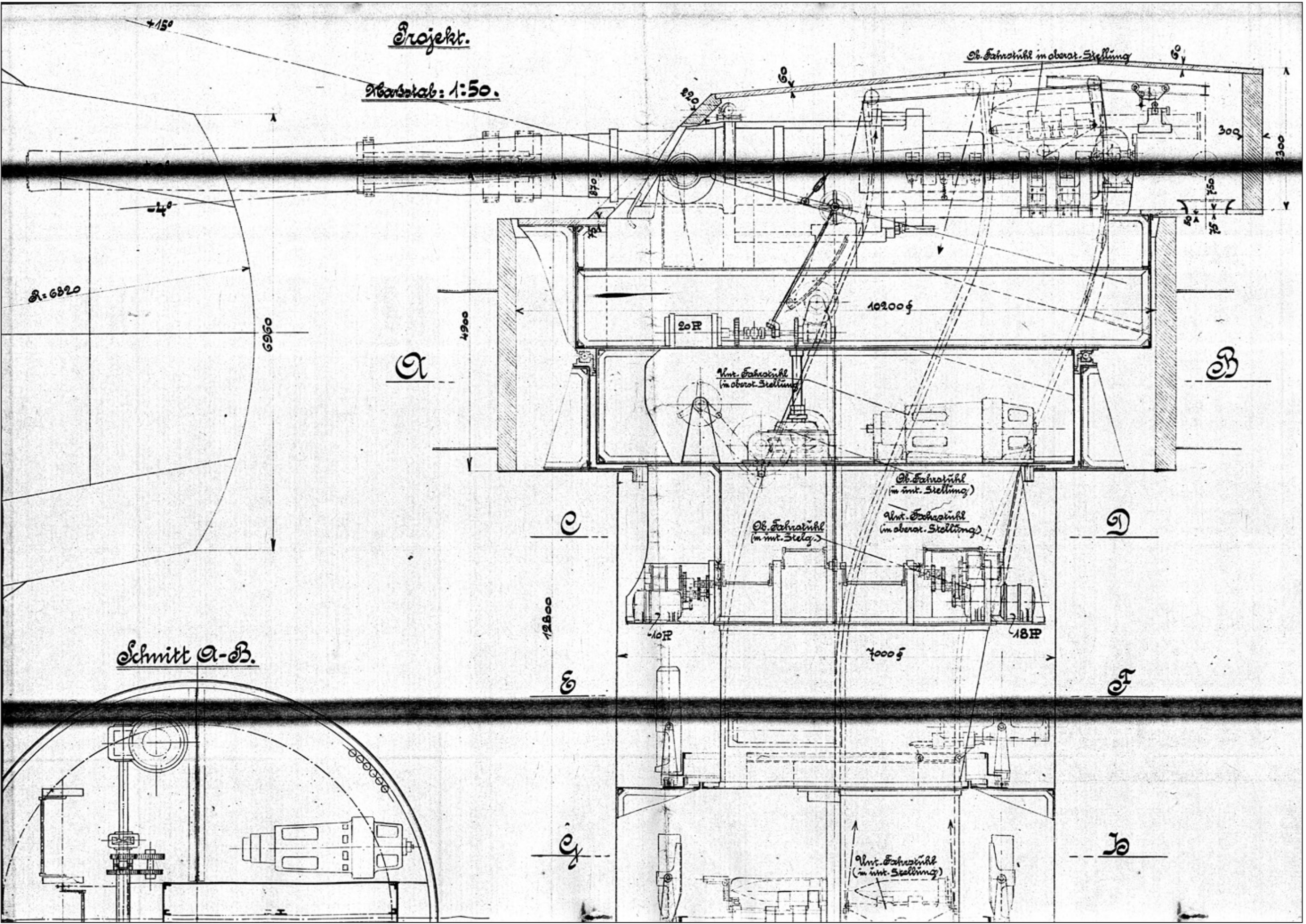
| Designation | Twin (2) and Triple (2) Mounts |
|---|---|
| Weight | Twin turrets (bow / stern): 603 / 599 tons (613 / 609 mt)
Triple turrets (bow / stern): 836 / 830 tons (849.2 / 843 mt) |
| Elevation | -4 / +15 degrees |
| Elevation Rate | 3 degrees per second |
| Train | Bow turrets: -140 / +140 degrees
Stern turrets: -135 / +135 degrees |
| Train Rate | 3 degrees per second |
| Gun recoil | 39.4 in (100 cm) |
| Loading Angle | probably +2 degrees |
The four turrets would have been all-electric operated, fed by 6×250 KW turbine-driven dynamos. On the evidence of few drawings and documents, it seems that the ammunition supply would have been similar to the contemporary German turrets.

"Az Osztrák-Magyar Monarchia Csatahajói: 1904-1914" [Battleships of the Austro-Hungarian Empire: 1904-1914] by Mihály Krámli - Link to complete book in pdf form.
---
Kriegsarchiv, Vienna: MS/PK I-4/12 ex 191
Archive of the Hungarian Museum of Science, Technology and Transport, Budapest: Mladiáta-collection
---
Original research by Mihály Krámli and Erwin F. Sieche
29 May 2004 - Benchmark
18 July 2010 - Updated with information supplied by Mihály Krámli
21 August 2010 - Added projectile pictures and information supplied by Mihály Krámli
07 April 2020 - Converted to HTML 5 format
17 July 2020 - Added mounting sketch and link to Mihály Krámli book
22 February 2024 - Added comment about the four completed guns